What Mobile County Residents Should Know About the Sheriff’s Civil Division
From evictions and pistol permits to custody pick-up orders and Sheriff's sales, the Mobile County Sheriff's Office Civil Division answers residents' most common questions about civil court enforcement.
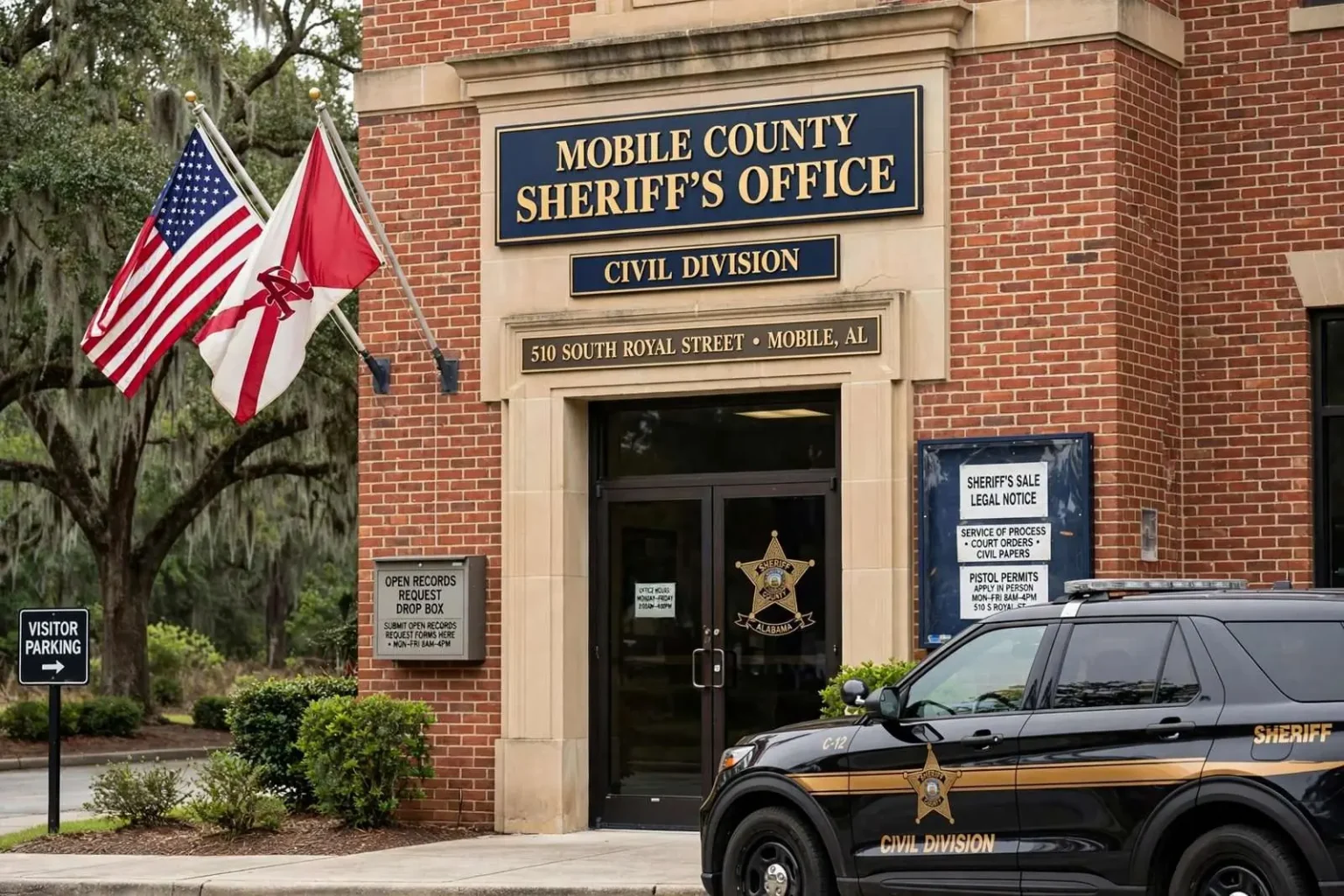
The Mobile County Sheriff’s Office Civil Division handles a wide range of court-ordered actions on behalf of Sheriff Paul Burch, from serving legal papers to carrying out evictions, custody pick-up orders and mental health pick-up orders. The division, which also oversees the office’s pistol permits function, fields frequent questions from residents navigating the civil court process, and the Sheriff’s Office has compiled guidance addressing many of the most common ones.
Serving Papers and Court Orders
Deputies assigned to the Civil Division work through a range of resources to track down individuals who need to be served with court papers. According to the office, the process moves fastest when a resident or their attorney can supply the court with a current, daytime address for the person being served. If deputies are unable to complete service after multiple attempts, the office recommends consulting an attorney about alternatives, including serving notice by publication in a local newspaper.
The Civil Division only serves papers connected to Alabama courts and certain state administrative agencies, such as the Alabama State Bar and the Alabama Department of Revenue — it does not serve out-of-state papers, with one exception carved out by federal law: protection-from-abuse orders issued in other states. Those orders can be forwarded for service by having a court clerk mail a certified copy to the Civil Division at the Mobile County Sheriff’s Office, P.O. Box 113, Mobile, AL 36601.
Evictions and “Set Outs”
Alabama law requires eviction cases to be filed in Mobile County District Court, and the Sheriff’s Office does not get involved until that process is complete and the court clerk has issued a writ of restitution. Only then can deputies carry out what the office calls a “set out.” Because the eviction process can be complicated, the office recommends landlords and tenants alike consult legal counsel; the Alabama State Bar’s lawyer referral service can be reached at 1-800-392-5660, and Legal Services Alabama offers free assistance to qualifying tenants at 251-433-6560.
Once a landlord has a writ from the district court, a deputy will contact them to schedule the set-out, though the appointment can be pushed back due to inclement weather. Landlords are responsible for arranging their own moving services, and the deputy’s role is to stand by and keep the peace during the move and, if necessary, remove people from the premises. The office advises landlords to bring enough manpower to move a tenant’s belongings quickly, which reduces the chance of confrontations, and to notify the deputy of any potential safety issues in advance. Deputies verify that the property address matches the one listed on the writ before beginning, and a typical writ requires that all items in the residence be moved to the curb, where a tenant generally has about 24 hours to remove them. The office also suggests landlords notify their city’s code inspector or environmental enforcement office ahead of a set-out — within the city of Mobile, deputies typically notify the city’s 311 service — as a way to help avoid tickets tied to items left at the curb. Some items, including firearms, medications and alcohol, cannot be placed curbside and may be temporarily confiscated by the deputy. Tenants facing eviction are encouraged to move out before the deputy arrives, allowing them to do so in a more organized, gradual manner over the course of a few days.
Custody Orders, Foreclosures and Vehicle Pickups
The office stresses that a divorce decree alone is not sufficient for deputies to remove a child from one parent and give custody to another — that requires a specific, current “pick up order” from a court, and residents typically need an attorney’s help to secure one.
Because Alabama is a “non-judicial” foreclosure state, foreclosures take place outside the court system, and the Sheriff’s Office becomes involved only when a circuit court issues an ejectment order after the foreclosure process is finished. Similarly, the Civil Division picks up vehicles only pursuant to a court order; owners looking to recover a vehicle can file something with the court, make arrangements with the plaintiff who had it picked up, or simply pay the full judgment amount to the Sheriff’s Office in cash, money order or certified check, which is then remitted to the plaintiff. Vehicles are held by outside storage companies during the judicial process, and storage costs accrue on a daily basis, payable by whoever ends up with the vehicle at the conclusion of the process.
Items picked up under a court order that carry a lien can complicate matters for lienholders, who the office says should consult an attorney about what can be filed in court to protect their interest, since the Sheriff’s Office cannot stop a sale to protect a lienholder without an order from the court.
Sheriff’s Sales and Records Requests
Sheriff’s sales are advertised in local newspapers as required by state law, with the same notices also posted online. All sales are cash-only and subject to any pre-existing liens, and the office cannot guarantee clear title to items sold at a court-ordered sale — a caveat that applies even when property sells for as little as $1, since only a court, not the Sheriff’s Office, has the authority to set aside a sale or establish reserve prices for civil auctions.
Residents seeking public records from the office can do so by completing the Mobile County Sheriff’s Office Open Records Act Request Form and following the instructions provided on it.
Pistol Permits
The pistol permits office operates as part of the Civil Division. Determining eligibility for a concealed carry permit requires an electronic background check, and common reasons for denial include felony convictions and domestic violence convictions of any type, even misdemeanor-level ones, because federal law bars individuals convicted of those offenses from possessing firearms. Alabama does not offer a statewide concealed carry permit, so residents who move to Mobile County from elsewhere in Alabama must apply for a new permit in person at the Sheriff’s Office’s main office, located at 510 South Royal Street in Mobile.
Why the Civil Division Matters for Residents
The Civil Division’s reach extends well beyond what most residents see in a typical interaction with law enforcement. The unit touches almost every kind of court-ordered enforcement that does not arise from a criminal arrest, including the eviction process that affects renters and landlords alike, the custody disputes that surface during family breakdowns, the foreclosure aftermath that draws on the Sheriff’s role after the lender has completed its non-judicial process, and the routine service of subpoenas and small-claims papers that keep civil litigation moving.
For Mobile County residents, knowing what the division will and will not do is half the battle. A deputy will not arrive to enforce a private agreement that has not been reduced to a court order, and the office explicitly notes that staff cannot offer legal advice or predict how a court will rule. Residents facing any of the situations described above are encouraged to consult an attorney, and the Alabama State Bar’s lawyer referral line and Legal Services Alabama are listed by the Sheriff’s Office as starting points for people who do not already have counsel.
The Civil Division also handles pistol permits, an area of routine interaction between the Sheriff’s Office and the public. Because Alabama does not have a statewide concealed carry permit, residents moving into Mobile County from another part of the state must apply locally, and the background check process run by the division can result in denials for felony or domestic violence convictions of any level. The office’s main office, at 510 South Royal Street in Mobile, is where applicants go in person to begin that process.
How the Civil Division Fits in the Sheriff’s Office
The Mobile County Sheriff’s Office is one of the larger law enforcement agencies in the region. Sheriff Paul Burch oversees the agency and its multiple divisions, including uniformed patrol, criminal investigations, the jail, and the Civil Division. Unlike patrol deputies who respond to 911 calls, Civil Division deputies spend most of their time on court-ordered paperwork, scheduled appointments and paperwork-driven enforcement actions, which is why the office encourages residents to supply daytime addresses and contact information up front to avoid wasted trips.
The Civil Division also serves as a point of contact between the Sheriff’s Office and the Mobile County court system, which includes the Mobile County Circuit Court, District Court and Probate Court. Each of those courts issues the orders the division enforces, and a working knowledge of how those courts handle evictions, custody disputes and foreclosure ejectments helps deputies move cases forward efficiently.
Residents with questions about a pending matter can reach the Civil Division through the Sheriff’s Office’s main switchboard or by writing to P.O. Box 113, Mobile, AL 36601, which the office lists as its mailing address for service of out-of-state protection-from-abuse orders. The office has emphasized that deputies cannot give legal advice, but staff can usually explain the procedural status of a particular case and identify what documentation is still needed.