
White House Backs Push to Return Amtrak Service to the Gulf Coast
The Biden administration formally supports restoring Amtrak passenger rail from Mobile to New Orleans, halted since Hurricane Katrina.
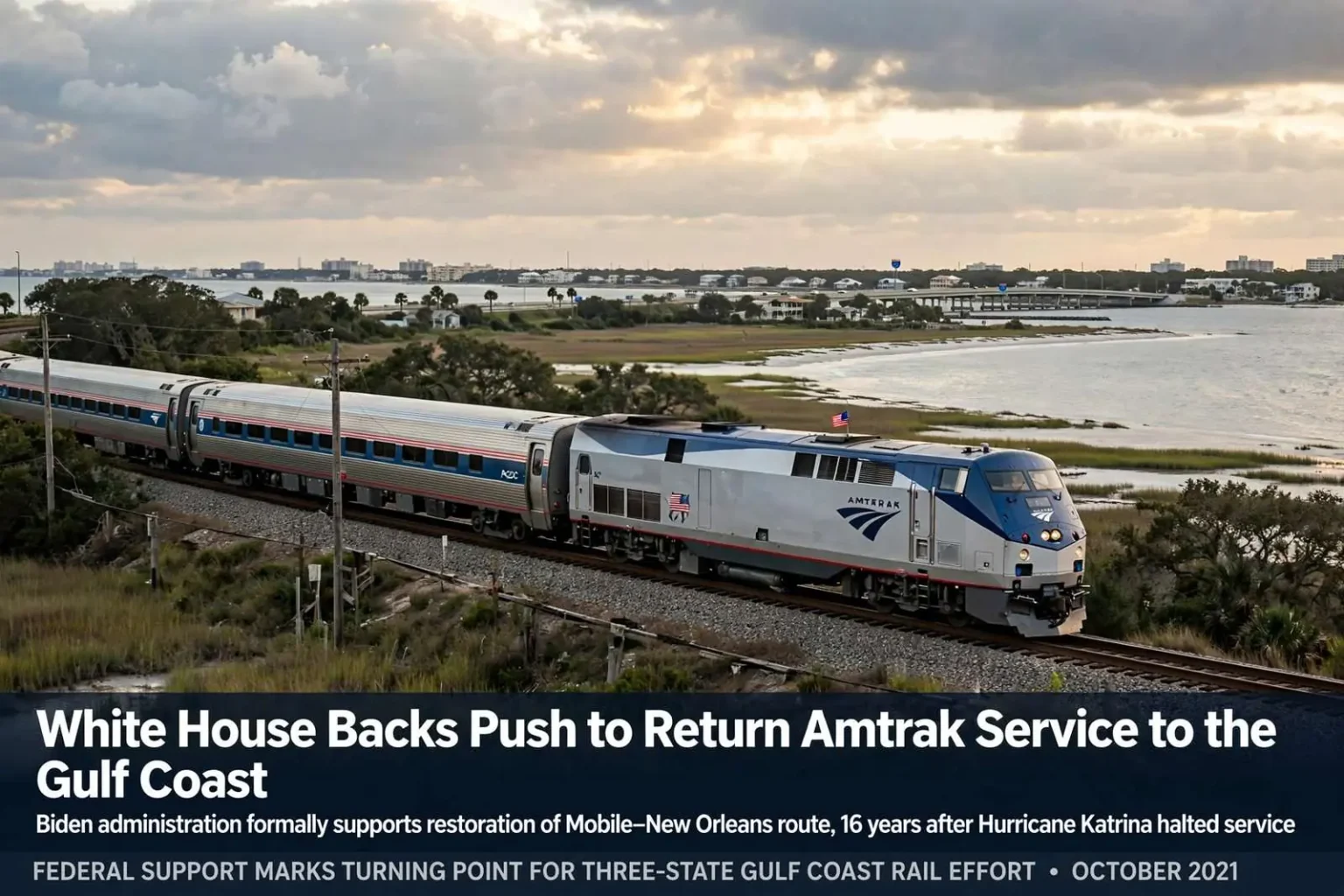
The Biden administration is formally backing efforts to bring passenger rail back to the Gulf Coast, throwing federal weight behind a long-running campaign to restore Amtrak service between Mobile and New Orleans. The U.S. Department of Transportation filed a letter of support for the restoration effort, an endorsement that advocates describe as the most significant sign of federal interest since the service was lost sixteen years ago.
The proposed route would run twice daily between Mobile and New Orleans, with four stops in Mississippi coastal cities, reestablishing a connection that existed for generations before Hurricane Katrina devastated the line in 2005. The storm destroyed track, bridges, and stations along the coastal corridor, and Amtrak’s Sunset Limited — the long-distance train that linked the Gulf Coast to the rest of the national network — was never restored east of New Orleans. Ever since, a coalition of local officials, planning bodies, and passenger rail advocates has pressed to bring trains back to a region that has grown substantially in the intervening years.
The route would trace the same coastal corridor that made rail travel a defining feature of Gulf Coast life for more than a century, passing through the heart of Mississippi’s beach communities before crossing into Alabama and terminating in downtown Mobile. For residents of the coastal counties, the return of service would restore a travel option that has been missing since 2005 — one that bypasses the I-10 congestion that has come to dominate travel between the coast’s cities.
Federal support as a turning point
In its letter, the administration argued that expanding intercity passenger rail “plays an essential role in meeting the most important objectives of our transportation system,” citing goals that include fighting climate change, ensuring equitable mobility and driving economic growth. The language put the restoration effort squarely within the administration’s broader transportation priorities, aligning the Gulf Coast project with a national agenda that has emphasized investment in rail as both a climate measure and an economic development tool.
For advocates, the letter mattered for reasons beyond its language. Passenger rail projects compete for federal attention and funding against highways, transit, and aviation projects across the country, and a formal statement of support from the department that oversees those decisions signals to freight railroads, state agencies, and local partners that the effort has backing at the highest level. In restoration campaigns that often stall in negotiation, that kind of visible endorsement can determine whether momentum builds or dissipates.
Knox Ross, secretary-treasurer of the Southern Rail Commission, called the move a step in the right direction. “This opens it up to the whole Gulf South and we think it’s a real opportunity,” Ross said, noting the economic development potential for every coastal city — from hosting train crews to drawing visitors as the region emerged from the pandemic.
The Southern Rail Commission, a federally supported interstate compact whose members represent Louisiana, Mississippi, and Alabama, has been the institutional backbone of the restoration campaign since its earliest days. The commission’s mandate is to promote and improve passenger rail service across the Gulf South, and it has shepherded the Mobile-to-New Orleans proposal through feasibility studies, service development plans, and negotiations with the freight railroads whose tracks any new Amtrak service would use.
Ross’s remarks captured the argument that has carried the proposal this far: that passenger rail is not merely a transportation convenience but a regional economic asset. Cities along a passenger line gain stops that bring visitors to their downtowns, and communities that host crew bases and maintenance activity gain jobs that do not depend on the next tourist season. For coastal cities still working to diversify their economies, those are steady, recurring benefits that accumulate year after year a train operates.
Preparation work already underway
Preparation work was already underway, including bringing stations into compliance with accessibility requirements and training crews. Restoring passenger service involves far more than running trains on existing track: stations along the route need upgrades to meet the Americans with Disabilities Act, from accessible platforms and pathways to signage and restrooms, and operational agreements with the host freight railroad must address everything from dispatching priorities to liability coverage before the first passenger car rolls.
Crew training is another piece of the puzzle that begins long before service launches. Conductors, engineers, and onboard service staff must be qualified on the route, and Amtrak works with host railroads to establish the operating procedures that govern new service over freight lines. The early attention to those details signaled that organizers were treating the restoration as an operational plan rather than an aspiration, an approach that has historically distinguished rail projects that launch from those that remain on paper.
Organizers were targeting a first trip in January 2022, and support from the White House made that timeline appear more attainable. The proposed launch date gave the project a concrete milestone after years in which the restoration effort advanced through studies and agreements without a firm date attached. Advocates framed the federal letter as the ingredient that could keep the target within reach by accelerating the remaining negotiations with the freight railroad and the funding commitments needed to stand up the service.
The push for restoration has drawn support from officials across state lines because the corridor’s benefits would not stop at any state line. Louisiana, Mississippi, and Alabama all sit along the proposed route, and each would gain stations, connections, and economic activity. That three-state interest is embodied in the Southern Rail Commission itself, which was created by Congress precisely to coordinate passenger rail planning across the Gulf South’s state boundaries — a structure that has kept the Mobile-to-New Orleans proposal alive through changes in governors, legislatures, and administrations in all three states.
For Mobile, the restoration would return the city to the national passenger rail map. Mobile was the eastern terminus of the Sunset Limited before Katrina, and its downtown station — a landmark of the city’s railroad heritage — has stood without regular passenger service ever since. City leaders have promoted the restoration as a complement to the city’s growing tourism and convention business, offering visitors a car-free way to reach Mobile from New Orleans and points west, and giving Mobilians a new option for reaching the casinos, beaches, and attractions of the Mississippi coast.
Restore service advocates have also pointed to the region’s vulnerability to hurricanes as a reason the connection matters. When storms close the I-10 corridor or force evacuations along the coast, transportation options are scarce, and rail provides an additional artery for moving people in and out of the region before and after major storms. The same storm that severed the line in 2005 demonstrated how much the region depends on a handful of north-south and east-west corridors — and how valuable an alternative can be when those arteries are strained.
The logistics of the proposed service reflect its regional character. Twice-daily round trips would make the train usable for both same-day business travel between Mobile and New Orleans and longer trips connecting to Amtrak’s national network at the New Orleans end, where travelers can connect to trains serving Chicago, the Carolinas, and New York. Four intermediate stops in the Mississippi coastal cities would put the service within reach of the population centers of Mississippi’s Gulf Coast, turning the train into true regional transit rather than an end-to-end shuttle.
What happens next depends on the remaining pieces falling into place: a final agreement with the host freight railroad, identification of operating support, and completion of the station and infrastructure work already in progress. The federal letter of support does not by itself guarantee any of those steps, but it changes the tone of the conversation — and for the advocates who have worked since 2005 to restore Gulf Coast passenger rail, it marks the clearest sign yet that the effort to bring trains back to Mobile is being taken seriously at the national level where the final decisions are made.
The journey from Katrina’s devastation to this point has been long and often discouraging for the proposal’s supporters. In the years immediately after the storm, repairs focused on restoring freight traffic, and passenger service was left off the list. Feasibility studies commissioned in the years since have repeatedly concluded that the corridor could support new intercity service, but translating those findings into an operating agreement required patient negotiation over access, scheduling, and costs with the railroad that owns the track. Each step — a service development plan here, an interagency agreement there — moved the proposal forward incrementally, and the Biden administration’s endorsement is the latest and most visible of those incremental wins. For the communities along the route, the hope now is that the remaining steps follow the same pattern and that the first train in nearly two decades is, at last, within sight.


