Crowds Turn Out as Whole Foods Celebrates Grand Opening on Airport Boulevard in Mobile
Hundreds lined up for the grand opening of Mobile's new Whole Foods on Airport Boulevard, with Mayor Sandy Stimpson calling it a sign of the city's growth.
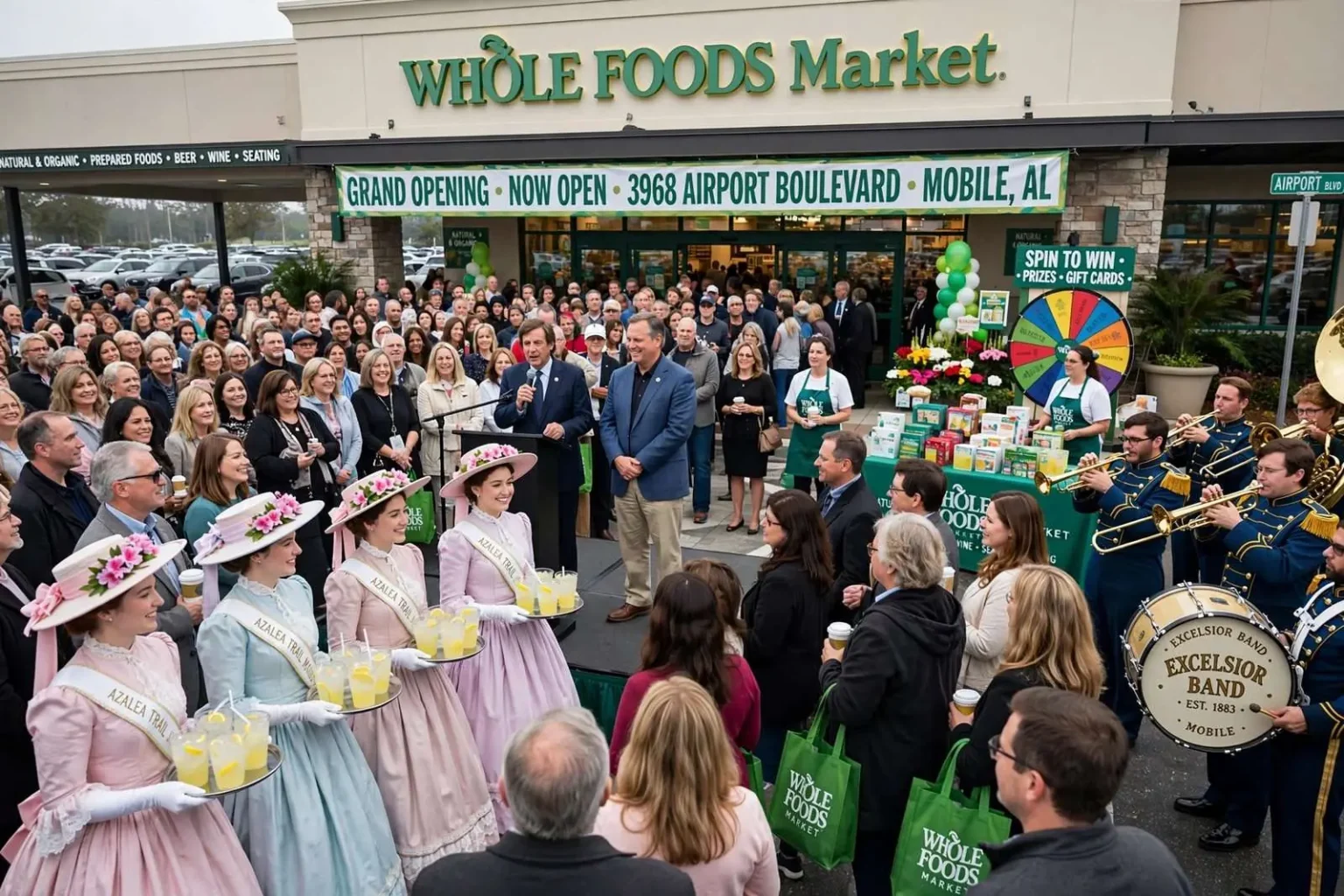
Hundreds of shoppers lined up early on a crisp Tuesday morning to celebrate the grand opening of Mobile’s new Whole Foods Market on Airport Boulevard, marking only the second location of the upscale grocery chain in Alabama. The turnout turned a store opening into a civic event, with crowds stretching toward the doors an hour before they opened and the parking lot filling as early as dawn.
Crowds began gathering well before the doors opened at 9 a.m., with festivities kicking off around 8 a.m. featuring the Azalea Trail Maids and the Excelsior Band. The pairing was deliberately local: the Azalea Trail Maids, the city’s antebellum-dressed goodwill ambassadors in their pastel gowns, and the Excelsior Band, a Mobile brass institution dating back to the 19th century, signaled that the city considered the arrival worth celebrating in its own idiom.
Store representatives, Mobile Mayor Sandy Stimpson and City Councilman John Williams were also on hand for the celebration, joining a crowd that mixed serious grocery shoppers with the merely curious. While they waited, patrons were treated to fresh lemonade and had the chance to spin a prize wheel for gift cards and other items from the store. The festive atmosphere drew enthusiastic reactions from those in line, with several describing genuine excitement over the store’s arrival in Mobile.
“We are on the move”
Mayor Stimpson addressed the crowd, framing the store’s opening as a milestone for the city’s economic momentum. “It changes the perception of Mobile,” Stimpson told the crowd. “We have a Whole Foods; we are no longer the city of perpetual potential, we are on the move.” The remarks captured what many civic leaders have long argued: that which retailers choose to locate in a city is read by other retailers, by relocating families and by employers as a signal about the market itself.
The new store brought about 100 jobs to the Mobile area, according to company representatives. Grocery jobs range from stocking and cashier positions to butchers, bakers and prepared-foods staff, and the chain’s presence adds a new set of retail employers to the Airport Boulevard corridor. For a stretch of road that has seen decades of commercial change, the store represents one of the more significant retail additions in recent years.
What the store carries — and doesn’t
Known nationally for its focus on natural and organic products, the Airport Boulevard location does not carry items with artificial sweeteners, artificial coloring or high fructose corn syrup, and its meat department is free of antibiotics. The chain also touts a company-wide policy against animal testing on its products. Those standards are the brand’s foundation, and shoppers who have visited Whole Foods stores elsewhere will find the same sourcing philosophy applied to the Mobile shelves — with regional and local products worked in where possible.
Beyond groceries, the new location includes several prepared food and beverage stations, including a beer selection, along with a seating area for customers to eat on-site. The arrangement gives the store a gathering-spot feel in addition to its grocery function — part market, part cafe — and reflects the industry-wide shift toward ready-to-eat meals that has reshaped grocery chains over the past decade.
The Whole Foods location at 3968 Airport Boulevard is open daily from 8 a.m. to 10 p.m., giving Mobile shoppers regular access to a chain that until now required a drive to the Birmingham area. The store’s hours extend an hour earlier than most competitors in the corridor, a nod to the early-morning traffic that already moves along Airport Boulevard on its way into downtown.
Why Airport Boulevard
Airport Boulevard has long been one of Mobile’s primary east-west commercial spines, running from the older neighborhoods near the city center out through the growing western suburbs. The corridor already hosts a dense mix of national retailers, restaurants and medical offices, making it the logical address for a chain that draws shoppers from across the metro area. The store’s position puts it within a short drive of both established midtown neighborhoods and the fast-growing western reaches of the city.
Retail analysts have long noted that organic and natural foods grocers select markets carefully, looking for the combination of income levels, education and demonstrated demand for higher-priced specialty products. Mobile’s selection as only the second Alabama location — following the chain’s entry in the Birmingham area — suggests the company saw a market ready to support the format. For civic boosters, that analysis matters as much as the store itself: a national retailer’s market research concluding that Mobile can sustain an upscale grocer is a data point other companies will read.
A boost for the city’s image campaign
The opening dovetails with the city’s broader efforts to market itself as a growing, modern Gulf Coast city — a campaign that has emphasized downtown revitalization, recruitment of aerospace and manufacturing employers, and amenities that make the city attractive to young professionals. Grocery retail may seem a small part of that picture, but quality-of-life amenities are consistently cited by relocating companies and their employees, and a Whole Foods is among the most recognizable brand signals in the category.
Councilman John Williams’ presence at the opening underscored the district-level significance. Retail developments of this scale affect property values, sales tax collections and the commercial momentum of surrounding blocks, and city officials have courted such tenants as actively as they court manufacturers. Sales taxes from a high-volume grocery store flow into the city’s general fund, adding revenue that supports the services residents demand.
What shoppers can expect
For shoppers, the store’s arrival ends the routine of driving to Birmingham for the chain’s selections, and introduces a competitor that will push the local grocery market on freshness, prepared foods and product sourcing. Shoppers in line on opening day described everything from specific products they had missed to the simple pleasure of having the option nearby. The store’s prepared-food stations and beer selection position it to compete for the lunch and dinner crowd, not just the weekly grocery run.
The grand opening crowd — hundreds deep, entertained by the Excelsior Band, served lemonade by the Azalea Trail Maids and addressed by the mayor — made clear that Mobile had been waiting for the store. Whether the enthusiasm holds through the following months will be answered by the weekly shopping patterns of a city that now, as Stimpson put it, has a Whole Foods and is on the move.
The grocery wars along the corridor
The new store enters a Mobile grocery market already served by established chains, and its arrival will test where shoppers — particularly those in midtown and west Mobile — spend their specialty-food dollars. Organic and natural products have moved steadily from niche to mainstream over the past decade, with conventional supermarkets expanding their own organic sections in response. A dedicated natural-foods grocer raises the bar on that competition, stocking items that smaller sections cannot justify and employing trained specialists in departments like meat, cheese and prepared foods.
Local producers also stand to benefit. Chains of this type typically seek out regional suppliers — Gulf seafood vendors, Alabama farms, local bakers — to anchor their local-market identity, and a store of this size can become a steady wholesale customer for small producers who have struggled to get shelf space. Company representatives said the Mobile store would follow the chain’s practice of incorporating local items where they meet its standards.
Jobs and the local economy
The roughly 100 jobs the store brings are a modest but real addition to the city’s retail employment base. Grocery positions offer a mix of part-time and full-time work with structured advancement, and specialty departments — butchery, baking, prepared foods — call for skills that command better wages than standard retail. Store representatives said hiring drew from across the Mobile area, with training conducted ahead of the opening to bring new staff up to the chain’s service standards.
There are secondary effects as well. A high-traffic anchor store lifts visits to neighboring businesses in the same development, generates steady daily traffic along its section of Airport Boulevard, and contributes sales tax revenue that stays in the city. Retail developments succeed or fail on these daily rhythms rather than grand openings, which is why city officials watch the months after a launch as closely as the opening week.
A long-awaited arrival
The path to the opening stretched across years of market speculation, site selection and construction, and the payoff was visible in the crowd on opening morning. Mobile has watched other Southeastern cities add the chain while remaining on the expansion list itself, and civic leaders made no secret of wanting the store as part of the city’s retail portfolio.
The Tuesday morning celebration — brass band, lemonade, prize wheel and all — was the public’s first chance to walk the aisles, sample the prepared foods and see whether the store lived up to the wait. By the numbers that matter to the city, it already had: hundreds of shoppers through the doors in the first hours, 100 jobs added to the local economy, and a national brand planted on one of Mobile’s most important commercial corridors. The mayor’s line about no longer being the city of perpetual potential was aimed at exactly that audience — the residents who had waited, and the retailers deciding whether Mobile’s momentum is real.