Why Mobile County Needs a Real Stormwater Plan Before the Next Big Storm
As Mobile and Baldwin counties keep growing, observers say Mobile County still lacks a real stormwater plan to control runoff and protect the bay.
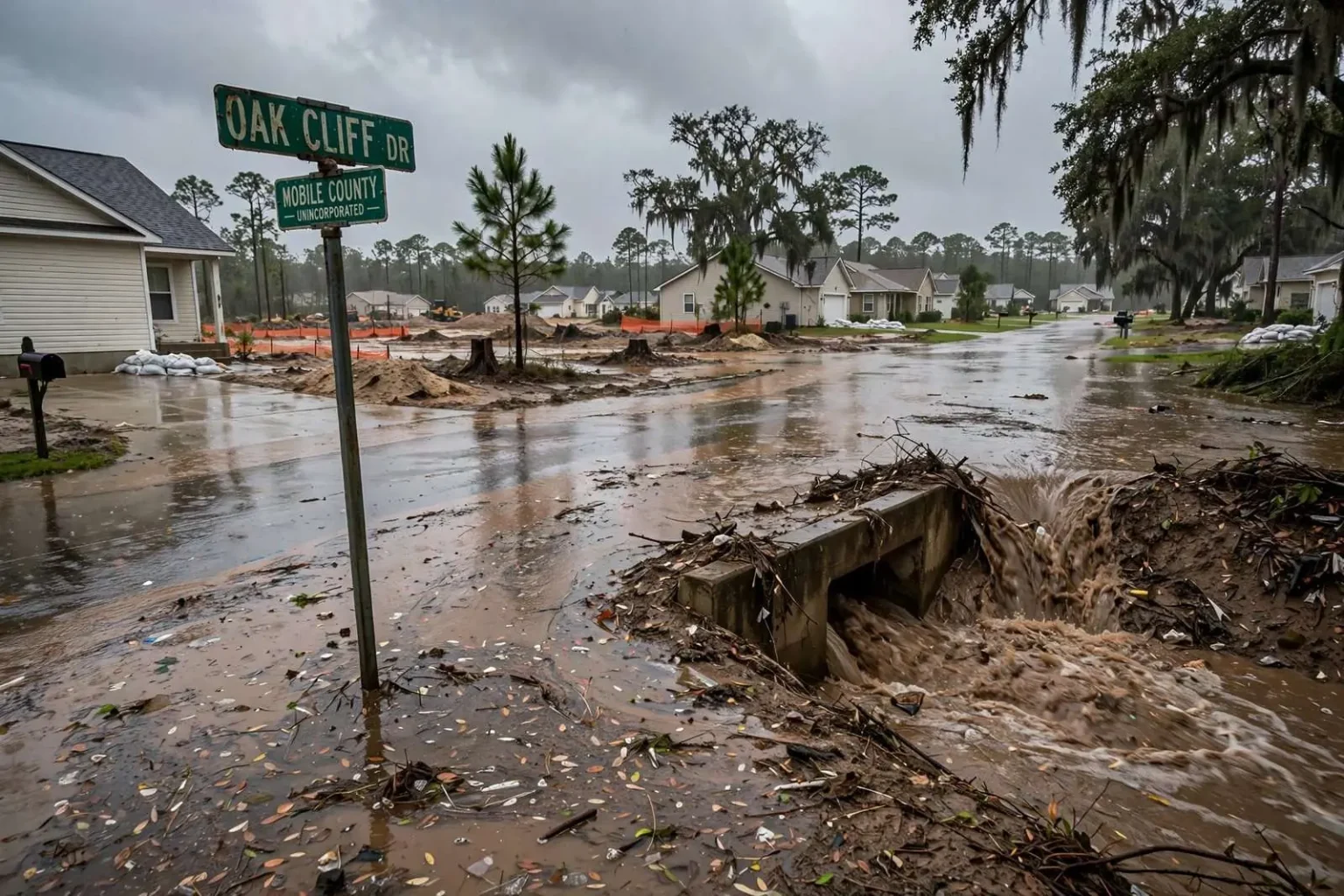
As rain rolls off rooftops, parking lots and newly cleared subdivisions across the Gulf Coast, a growing number of residents and observers are asking a pointed question: why does Mobile County still lack a comprehensive stormwater management plan, when neighboring Baldwin County has already moved further down that road?
The question surfaces after nearly every major rain event, when streets that should drain instead flood, when creeks run the color of chocolate milk, and when homeowners discover that the drainage ditch behind their subdivision was sized for the forest that stood there a decade ago.
Where the Water Goes
Stormwater management is not a glamorous topic, but it shapes daily life in coastal Alabama more than most infrastructure issues. Every time a hard rain falls, water that once soaked into forests, farmland and wetlands now runs off pavement, rooftops and compacted lawns, picking up sediment, fertilizer, oil and debris along the way. Without adequate planning, that runoff overwhelms ditches and culverts, contributes to localized flooding, and eventually carries pollutants into creeks, rivers and ultimately Mobile Bay.
The arithmetic is unforgiving. A forested acre can absorb most of a moderate rain; the same acre covered by a parking lot sheds nearly all of it, and faster. Multiply that conversion across a county adding subdivisions, retail pads and warehouses, and the drainage that worked for yesterday’s landscape finds itself sized for a landscape that no longer exists.
Coastal Alabama’s geography compounds the problem. The region’s flat terrain, high water table, sandy soils and heavy annual rainfall — measured in feet, not inches — mean there is little natural margin for error. Water that cannot soak in must be carried somewhere, and that somewhere is usually a neighbor’s property downstream.
Baldwin’s Head Start — and Its Limits
Baldwin County has generally been viewed as further along in addressing these issues than Mobile County, having taken steps toward a more structured approach to managing runoff as its population and development have surged. But critics note that Baldwin County’s own rapid, in some cases loosely restrained, pace of residential and commercial development undercuts a lot of that progress. Adding rooftops and parking lots faster than drainage infrastructure can keep pace creates the very problems a stormwater plan is supposed to solve.
Baldwin’s experience is instructive in both directions. It shows that a county government can organize around stormwater — mapping drainage, setting standards, coordinating with municipalities — and it shows how quickly unmanaged growth can outrun the safeguards. The county’s population boom along the Highway 181 and Foley corridors turned farmland into rooftops at a rate that drainage design rarely anticipated.
One frequently cited example of the tension between development and environmental stewardship is the Bass Pro Shops location in the region. The irony is not lost on local observers: an outdoor recreation retailer that markets itself around fishing, boating and enjoying clean waterways sits on a large paved footprint that itself contributes to the runoff problem. Critics argue that if a business built around the outdoors and healthy waterways can’t be paired with runoff controls, it raises questions about how seriously that balance is being struck elsewhere in the county.
What the Bay Has to Lose
The stakes go beyond a few flooded parking lots after a summer thunderstorm. Mobile Bay is one of the region’s defining natural and economic assets, supporting fishing, tourism and a broader coastal ecosystem. Untreated runoff carrying sediment and pollutants degrades water quality in the bay and its tributaries over time, a slow-moving problem that is far easier to prevent than to reverse.
The bay’s economy is quietly enormous. Commercial and recreational fishing, oyster harvesting, boating, and the tourism that follows all depend on water quality that most residents take for granted. Sediment plumes after a storm do not just look bad; they smother oyster reefs, cloud seagrass and carry the nitrogen and phosphorus that feed the algal blooms that choke coastal waters in summer.
Because the damage accumulates gradually, it rarely generates the urgency that a bridge collapse or a burst water main commands. A creek that grows slightly murkier each year does not make the evening news. By the time the effects are undeniable — closed harvest areas, fish kills, beaches posted after rain — the fixes are exponentially more expensive than the prevention would have been.
What a Real Plan Looks Like
Advocates for a more serious stormwater strategy in Mobile County argue that the fix does not have to be dramatic or immediate. It starts with adopting clear standards for new development, requiring detention and retention measures that slow runoff before it reaches waterways, and coordinating with municipalities and Baldwin County on regional approaches to a problem that does not respect county lines. Rainwater that falls in one jurisdiction often ends up flowing into another before it reaches the bay.
The tools are well established. Detention ponds hold a storm’s first flush and release it slowly. Retention basins let water soak into the ground where it falls. Swales, permeable pavement, buffer strips along creeks and preserved wetlands all do the same work at different scales. None is exotic; the question is whether they are required, inspected and maintained.
Coordination is the harder half. Mobile County is a patchwork of the county commission and a dozen municipalities, and a drainage ditch that begins in an unincorporated subdivision may cross two city limits before it reaches a river. A plan that governs only part of a watershed governs almost nothing, which is why advocates keep returning to the word “comprehensive.”
For now, the call to action is straightforward: Mobile County officials should take a hard look at what a real stormwater management plan would require, rather than continuing to treat it as an afterthought. Whether that plan comes together this year or takes longer to develop, residents along the Gulf Coast are likely to keep feeling the effects of runoff every time the skies open up.
And the skies will open up. On the Gulf Coast, the only certainty in the stormwater debate is the rain — the question is whether the region’s governments will plan for it or keep paying for it after the fact.
Homeowners experience the failure of stormwater planning in ways that never appear in a drainage manual. It is the flooded yard after every hard rain, the crawlspace that never quite dries, the street that turns into a shallow river because a culvert under the road was installed decades ago for a neighborhood half this size. It is also the erosion that eats away a backyard as a creek, fed by a subdivision’s worth of new runoff, cuts a wider channel than it carried twenty years ago.
Flooding, in turn, feeds back into the economy in ways officials rarely tabulate. Homes that flood repeatedly lose value and become harder to insure. Businesses along flooded corridors lose inventory and customers. Road departments spend storm after storm clearing ditches and replacing culverts that better upstream planning would have spared — money that comes from the same budgets that might otherwise fund the planning itself.
The environmental ledger is subtler but no smaller. The creeks and rivers that drain Mobile County — from Mobile Bay’s western tributaries to the Delta rivers that feed it from the north — are the nursery grounds for much of what makes the bay productive. The Delta itself, one of the largest intact wetland systems on the Gulf Coast, depends on clean, slow-moving freshwater from the very watersheds that development is hardening. Sediment and nutrients that wash off a parking lot in west Mobile do not stop at the county line; they finish their journey in the same waters that the region’s seafood industry depends on.
That is why advocates frame a stormwater plan as economic policy rather than environmental luxury. The bay and the Delta generate their value because they are healthy; the region’s beaches and waterways draw the visitors who fill its restaurants and hotels; and the quality of life that keeps attracting new residents to coastal Alabama rests, in no small part, on water that looks like water rather than mud.
A comprehensive plan, supporters acknowledge, would cost money to write and more to enforce. But they point out that the county is already paying for stormwater — in repair crews, in flood claims, in lost water quality — simply without the coordination that would make the spending count. Planning, on their account, is not a new expense. It is the difference between paying once and paying forever.
There is also a fairness argument that residents downstream have begun to make more forcefully. Development decisions are made parcel by parcel, approved one subdivision at a time, and the cumulative effect lands on whoever lives lowest in the watershed. A property owner who never consented to the upstream growth still inherits its runoff, its erosion and its flooding. A comprehensive plan is, among other things, the county’s way of accounting for the neighbors downstream before the water arrives at their door.