Wilmer Woman’s Missing Emotional Support Dog Kobe Found Safe
Savannah Halcomb's emotional support dog Kobe went missing in Wilmer, Alabama, and was found after a viewer responded to her public plea.
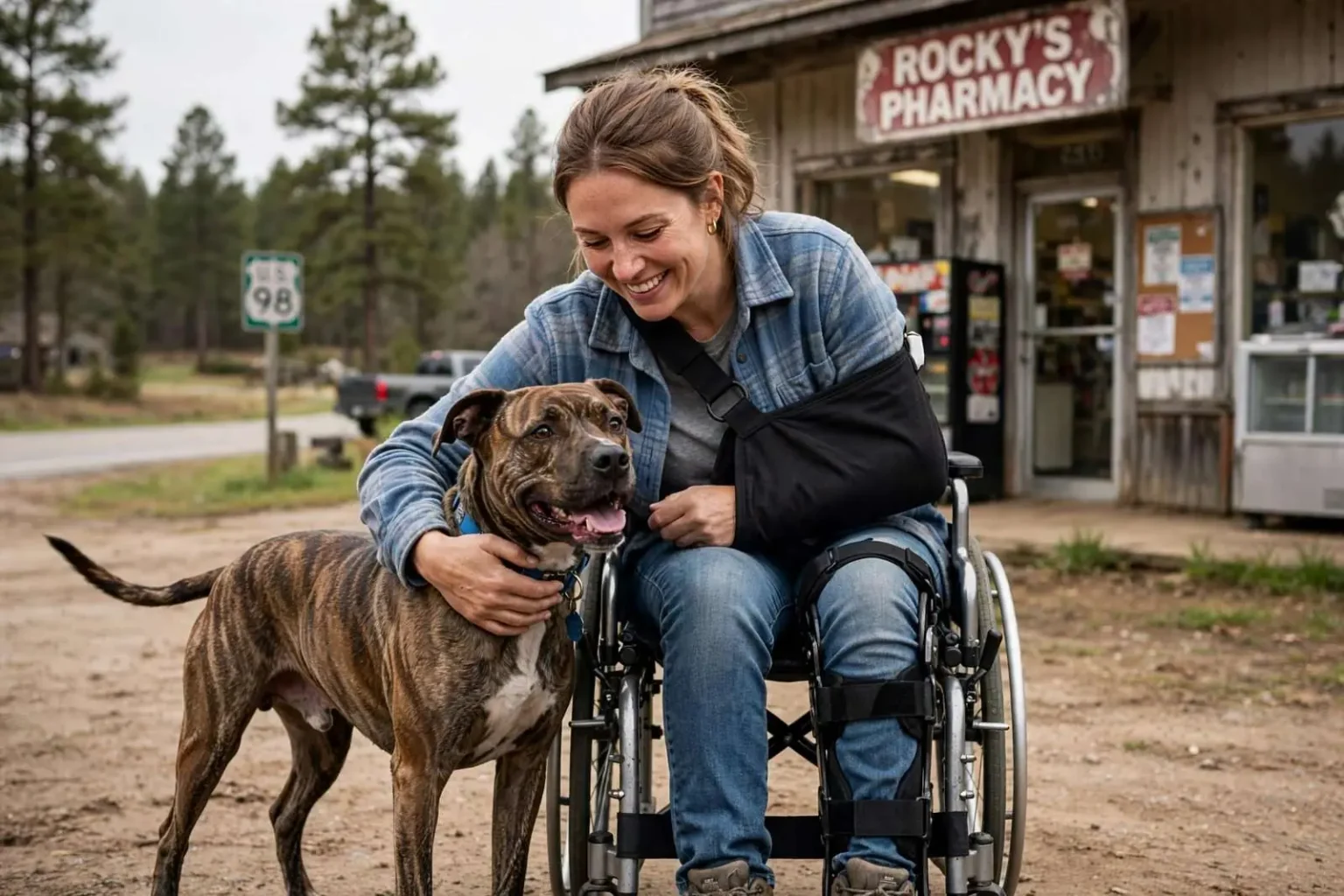
A Wilmer woman’s desperate search for her missing emotional support dog ended in relief after a viewer came forward with the animal’s whereabouts. The search for Kobe, a brindle pit bull mix who serves as Savannah Halcomb’s constant companion and helper, had reached the public through local news coverage — and it was that coverage, and the audience it reached, that brought him home.
Halcomb had asked the public to watch for her dog, Kobe, after the pit bull mix jumped the fence at her home in the Wilmer community behind Rocky’s Pharmacy. The landmark matters in a rural community like Wilmer, where directions run by familiar businesses rather than street names, and the pharmacy on U.S. 98 anchors the crossroads that most of the community navigates by. A dog on the loose in that area faces busy highway traffic on one side and miles of rural property on the other — the kind of terrain where a missing pet can stay missing.
Kobe, who has brindle coloring, is a constant companion to Halcomb, whose legs are weak and whose left arm does not work. He opens doors for her and stays with her around the clock, helping keep her safe as she is mostly homebound. That description, which Halcomb shared during the search, is what distinguished Kobe from an ordinary lost dog: he is not simply a pet but a working presence in her daily life, performing small physical tasks her body cannot and providing the constant companionship that an emotional support animal provides by definition.
A community response
After the story aired on Tuesday evening, a viewer reached out. That person was connected with Halcomb, who then updated her Facebook post to share the good news: Kobe was found. The turnaround — a Tuesday evening broadcast, a viewer’s call, a reunion — shows how quickly a missing animal case can resolve when the right person sees the right description at the right time.
The mechanism of the reunion was almost old-fashioned: someone recognized the dog from a television description and picked up the phone. But it ran on the modern layer that missing-pet searches now depend on — the Facebook post Halcomb had been updating, the community sharing that spread the story, and the local news coverage that put Kobe’s face and story in front of an audience far beyond Halcomb’s own circle of friends.
Halcomb thanked everyone who shared the story to help bring him home. The thanks were aimed at the chain of strangers who amplified her search without being asked — the neighbors who shared the post, the viewers who kept an eye out, and the person whose call ended the search. In missing pet cases, that amplification is often the deciding factor: the distance a shared post travels is frequently the distance between a search that stalls and one that ends.
Emotional support animals and their people
For a homebound person with limited mobility, a dog like Kobe occupies a role that goes well beyond companionship. The tasks he performs — opening doors, staying close, alerting his owner to what is happening around a home she cannot easily leave — are the practical functions that make independent living possible. When a dog like that goes missing, the loss is measured not just in heartbreak but in the sudden difficulty of every small physical task the animal had been performing.
That is what made the search so urgent from Halcomb’s side. A person who is mostly homebound cannot mount a door-to-door search across rural Wilmer; her search had to run through the community — the post, the shares, the news story, the viewers. Kobe’s ability to open doors, meanwhile, cut both ways in the search: it meant he could potentially get into outbuildings or homes on his own, and it meant he might turn up anywhere a nosy, capable dog could reach.
The fence-jumping itself is a reminder of how quickly a rural dog situation can develop. A dog left unattended in a fenced yard for even a short time can clear or slip a fence in minutes, and in a community like Wilmer — spread out, heavily wooded, and bounded by a highway — a loose dog’s radius grows fast. Owners who lose a dog in that setting face a search area measured in square miles within hours, which is why the public appeal Halcomb issued was the right move as soon as the fence was cleared.
The reunion also reflects what local news coverage does in small communities that no statewide outlet can. A dog missing behind Rocky’s Pharmacy means nothing to most of the Gulf Coast, but to viewers in Wilmer and the surrounding communities, the landmark and the name land instantly. Local coverage of missing pets, like local coverage of everything else, works because the audience is exactly the population that can actually help — the people who drive the roads where the dog might be.
Anyone who spots a lost or stray animal in the area is encouraged to contact local animal control or post to community pages so owners and pets can be reunited quickly. That guidance runs in both directions: owners should post immediately, with photos and landmarks, and people who spot a wandering dog should report it rather than assume someone else already has. The combination of those two habits — prompt posting, prompt reporting — is what resolved Kobe’s case in a matter of hours.
For rural Mobile County, where animal control coverage is spread thin across wide territory, community pages often move faster than any official channel. A post about a spotted dog can reach the owner within minutes, while a formal report to an agency may take a day to route. The best outcome, as Kobe’s case showed, comes when both happen at once: the official channel logged, and the community network activated.
Kobe’s homecoming closed out the search the way owners always hope one will — with a phone call, a reunion, and a Facebook post flipped from desperate to grateful. For Halcomb, it restored the companion who opens her doors and watches over her home; for the community that shared and called and looked, it was a small piece of good news that cost nothing and mattered a great deal.
Lost-dog searches in rural communities follow patterns worth knowing, and Kobe’s case checked every box that works. The owner posted immediately with the details that matter — the dog’s name, coloring, breed mix, the location behind a recognizable landmark, and the specific role the dog plays at home. Local news picked up the story, which multiplied the audience. And the owner kept updating the Facebook post, so that people following along saw the resolution as soon as it came. Each step widened the net, and the net caught.
The emotional support role Kobe plays also carries a legal and practical dimension worth understanding. Emotional support animals are not the same as service animals under federal law, but for a person whose disability limits mobility, a dog trained or accustomed to helping with small tasks can be essential to daily living. What an ESA provides formally is therapeutic companionship; what a dog like Kobe provides in practice is far more physical — the door-opening, the constant presence, the safety of never being alone in a rural home. For homebound owners, losing the dog is closer to losing a piece of their independence than most people realize.
Wilmer’s geography worked against the search in the hours Kobe was loose. The community stretches along U.S. 98 toward the Mississippi line, with homes on multi-acre lots connected by a web of unpaved roads. A brindle pit bull mix moving through that landscape is visible to some neighbors and invisible to most, and the dogs most likely to be spotted — the ones approaching houses looking for food or shelter — are also the ones most likely to be mistaken for strays. Making Kobe’s name and story widely known was the antidote: a stray is anonymous, but Kobe had a face, a name, and an audience looking for him.
The fence question will occupy Halcomb’s attention going forward, as it does for every owner of a determined dog. Rural fences that contain a calm dog fail when the dog is frightened or motivated, and the standard fixes — reinforcing the base, adding height, supervising yard time — are the practical steps that follow every homecoming like this one. The alternative, a yard that occasionally produces a county-wide search, is a risk most owners work hard to close after living through it once.
The viewer who made the call did the simplest and most important thing in the entire story: paid attention and acted. Most missing pet cases never resolve because the information never reaches the one person positioned to help. Kobe’s case resolved because a television audience in western Mobile County heard a description, and one viewer recognized enough to pick up the phone — the whole chain working exactly as it should, from a desperate post behind Rocky’s Pharmacy to a dog back where he belongs, opening doors and keeping watch over a home that needed him.