
Winners Named in American Cancer Society’s 30th Annual Chili Cook-Off
Harbor Communications took Best Overall Chili as the American Cancer Society's 30th Annual Chili Cook-Off wrapped in Mobile.
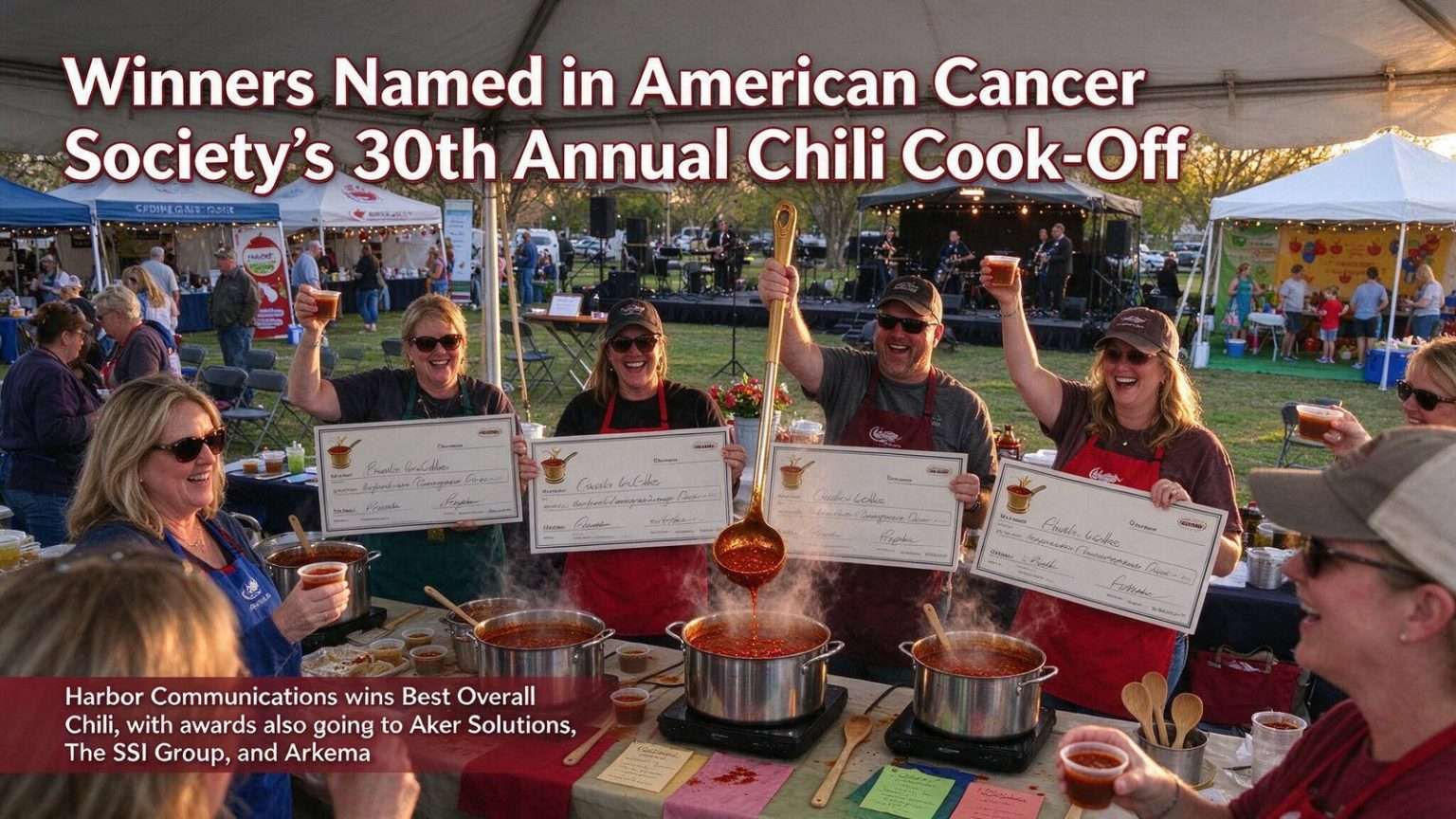
The American Cancer Society’s 30th Annual Chili Cook-Off delivered its usual four-hour stretch of competition, live music and family activities as teams vied to cook up the best chili in town — and the winners are now in.
Harbor Communications took home Best Overall Chili. Aker Solutions won Best Decorated Tent, The SSI Group earned the Spirit of Chili Cook-Off Award, and Arkema claimed the Chili Change Award.
The event doubled as a fundraiser for the American Cancer Society, whose programs fund cancer research and patient support services.
The winners
Best Overall Chili — the prize every team enters the event chasing — went to Harbor Communications, whose pot outpolled a field of corporate and amateur competitors judged across the four-hour run of the cook-off. The award is the event’s top honor, and it goes to the team whose chili best survives the scrutiny of the judging rather than simply the appetite of the crowd.
The rest of the awards recognized the elements that make the cook-off more than a tasting contest. Aker Solutions won Best Decorated Tent, the prize that rewards the visual effort teams put into their setups — the themes, signage and hand-built environments that turn a row of tents into one of the event’s signature spectacles. The SSI Group earned the Spirit of Chili Cook-Off Award, an honor aimed at the team that embodies the event’s energy and character rather than its cooking alone. And Arkema claimed the Chili Change Award, the category that highlights a distinctive or unexpected take on the dish.
Together the four awards spread recognition across the field, which is part of the cook-off’s design. Teams compete in cooking, decoration and spirit simultaneously, which keeps companies engaged in the event year after year and gives newcomers a path to recognition even against cooks with decades of experience.
Three decades of a Mobile tradition
Now three decades old, the cook-off has become one of Mobile’s signature spring charity traditions, drawing corporate and amateur teams alike each year. Thirty annual editions mark an institution: an event that has survived economic cycles, venue changes and generational turnover among its teams and volunteers, and that has become fixed enough on Mobile’s calendar that companies build their spring philanthropy around it.
The corporate presence is central to how the event works. Teams from companies across the Mobile area — including the winners honored this year — enter as workplace projects, with employees organizing recipes, decorating crews and fundraising around their tents. The competition gives co-workers a shared project outside the office, and it gives the participating companies visible roles in one of the city’s best-known charity events.
The amateur teams balance that corporate presence with the home-cook energy that anchors any chili competition. Recipes guarded for years, family traditions brought out for one weekend and rivalries that persist across editions are part of the event’s texture, and the four-hour format compresses all of it into a single afternoon of cooking, sampling and judging.
A fundraiser with a mission
The event doubled as a fundraiser for the American Cancer Society, whose programs fund cancer research and patient support services. The dollars raised through team entries, tastings and event activities flow into the society’s national and local work — the research grants that have shaped cancer treatment over decades, and the patient services that connect people facing cancer with information, lodging, transportation and support.
For attendees, the connection between the afternoon’s festivities and the mission is the event’s reason for being. The cook-off raises money precisely because it draws crowds, and the crowds come because the event is genuinely entertaining — which makes the format self-reinforcing: the better the party, the bigger the fundraiser.
Cancer’s reach in every community gives the mission immediate resonance. Nearly everyone in the crowd has been touched by the disease in their family or their workplace, and the cook-off has long served as a way for Mobile’s business community and its residents to respond to that shared experience with something collective and constructive.
Music and family on the schedule
Entertainment kept the crowd moving between tastings, with performances from the Coastal Alabama Sun Chief Show Band, Delta Smoke, and Jesh Yancey & the High Hopes, plus kids’ activities throughout the day.
The lineup blended local and regional acts across styles. Delta Smoke brought blues-inflected sets to the stage, the kind of music that pairs naturally with an afternoon of chili and open-air socializing. Jesh Yancey & the High Hopes added their own sound to the bill, and the Coastal Alabama Sun Chief Show Band brought the large-ensemble energy of a collegiate show band to the event’s main stage.
The kids’ activities running throughout the day make the cook-off a family event rather than an adults-only gathering. Families come out together, children have their own things to do between visits to the tents, and the event’s four-hour span accommodates an afternoon that works for all ages. That family orientation is part of how the cook-off has sustained itself across three decades — each generation of Mobile children grows up attending, and some eventually cook.
The judging and the competition
The four-hour stretch of the cook-off is a compressed competition. Teams arrive early to set up, begin cooking well before the public arrives and spend the event keeping pots at their best while serving the steady stream of tasters who circulate through the grounds. Judging runs through the event, with awards announced as the afternoon concludes — the moment when weeks of preparation by each team resolve into the four results that were named this year.
The competition’s categories shape how teams prepare. Best Overall Chili demands a pot that impresses the judges on its merits. Best Decorated Tent turns the event grounds into a display of corporate and team creativity, with themes that range from elaborate to satirical. The Spirit award honors the teams whose enthusiasm defines the day. The Chili Change Award invites experimentation — the chili that departs most memorably from tradition. A team can chase one category or all of them, and many do.
That structure has kept the event fresh across thirty years. The cooking contest at its core is stable, but the categories around it evolve with the teams, and each year’s edition reflects the creativity of the companies and cooks currently involved.
What the event means for Mobile
The cook-off’s longevity in Mobile reflects the city’s broader culture of charity events that double as civic gatherings. Mobile’s spring calendar is anchored by traditions that bring the community together, and three decades of chili competition have earned the event a place among them — an afternoon that residents plan around and companies budget for.
The corporate teams that dominate the entry list represent a cross-section of the region’s economy. Companies in engineering, communications, chemicals and services — the sectors that employ much of Mobile’s workforce — field the teams that make the event possible, and the employee involvement that comes with each tent extends the event’s reach deep into the local workplace culture.
For the American Cancer Society, the event is one of its signature fundraising traditions in the region, and the thirty-year run demonstrates the durability of the partnership between the charity and the Mobile community. The society’s mission — funding cancer research and supporting patients — gives the afternoon a seriousness beneath the competition, and the event’s continued success translates directly into the resources the society can deploy.
This year’s winners carry the honors: Harbor Communications with the best chili in town, Aker Solutions with the best-dressed tent, The SSI Group with the spirit of the cook-off, and Arkema with the chili that changed things up. Around them, the rest of the field, the bands and the families in attendance made the 30th Annual Chili Cook-Off what it has been for three decades — one of Mobile’s signature afternoons.
Chili culture and competition cooking
Chili cook-offs occupy a particular place in American community fundraising, and the Mobile event’s structure reflects the conventions the format has developed nationwide. Teams cook on site, the crowd tastes, judges deliberate, and the awards spread across cooking, presentation and intangibles. The format works because chili itself is accessible — everyone has an opinion about it, and the distance between a good home recipe and a prize-winning pot is close enough to keep every team believing.
Competition chili also rewards the specifics: consistency across a long serving window, heat that impresses without overwhelming the judges, and a texture that survives the hours between cooking and tasting. Teams that win year after year tend to treat the competition seriously, refining recipes across editions and bringing the same discipline to their tent operations that they bring to the pot itself.
The four-hour window is a demanding format for the cooks. Chili benefits from long, slow cooking, and teams must judge their timing so their best pot is ready for the judging while still serving the public throughout the event. Managing that balance — a full afternoon of service with the competition moment embedded in it — is part of the craft the event tests.
The American Cancer Society’s local footprint
The funds the cook-off raises support the American Cancer Society’s work at both the national and community levels. The society’s research program has funded work behind many of the advances in cancer prevention, detection and treatment over its long history, and its patient support services — including helplines, lodging programs for patients traveling for treatment, transportation assistance and educational resources — reach patients and families in communities like Mobile.
Local fundraising events are the financial base for that work, and the volunteers who organize them are the mechanism by which the society’s mission is sustained outside its national office. In Mobile, the cook-off’s organizing tradition spans three decades of committees, sponsors and teams, each year’s edition built on the experience of the ones before it.
The event’s timing in spring places it in the season of Mobile’s largest civic gatherings, and its four-hour afternoon format makes it accessible to families and companies whose weekends are committed elsewhere. That accessibility has been part of its endurance: a charity event that fits into an afternoon is one people return to, year after year.
The teams behind the tents
Behind each of the winning entries was an organization. Harbor Communications’ Best Overall Chili represents a company whose employees cooked, served and competed their way to the event’s top prize. Aker Solutions’ Best Decorated Tent represents a crew that invested in building an environment as much as a meal. The SSI Group’s Spirit award and Arkema’s Chili Change Award each mark a different form of engagement with the competition.
Companies return to the cook-off year after year because the event delivers something beyond the fundraising total: it builds camaraderie among employees, gives companies a visible role in the community and creates the internal traditions — recipes, tent themes, rivalries — that workplaces carry across years. For many participants, the cook-off is the spring event their office plans around.
The amateur teams that compete alongside them keep the event honest in the way only home cooks can. A company tent can be out-cooked by a family recipe, and the cook-off’s history includes enough of those reversals to keep the corporate teams mindful that the prize goes in the pot, not the payroll.
With its 30th edition complete, the cook-off’s four winners are recorded, the funds raised are at work in the American Cancer Society’s programs, and the teams are already thinking about next year — which is how a tradition reaches three decades and keeps going.


