Woman dies after armed confrontation with Mobile County sheriff’s deputy in Coden
A woman died Friday afternoon in Coden after a shootout with a Mobile County sheriff's deputy, who was not injured; the sheriff's office is investigating.
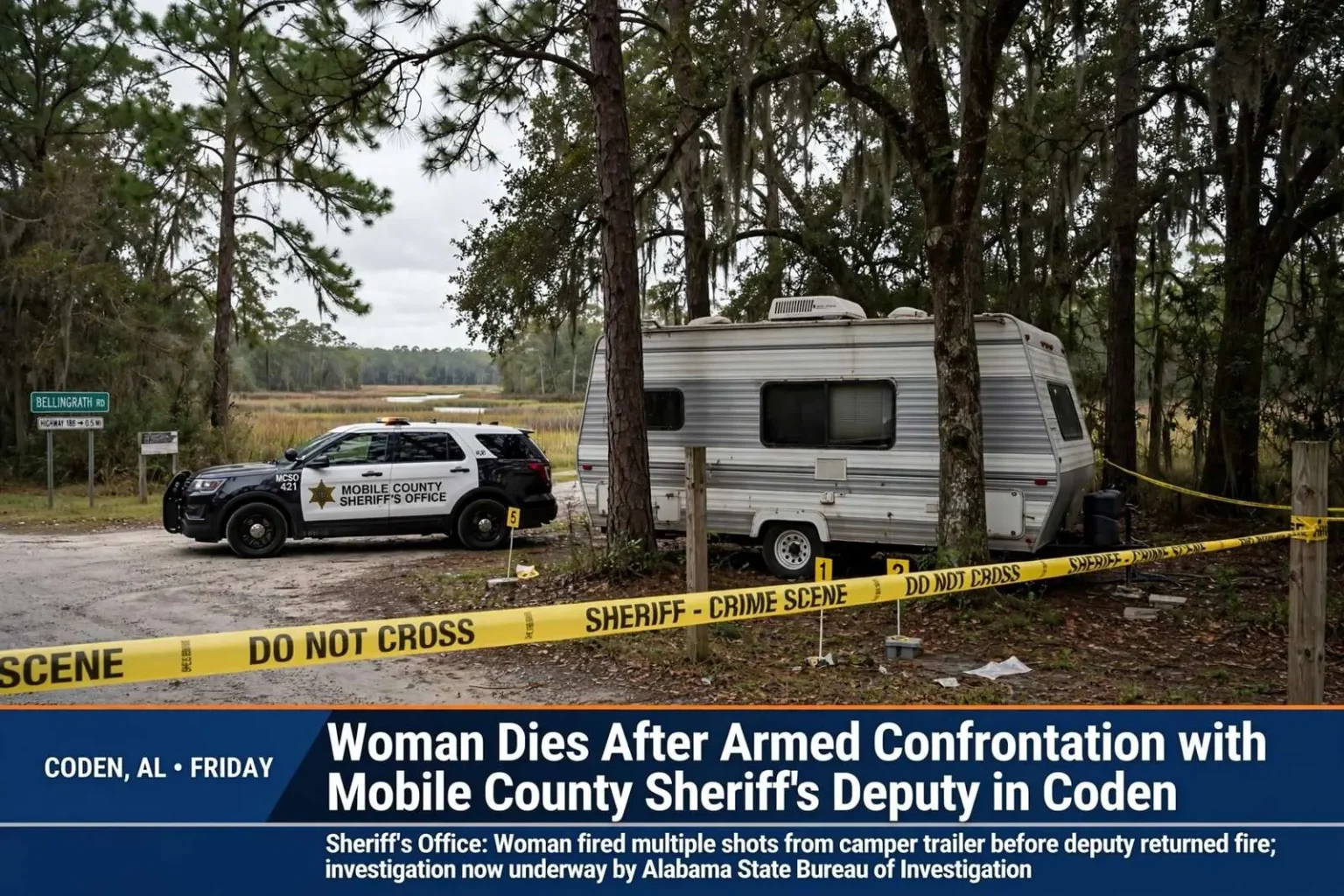
The Mobile County Sheriff’s Office has confirmed that one of its deputies shot and killed a woman during an armed confrontation in Coden on Friday afternoon. According to Capt. Paul Burch, the encounter occurred after deputies responded to a report of a “disorderly female” at a property on Bellingrath Road near Highway 188 around 3 p.m.
Burch said the property is large and shared by several members of the same family, one of whom called police. “Upon arrival, they talked with the complainant, who told them the female had gone into a camper trailer on the back of the property,” Burch said. “As deputies approached and attempted to establish contact, she began firing at them from a window. One deputy returned fire and she was struck.”
According to Burch, the woman fired multiple shots at the officers, but neither the deputy nor anyone else on the property was injured. The sheriff’s office has not released the name of the deputy or of the deceased. The investigation into the shooting is ongoing.
The scene in Coden
Coden sits at the southern end of Mobile County, a bayou-laced fishing community along the western shore of Mobile Bay where residential lots are often sprawling, wooded and spaced far apart. That geography shaped the response in practical ways: a large shared family property with a camper trailer positioned at the rear means deputies arriving on a disorderly-persons call could not simply see across the scene, and the approach to the trailer involved moving through unfamiliar ground near other occupied structures.
Bellingrath Road runs through the heart of the Coden community and carries local traffic toward Highway 188, the route that connects the area to Bellingrath Gardens and the communities farther south. The area is served by the Mobile County Sheriff’s Office rather than a municipal police department, as Coden is an unincorporated community — meaning deputies respond from district substations and often work alone or in pairs across wide patrol zones.
The call itself — a report of a disorderly female — is among the most common types of service calls deputies handle, and it is also among the least predictable. Dispatches of that kind routinely involve family disputes, mental health crises or intoxication, and deputies approach them as welfare and de-escalation matters first. In this case, the sheriff’s account indicates that contact with the woman inside the camper was attempted before any shots were fired.
What happens in the hours after an officer-involved shooting
Officer-involved shootings in Alabama are handled under a now-standard separation of responsibilities: the involved agency typically hands the criminal investigation of the shooting to the Alabama State Bureau of Investigation, which processes the scene, interviews witnesses and prepares findings for presentation to a grand jury. That division of labor exists to keep the investigation of the use of force out of the hands of the agency whose deputy fired.
In the immediate aftermath, the deputy involved is generally placed on administrative leave, which is standard practice across law enforcement agencies nationwide. The deputy’s name, as in this case, is typically withheld in the early stages while investigators work and in some cases until any threat assessment is complete. The Mobile County Sheriff’s Office has not released the name of the deputy involved or of the woman who was killed.
Scenes like the one on Bellingrath Road are secured for hours after a shooting. Investigators photograph the camper, recover shell casings from both sides of the exchange, canvass for witnesses among family members on the property, and document the positions of everyone involved. Those findings eventually become the evidentiary record that determines whether the deputy’s use of force is reviewed as justified.
“As deputies approached and attempted to establish contact, she began firing at them from a window,” Burch said in his account of the encounter, describing the moment the call for a disorderly person became a gunfight. “One deputy returned fire and she was struck.” The sheriff’s office says the woman fired multiple shots at the officers before a single deputy returned fire.
The distinction between one deputy firing and others holding fire will be part of what investigators reconstruct. In a confined approach toward a trailer window, sight lines, cover and the direction of fire all matter to the analysis, and the State Bureau of Investigation’s scene work will document each of those elements. The sheriff’s office has said no one besides the woman was injured — no deputies struck, no family members hurt — despite multiple shots fired at the officers.
Shootings at rural residences: the broader pattern
Encounters of this kind — a welfare or disturbance call at a rural property ending in gunfire — represent a small but persistent category of officer-involved shootings in Alabama and across the country. Research on these incidents consistently points to the difficulty of the approach phase: deputies arriving at a large parcel have little information about where the person is, what weapons may be present, and who else is on the property. Camper trailers, outbuildings and heavy vegetation all obstruct sight lines in ways that urban calls do not.
Mobile County’s southern communities — Coden, Bayou La Batre, Grand Bay, Irvington — are patrolled by sheriff’s deputies covering some of the largest beats in the county. The distances involved mean response times are longer than in west Mobile or Prichard, and deputies arriving on scene frequently have less backup available in the opening minutes of an encounter. Those realities are part of the context that investigators and, eventually, reviewers weigh when a rural call turns violent.
Family members who called in the disorderly-person report in this case had made the decision many households across the county face: to bring deputies into a private dispute because someone in the home appeared to be in crisis. The sheriff’s office has emphasized the complainant’s account — that the woman had gone into a camper on the back of the property — as the starting point for the encounter that followed.
What remains unknown
Significant facts were not available in the hours after the shooting. The sheriff’s office had not released the identity of the woman killed, the name of the deputy involved, how many deputies were on scene, or whether any weapon was recovered from the camper. Those details typically emerge through official statements as the State Bureau of Investigation’s work proceeds and the case is presented for review.
The sheriff’s office has said the investigation into the shooting is ongoing, and Burch’s statements so far represent the agency’s preliminary account rather than a completed investigative record. As with any officer-involved shooting, the findings that matter — whether the deputy’s actions are reviewed as justified, and whether any policy changes result — will come from that investigation, not from the first press briefing.
For the Coden community, the episode is a stark one: a Friday afternoon disturbance call on Bellingrath Road ended with a woman dead inside a camper trailer and a deputy on administrative leave, on a property where a family had asked for help. The county’s review of what happened there is just beginning.
The grand jury process that follows such investigations is worth understanding for residents following the case. In officer-involved shootings across Alabama, the district attorney presents the completed investigation to a grand jury, which decides whether the use of force warrants criminal charges or whether the shooting falls within the legal boundaries governing a deputy’s use of deadly force. That review can take weeks or months after the scene work is finished, and the outcome is announced publicly when the grand jury’s decision is returned.
Resources for families and deputies
Encounters that begin as crisis calls also renew attention to the training and resources available to deputies and families in Mobile County. Crisis intervention training, which teaches officers to recognize and de-escalate encounters involving mental health crises, has been adopted by departments across Alabama in recent years, and co-responder models that pair officers with mental health professionals have been piloted in parts of the state. Families in unincorporated communities like Coden who are managing a relative in crisis can also reach the 988 Suicide and Crisis Lifeline by phone or text, a resource that can connect them to help before a situation requires a law enforcement response.
For deputies, the aftermath of a shooting involves its own institutional supports. Agencies typically provide the involved officer with access to peer support and counseling, and the administrative leave period serves both the investigation and the deputy’s own recovery from a life-threatening encounter. The Mobile County Sheriff’s Office has not said how long the deputy in this case will remain on leave, which generally depends on the pace of the investigation.
Waiting for answers in Coden
The community impact of an incident like this one extends beyond the family involved. Coden is a close-knit community of fishing families and longtime residents, and news of a fatal shooting on Bellingrath Road travels quickly through a part of the county where everyone seems to know someone connected to the property. Deputies who patrol the area live with the knowledge that the next routine call — a disorderly person, a welfare check — can unfold the way this one did.
What is known so far comes entirely from the sheriff’s office: a report of a disorderly female at a family property on Bellingrath Road near Highway 188 around 3 p.m. Friday; a complainant who said the woman had gone into a camper trailer on the back of the property; deputies who attempted to make contact; and gunfire from a window that ended when one deputy returned fire and the woman was struck. The woman fired multiple shots at the officers, according to Capt. Paul Burch, and neither the deputy nor anyone else on the property was injured.
Everything else — the woman’s name, the deputy’s name, the full forensic picture, the grand jury’s eventual judgment — belongs to the ongoing investigation. Until that process concludes, the account of the armed confrontation in Coden remains the sheriff’s office’s initial description of a Friday afternoon that ended with the first fatal deputy-involved questions of the year in that part of Mobile County.