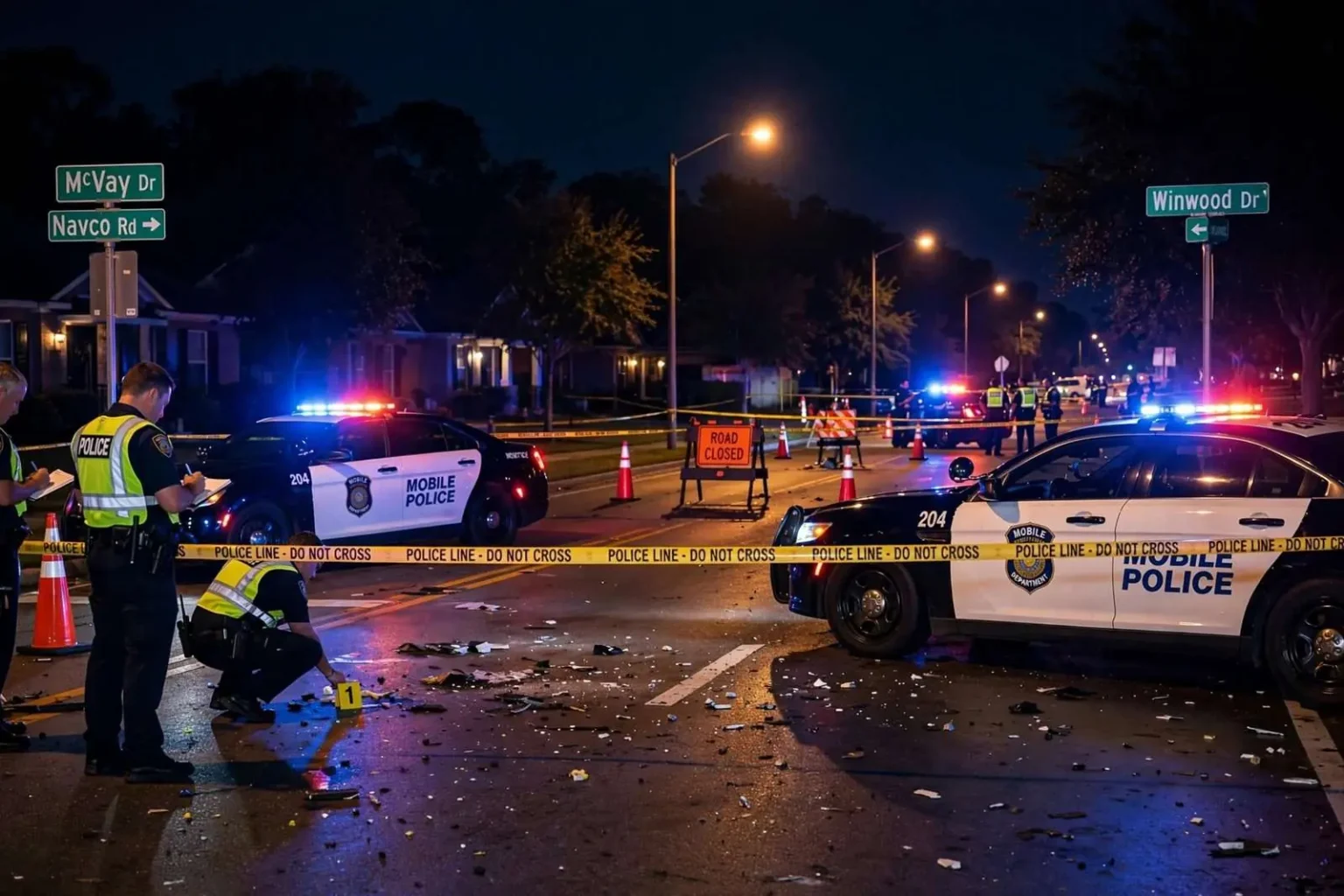
A 29-year-old woman died Thursday night after being struck by a vehicle on McVay Drive in Mobile, according to the Mobile Police Department. Officers were dispatched to the area near Navco Road around 8:12 p.m. after receiving a call about a person having been hit by a vehicle.
When police arrived, they found the victim’s body in the roadway on McVay Drive between Winwood Drive and Navco Road. She was identified as 29-year-old Jestina Lanae Campbell. Investigators say the driver of the vehicle was traveling westbound on McVay Drive at the time of the crash.
The vehicle, which was occupied only by the driver, remained at the scene, and the man behind the wheel was not injured. The driver’s cooperation at the scene and the absence of any reported injuries there left investigators with the slower, methodical work of reconstructing how the collision happened — a task that falls to the department’s specialized traffic unit. The vehicle was documented and processed at the scene, and the driver provided his account to investigators as the roadway remained closed for the reconstruction work that followed.
The Scene on McVay Drive
McVay Drive is a busy multi-lane roadway that connects several residential neighborhoods on Mobile’s east side, and the stretch between Winwood Drive and Navco Road sees a steady flow of evening traffic. At the hour the crash occurred, drivers were moving through the corridor under conditions that investigators would later have to account for — lighting, sight lines and the speed of the vehicles traveling the road.
News of a fatal pedestrian crash rippled quickly through the neighborhoods the roadway serves. McVay is not a high-speed thoroughfare like the highways that ring the city, but it carries significant local traffic between the east-side communities it links, and residents along the corridor know its crossings well. The section between Winwood and Navco is lined with the entrances and turnouts of the neighborhoods behind it, places where vehicles slow to turn and pedestrians step out of driveways and side streets throughout the evening hours.
The timing of the dispatch call — shortly after eight — placed the crash squarely in the post-dusk window when the corridor’s streetlights are on but the road’s activity has not yet thinned. First responders closed the affected portion of the roadway while they worked the scene, a standard practice in fatal collisions that allows investigators to document everything before the pavement is disturbed.
Investigators have not released additional details about the sequence of events leading up to the crash or whether the victim was crossing the road at the time she was struck. Those questions — where Campbell was in the roadway, what the driver saw, and the timing of each element — are precisely the points a traffic homicide investigation is built to answer.
The Investigation
The Mobile Police Department’s traffic homicide unit is continuing to investigate the fatal collision. The unit handles the city’s most serious traffic cases, combining scene reconstruction, vehicle examination and witness interviews to establish the sequence of events and determine whether any violation contributed to the crash.
Reconstruction in pedestrian fatalities typically involves mapping the final positions of the vehicle and the victim, examining the roadway for marks and debris, and analyzing the damage to the vehicle itself. Investigators also work to determine factors that are standard questions in such cases: visibility at the time and place, the speed of the vehicle, and any distractions or impairments involved. Results of that work can take days or weeks to compile.
The unit’s investigators also canvass for witnesses and, where they exist, request footage from nearby security cameras — a step that has become standard in modern crash investigation. Businesses and homes along a corridor like McVay often hold recordings that capture a collision no human witness saw clearly, and locating that footage in the first days matters because many systems overwrite it within a week or two.
No charges had been announced as of Friday, and the investigation remained open. In Alabama, charges in a fatal pedestrian crash depend on what investigators find — from no violation at all, in cases where a tragedy occurs without negligence, to serious traffic or criminal offenses where the evidence supports them. The absence of immediate charges simply reflects that the reconstruction and review were not yet complete.
Anyone with information about the crash is asked to contact Mobile police. Witnesses who saw the vehicle or the victim before the collision, or who were driving the corridor around 8:12 p.m., can provide the details that fill gaps in the reconstruction — a contribution that often proves decisive in cases without independent camera coverage of the scene.
Pedestrian Safety on Mobile’s Corridors
Pedestrian deaths remain a persistent concern on heavily traveled Mobile corridors, and this latest fatality adds to a string of traffic-related deaths reported on and around McVay Drive in recent years. The pattern reflects a challenge common to mid-sized Southern cities: roadways designed primarily for vehicle throughput, paired with neighborhoods whose residents walk along and across them daily.
National safety data consistently ranks pedestrian fatalities among the most stubborn categories of traffic deaths, and Southeastern states have historically posted some of the highest per-capita rates in the country. Darkness is a compounding factor — a large share of pedestrian fatalities occur at night, when visibility shrinks and drivers have less time to react to someone in or near the roadway.
Thursday’s crash occurred around 8:12 p.m., a time when full darkness had settled over the corridor. The conditions investigators document in such cases — street lighting along the stretch, the victim’s clothing, crosswalk availability — feed into the larger picture of how and why pedestrian crashes happen on roads like McVay.
The corridor’s history gives the safety discussion a local urgency. Each fatal crash on a roadway like McVay prompts the same questions from the neighborhoods it serves: where drivers are speeding, where lighting fails, and where a crossing should exist but does not. Those answers typically emerge through a combination of police data and residents’ reports to the city, and they shape the improvements — signals, crosswalks, lighting — that eventually follow.
What Happens Next in the Case
The traffic homicide unit’s findings will determine the case’s next step. If the investigation supports charges, they would be presented for prosecution; if not, the case would close with a documented determination of what occurred. Either way, the unit’s report becomes the formal record of a fatal collision that took the life of a 29-year-old Mobile woman. That report also serves the family, who in most cases receive the findings that explain what happened in the final moments.
For the family of Jestina Lanae Campbell, the investigation’s pace can feel agonizing. Fatal crash investigations routinely take weeks, and answers about the final moments arrive in pieces — first the identification, then the reconstruction, and only at the end any determination of responsibility. Community members who wish to help can provide what investigators need most: information, however small it may seem, from those who saw something.
A Corridor’s History of Loss
The stretch of McVay Drive between Winwood Drive and Navco Road now carries the memory of another traffic death. Residents of the east-side neighborhoods along the roadway have watched a series of fatal and serious crashes occur on and around the corridor in recent years, a pattern that keeps pedestrian and driver safety at the center of local concern.
Mobile police routinely remind both drivers and pedestrians of the practices that reduce these collisions: drivers watching speed and scanning the roadway ahead, especially at night; pedestrians walking against traffic where sidewalks are absent, wearing visible or reflective clothing, and crossing at marked locations where possible. Neither side eliminates the risk entirely, but the combination measurably reduces it.
Engineering changes play their part as well. Multi-lane roadways like McVay carry a known risk profile for pedestrians, because each additional lane widens the distance a person on foot must cross and increases the exposure time in the roadway. Cities across the country have responded to corridor fatalities with narrower travel lanes, better-marked crossings, and improved lighting — measures that Mobile’s own traffic engineers weigh when a road’s crash history demands attention.
As the investigation continues, the corridor returns to its usual rhythm — commuters, school traffic, neighborhood errands — with the caution that follows any fatal crash. The questions of how Jestina Lanae Campbell came to be in the roadway, and what the westbound driver encountered, now rest with the investigators working the case. Their findings, when they come, will close the record on Mobile’s most recent pedestrian fatality — and add to the ongoing conversation about how the city’s busy corridors can be made safer for everyone who uses them.