Woman Shatters 22-Year-Old Oyster-Eating Record at Wintzell’s in Mobile
A 33-year-old Mobile woman ate 223 raw oysters to break a 22-year-old record at Wintzell's Oyster House, as the region gears up for a busy stretch of crawfish festivals and a new downtown diner prepares to open.
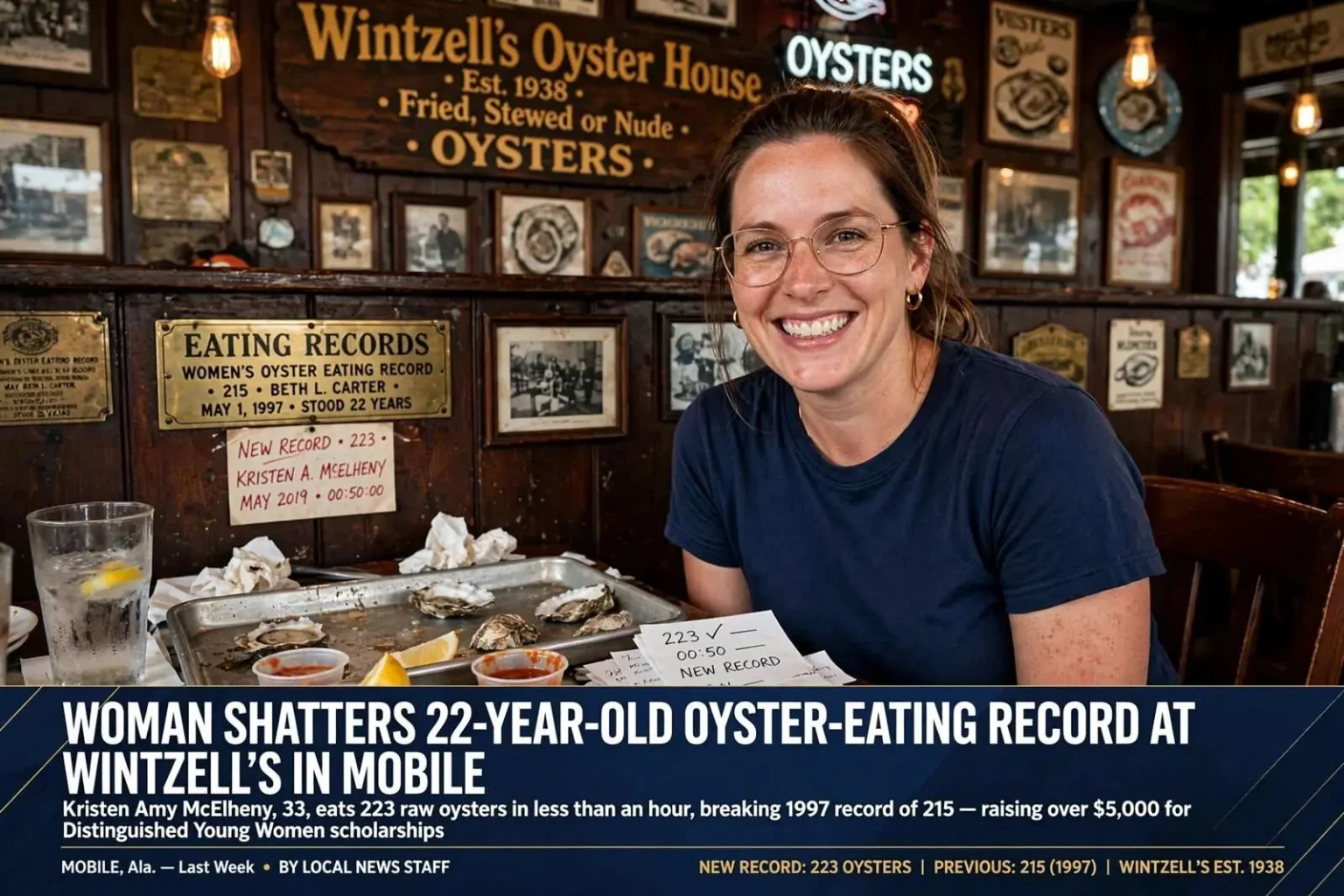
A record that stood for nearly 22 years at Wintzell’s Oyster House has fallen. Kristen Amy McElheny, 33, put away 223 raw oysters in less than an hour last week, breaking the women’s eating record that had hung on the wall of the downtown Mobile institution since 1997.
The previous mark of 215 oysters belonged to Beth Larimore Carter, who set the record on May 1, 1997. Carter’s name held the top spot for almost 22 years to the day before McElheny stepped up to reclaim it, finishing with 10 minutes still left on the clock.
Twenty-two years is an eternity in competitive eating, where records in most disciplines fall within a season or two of being set. The longevity of Carter’s mark said as much about its difficulty as about its holder: 215 oysters in under an hour is a pace of roughly one shellfish every 17 seconds, sustained, without the peppers or hot dogs that give other eating contests their fame.
McElheny, a former America’s Junior Miss participant, said she had wanted to hold the record since she was a child. That backstory gave the attempt the feel of a homecoming rather than a stunt — a Mobile native chasing a number she had grown up looking at on a restaurant wall, then rewriting it with ten minutes to spare.
In the lead-up to her attempt, she solicited sponsorships from several area businesses on behalf of the Distinguished Young Women program, raising more than $5,000 for scholarship funds in the process. The charity angle is no accident, and it is part of what makes the record run distinctively Mobile: America’s Junior Miss, the competition that once crowned teenage girls from every state, grew up in this city and lives on as Distinguished Young Women, its scholarship mission intact.
A Restaurant Tradition
Wintzell’s has long served as an informal proving ground for competitive eaters in the Mobile area, and the oyster-eating record is one of the restaurant’s most closely watched traditions.
The restaurant, founded in 1938 and long headquartered on Dauphin Street downtown, built its reputation on oysters served “fried, stewed or nude,” and its walls became a local museum of folklore, advice and ecclesiastical-grade homily. Among the plaques and photographs, the eating records occupy a special place — numbers that generations of regulars have dared each other to chase.
The feat adds a new chapter to a local tradition that blends appetite with charity, and it comes during a busy stretch of springtime food events across the region.
Crawfish Season in Full Swing
Among them is the 17th annual St. Mary’s Knights of Columbus Crawfish and Bluegrass Extravaganza, set for Saturday, May 18. Gates open from 3:30 to 8 p.m. for the rain-or-shine event, which pairs all-you-can-eat crawfish with several hours of live bluegrass music.
Advance tickets are $20 and available at Mobile Popcorn and St. Mary’s school, with the price rising to $25 on the day of the event. Tickets for kids ages 13 to 18 are $15, and children 12 and under get in free.
By its 17th year, the Extravaganza has settled into the rhythm of the spring social calendar — the kind of parish-boiler that draws extended families, church volunteers and anyone who has learned that May crawfish, boiled heavy on the spice, are as much a Gulf Coast season as hurricane prep.
The following day, Fairhope Brewing Company hosts its sixth annual Suck It, Cancer crawfish cook-off on Sunday, May 19, from 2 to 5 p.m. at 914 Nichols Ave. Sponsored by Bryant Bank and D.I.P. Seafood-Mudbugs, the event will put roughly 1,000 pounds of crawfish on the line as teams compete to see who can boil the bug best, with proceeds benefiting the American Cancer Society.
Tickets are $15 and include all the crawfish attendees can eat, along with live music from Stephen Sylvester.
The cook-off format adds a competitive edge to the afternoon. Instead of one kitchen boiling for the crowd, teams of amateur boil-masters work side by side, each convinced its recipe — the garlic count, the soak, the secret in the sack — is the one worth bragging about. The judges, in practice, are everyone holding a ticket.
Between the two events, a single May weekend offered crawfish in two counties, two causes and two settings — a school ground in Mobile and a brewery patio in Fairhope — a reminder that the mudbug’s place on the local calendar is not a single festival but a whole season of them.
A New Diner Downtown
Meanwhile, downtown Mobile diners have a new spot to watch for. Truman’s Diner is under construction at 14 S. Conception St. and is getting closer to an opening date. The 1930s-style diner plans to serve up classic Southern fare once it opens its doors.
Owner Bill Appling had initially targeted an early spring launch but is now aiming to seat customers sometime in June. In the meantime, progress updates have been trickling out on the diner’s social media pages, giving curious locals a preview of what to expect from the historic building.
Together, the record-breaking oyster run and the string of upcoming crawfish events underscore just how central food remains to community life across the Mobile Bay area, whether it’s a decades-old eating record or a new diner preparing to open its doors.
Competitive eating occupies a curious niche in Gulf Coast food culture. In most of the country it lives on ESPN and county fairs; in coastal Alabama it lives in restaurant walls and festival grounds, where the records are local, the challengers are neighbors, and the crowds are full of people who knew the previous holder. Wintzell’s board of records has worked that way for decades — a dare made permanent — and McElheny’s run will now hang where Carter’s hung, waiting for the next challenger who has been doing the math since childhood.
Raw oysters are a demanding discipline, for what it is worth. They are cold, they are briny, and their slipperiness offers no help to a competitor on a clock. Champions in other foods talk about pacing, jaw fatigue and hydration strategy; an oyster record adds the element of the sea itself, since a plate of Gulf oysters is never entirely uniform. That McElheny cleared 223 with ten minutes to spare suggests she was not merely steady but fast — a pace, for the record, of nearly four oysters a minute.
The scholarship fundraising also fit the moment. Distinguished Young Women, the program that evolved from the Junior Miss competition once staged in Mobile, exists to send young women to college, and McElheny’s sponsors turned her appetite into tuition money for someone else. More than $5,000 raised on the strength of one dinner is a respectable return on an hour’s work by any measure.
The crawfish events carry the same double meaning. The St. Mary’s Extravaganza has funded parish work for 17 springs; the Fairhope cook-off funnels its proceeds to the American Cancer Society, a cause with survivors at every table. On the Gulf Coast, the boiler and the collection plate are rarely far apart.
Downtown, the arrival of Truman’s Diner adds another note to the Conception Street corridor, where older buildings have been finding new tenants as downtown’s residential population grows. A 1930s-style diner in a historic building is a careful kind of nostalgia — chrome and counter service paired with plates that Mobile already knows how to eat — and Appling’s steady stream of construction updates has given the opening the feel of a neighborhood project rather than a chain’s arrival.
Put the week together and the pattern is plain. A 22-year-old record falls at a 1938 oyster house; two parishes and a brewery boil crawfish for charity; a diner owner revives a vintage building a few blocks away. Mobile Bay’s food culture runs on tradition, but it is not a museum — the traditions are made new every spring, one plate, one record and one opening at a time.
For locals weighing which events to catch, the logistics were simple enough: Saturday’s Extravaganza ran into the evening at St. Mary’s, Sunday’s cook-off took over the Fairhope brewery’s afternoon, and Truman’s Diner would follow in June. Spring along the bay does not ask residents to choose between good causes and good eating — it schedules them back to back and lets the season do the rest.
The oyster wall itself deserves the last word. Records like Carter’s and now McElheny’s survive because they are public — written down, displayed at eye level and renewed with every retelling. In an era when most restaurant ephemera lives on a phone screen, a brass plaque in a downtown dining room remains the most durable scoreboard in town, and the next challenger is presumably already counting.