Woman Shot While Sitting in Her Vehicle on Bay Avenue, Mobile Police Say
Mobile police investigated a Wednesday-morning shooting on Bay Avenue where a woman was shot while sitting inside her car.
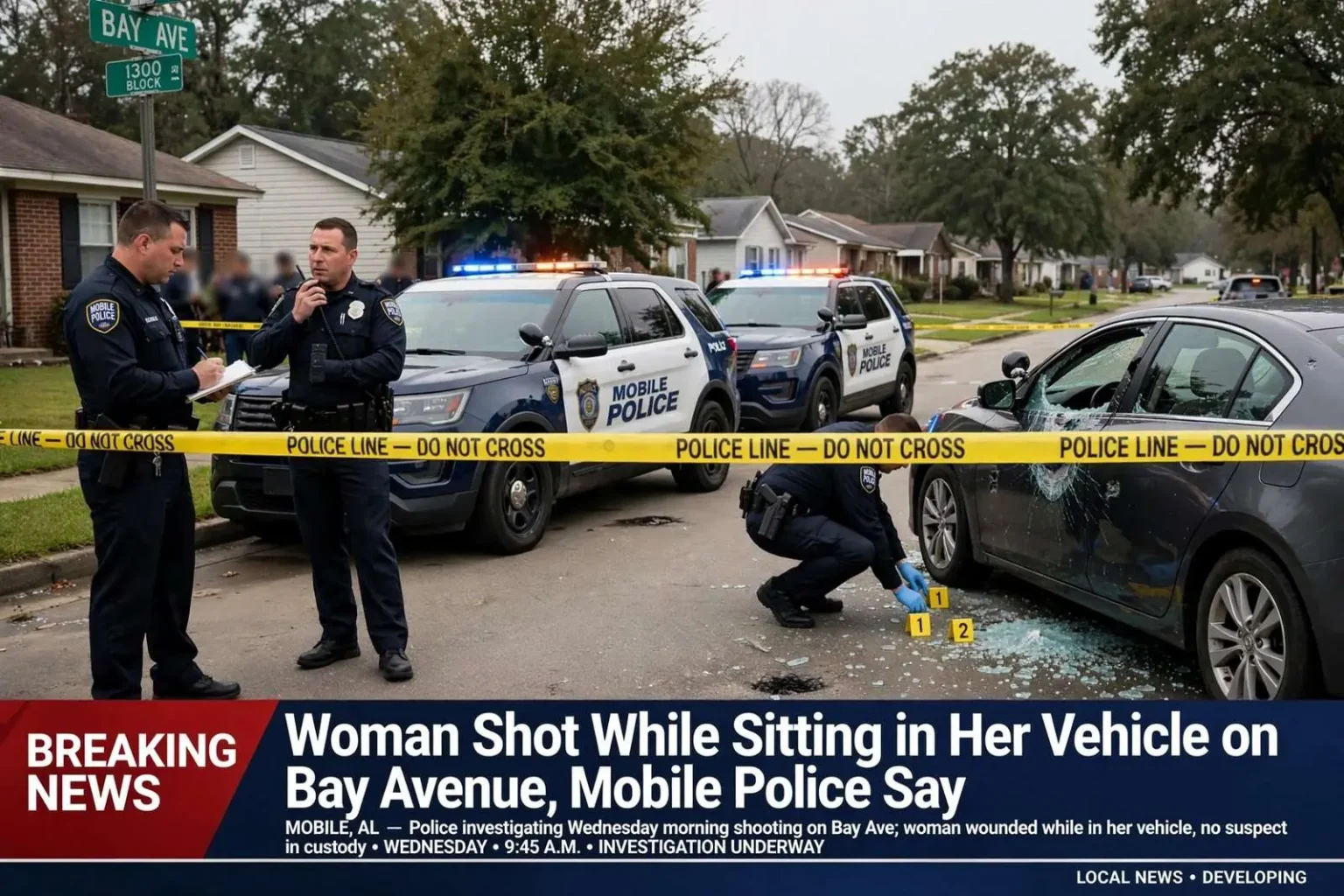
Mobile police are investigating after a woman was shot Wednesday morning while she sat inside her vehicle on Bay Avenue. Officers were called to the 1300 block of Bay Avenue at about 9:45 a.m. and found a female victim with a gunshot wound, launching an investigation into a shooting that unfolded in the middle of a residential street in daylight.
She told officers she had been sitting in her vehicle when someone shot her. Police did not immediately release the extent of her injuries or describe a suspect, and no arrest had been announced as the investigation got underway.
Responding officers secured the scene and began the standard work of a shooting investigation: rendering aid, interviewing the victim, speaking with anyone nearby who may have seen or heard something, and looking for physical evidence along the block. Detectives were called in to take over the follow-up work that patrol officers began.
A morning shooting on a residential block
The mid-morning gunfire on a residential street left neighbors shaken as officers canvassed the block for witnesses and surveillance video. A shooting before ten in the morning — in an area where residents were leaving for work and children were already at school — drew immediate attention from the people who live along the street.
Investigators went door to door asking a familiar set of questions: Did anyone hear gunfire? Did anyone see a vehicle or a person leaving the area quickly? Did any home security camera capture the moments before or after the shot was fired? Those canvasses are often how the first meaningful leads in a case like this one are found.
Surveillance has become central to cases like this. Doorbell cameras and home security systems now record much of what happens on Mobile’s residential streets, and detectives routinely collect footage from homes and businesses within sight of a scene. Even partial clips — a sound, a flash of movement, a car passing twice — can help investigators build a timeline.
What police have said — and haven’t
Police did not immediately release the extent of the woman’s injuries, a detail investigators often hold close in the early hours of a case. Withholding that kind of information can help detectives verify claims made by potential suspects, but it can also leave neighbors anxious for word about the condition of someone shot in their own block.
No suspect description was released either, and police did not say whether the woman was targeted or caught in random violence. Those determinations take time, and detectives generally avoid speculating publicly while interviews and evidence are still being collected.
The case remained under investigation. Anyone with information was urged to contact Mobile police or CrimeStoppers, which accepts anonymous tips and pays cash rewards for information that leads to an arrest in violent crime cases.
How Mobile police work shooting cases
The department’s response to a daytime shooting follows a pattern residents of the city have seen before. Patrol officers establish a perimeter and secure the scene, medics transport the victim, and detectives from the department’s investigative units arrive to conduct interviews and coordinate the collection of evidence.
Evidence technicians document the scene photographically, search for shell casings and other physical evidence, and note the positions of vehicles — including the victim’s — as they were found. That documentation supports everything that follows, from ballistic comparisons to witness interviews conducted days later.
Detectives will also pull records that may place people and vehicles near the scene: calls for service in the area, license plate camera hits if available, and the footage gathered during the canvass. The combination of those records and witness accounts is typically what shapes the early theory of a case.
When a vehicle is the scene of the crime
Shootings that target people inside vehicles present investigators with a distinct set of challenges. A car is a moving, enclosed space that holds evidence of its own — bullet holes, glass, interior damage — but the driver or passenger is also confined, with limited ability to escape or take cover when shots are fired.
For the victim, the circumstances matter in every way: where the car was parked, whether the windows were up, which direction the shots came from, and whether anyone was nearby who could have witnessed the encounter. Detectives will examine the vehicle itself as a piece of evidence, and its location in the 1300 block of Bay Avenue becomes the fixed point around which the timeline is built.
Incidents in which someone is shot while sitting in a parked car raise obvious questions that investigators will work to answer: Was this a targeted attack? Was there an earlier dispute? Did the shooter approach on foot or fire from another vehicle? Police did not answer those questions Wednesday, and detectives typically decline to speculate until witnesses and evidence point in a consistent direction.
What neighbors can do
Residents of the block who saw or heard anything — even details that seemed insignificant at the time — are the people detectives want to hear from. A doorbell camera clip, a description of a car that left the area quickly, or the sound of a single shot at a specific minute can all help place events in order.
CrimeStoppers offers a way to pass along information without attaching a name to it. Tips submitted to the program are routed to investigators, and the program’s board authorizes cash rewards when a tip produces an arrest. Anonymous tips can be submitted by phone, through the program’s app, or online, and tipsters are identified only by a code number.
Police also ask residents not to share unverified rumors on social media while a case is active. Speculation can reach witnesses before detectives do, contaminating recollections, and false information can point a neighborhood’s attention in the wrong direction while the real trail goes cold.
The wider toll of gunfire in the city
Every shooting in a residential block lands on a community that did not expect it. Neighbors describe the same aftermath in case after case: the shock of seeing patrol cars and crime scene tape on a street they walk every day, and the lingering question of whether what happened once could happen again.
Mobile police officials have consistently emphasized that the department’s investigations depend on community cooperation — that witnesses who come forward, even anonymously, are the difference between cases that end in arrest and cases that remain unsolved. Violent crime investigations that stall usually stall for a familiar reason: the people who know something have not yet said anything.
The department’s tip lines remain open as the investigation continues, and detectives will keep working the case in the days ahead — re-interviewing witnesses, running forensic comparisons and following up on whatever the canvass of the block produced.
For now, the questions residents along Bay Avenue are asking are the same ones investigators are trying to answer: who fired the shot, why, and whether the woman who was wounded — sitting in her own vehicle on a Wednesday morning — will recover. Anyone who can help answer them is asked to call Mobile police or CrimeStoppers.
What comes next in the investigation
In the days after a shooting like this, the pace of the work slows but does not stop. Detectives return to the block for follow-up interviews, submit recovered evidence to the state crime lab and wait on results that can take weeks. Ballistic comparisons, phone records and surveillance footage all move on their own timelines, and cases are rarely solved in the first news cycle.
Victims’ families are kept informed as the case develops, and advocates within the department often help connect families with services while the investigation runs its course. The woman’s identity has not been released by police, consistent with the department’s practice of protecting the privacy of victims of violent crime.
The role of anonymous tips in Mobile cases
CrimeStoppers has long played a role in Mobile’s violent crime investigations, providing a channel for people who know something but are reluctant to be seen cooperating. The program’s structure is simple: tipsters contact the hotline or app, information is passed to the relevant investigators with no identifying details, and rewards are paid in cash when information leads to an arrest.
That anonymity has proven important in neighborhoods where witnesses fear retaliation. Many of the arrests made in Mobile’s shooting cases began with an anonymous call, and detectives say the volume and quality of tips often determine whether a case moves forward at all.
Anyone with information about Wednesday morning’s shooting on Bay Avenue is urged to contact the Mobile Police Department or leave an anonymous tip with CrimeStoppers. Even a small detail — a voice heard outside, a car described to police for the first time, a camera angle nobody thought to check — can be the piece that completes the picture.
The investigation into the shooting remains active, and police say updates will be provided as they become available. Until an arrest is made, the block where a woman was shot in her own vehicle will keep its questions — and the detectives working the case will keep looking for the answers.