
Word on the Street: How Downtown Mobile Bars Handled Dauphin Street Beer Festival
The Dauphin Street Beer Festival drew crowds to more than 30 Mobile bars pouring 90 beers, with a heavy police presence keeping the night safe.
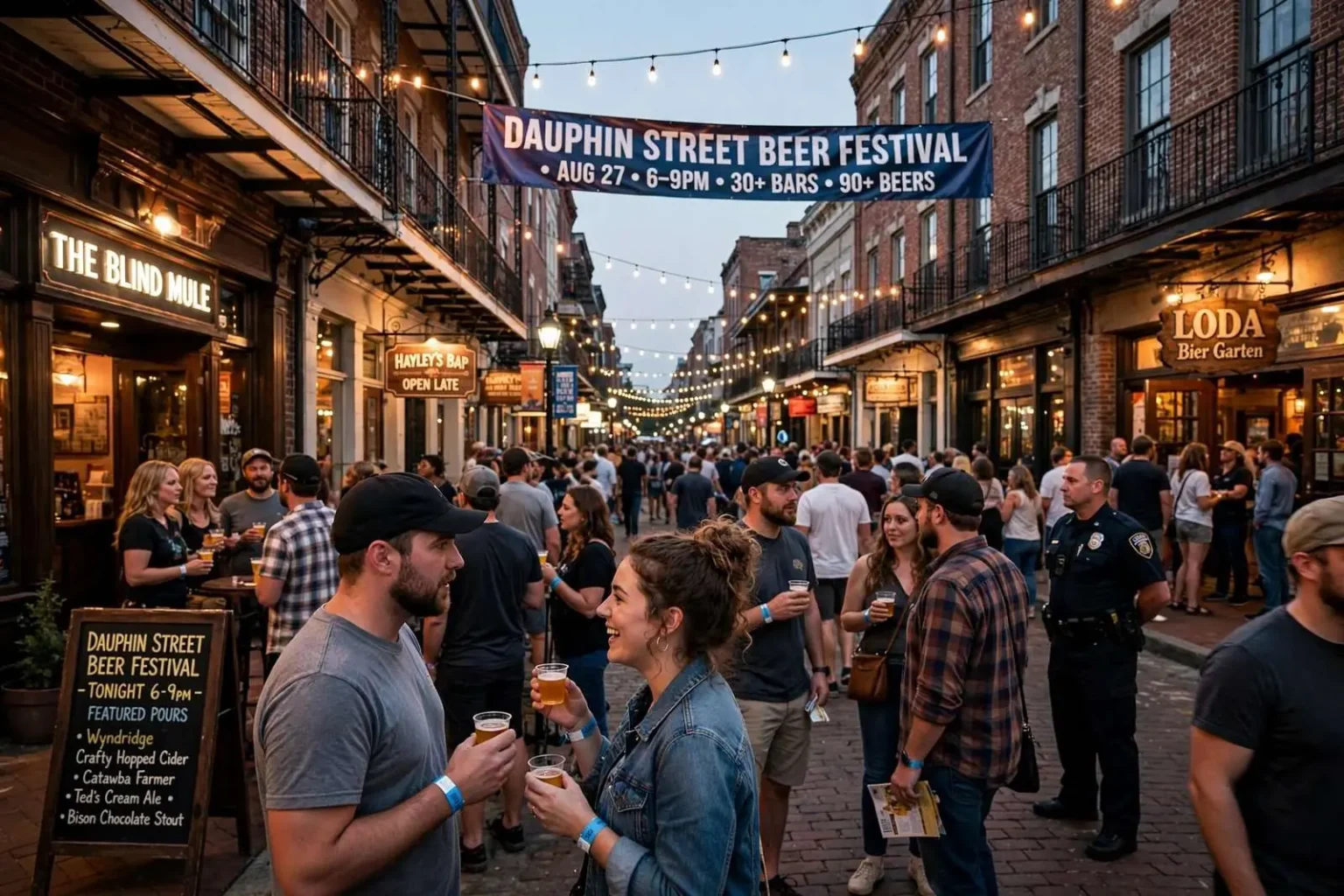
For Mobile beer lovers, late August means the Dauphin Street Beer Festival, held this year on Aug. 27 from 6 to 9 p.m. More than 30 bars and 90 beers drew crowds up and down Dauphin Street, with a heavy police presence keeping the celebration safe for those who walked home.
At The Blind Mule, bartender Clayton H. Bates said the night was “much less chaotic this year. Busy but manageable. Lots of happy drunks.” The Mule poured Wyndridge Crafty Hopped Cider, Catawba Farmer Ted’s Cream Ale and Bison Chocolate Stout. Lines wrapped the block at Alchemy Tavern and LODA Bier Garten, where bartender Brian Wattier recalled being “slammed” and turning people away for hours. Hayley’s Bar, open late, served Einstok White Ale and Catawba REDiculous Red IPA; bartender Wil Reid joked that after 9 p.m. the scene approached Mardi Gras levels.
The festival has become one of downtown Mobile’s signature late-summer events, transforming the historic corridor into a walkable tasting trail for a single evening. Ticket-holders move bar to bar sampling pours that most venues would never stock on an ordinary Saturday, and the three-hour window concentrates the crowd into a dense, festive tide that surges along the street from LoDa to the western end.
A Street Built for Celebration
Dauphin Street has anchored Mobile’s nightlife for generations. Lined with historic buildings that survived wars, fires and hurricanes, the corridor carries the same cobblestone-and-brick character that hosts Mardi Gras balls, parade routes and block parties through the year. Its entertainment district packs bars, restaurants and music venues within a few walkable blocks, which is precisely what makes a beer festival format work: no transportation required between stops, just a stroll and a wristband.
The event’s scale — more than 30 participating bars and roughly 90 beers poured — requires weeks of coordination between venue owners, distributors and the city. Each participating location selects its lineup for the night, typically leaning on regional distributors to bring in brews outside their usual rotation. That gives regulars a reason to visit bars they might normally skip, and it gives the street a shared identity for the evening rather than its usual collection of separate crowds.
Public safety is a central part of that coordination. A heavy police presence lined the street throughout the evening, with officers managing intersections, monitoring crowds and keeping the pedestrian traffic moving safely. The visible deployment has become a standard feature of downtown Mobile’s large events, honed by decades of Mardi Gras crowds that dwarf anything a beer festival can produce.
Behind the Bars
For the people pouring, festival night is one of the busiest of the year outside Mardi Gras. At The Blind Mule, bartender Clayton H. Bates reported the crowd as “much less chaotic this year. Busy but manageable. Lots of happy drunks.” His assessment matched the general tone on the street — a full house, but one that stayed good-natured from the 6 p.m. opening through the 9 p.m. close.
The Mule’s lineup ran from cider to stout: Wyndridge Crafty Hopped Cider for the fruit-forward crowd, Catawba Farmer Ted’s Cream Ale for the easy drinkers, and Bison Chocolate Stout for anyone closing out the night with something heavy. That spread illustrates the festival’s core appeal — a single bar effectively becomes a tasting room for styles and brands that rarely share a tap list.
Not every venue found it manageable in the same way. Lines wrapped the block at Alchemy Tavern and LODA Bier Garten, where bartender Brian Wattier recalled being “slammed” and turning people away for hours. The crowd crush at those stops reflected their reputations as destination bars on the street, drawing festival-goers from well beyond their regular clientele and testing the limits of even well-staffed operations.
The Pour List
Hayley’s Bar stayed open late to catch the crowd after the official festival window closed, serving Einstok White Ale and Catawba REDiculous Red IPA. Bartender Wil Reid joked that after 9 p.m. the scene approached Mardi Gras levels — a comparison only a Mobile bartender can make credibly, and a measure of how much the festival compresses into its three hours. When the taps officially shut down, the energy simply migrated to the venues still serving.
The beers themselves tell a story about the national craft boom reaching the Gulf Coast. Icelandic-inspired Einstok White Ale brought an imported wheat-beer profile to Hayley’s taps, while Catawba’s offerings — the Farmer Ted’s Cream Ale at The Blind Mule and the REDiculous Red IPA — represented western North Carolina’s growing footprint in Alabama distribution. Bison Chocolate Stout, an organic line out of the West, added a dessert-style pour, and Wyndridge Crafty Hopped Cider brought a craft-cider option for beer-averse ticket-holders.
For festival veterans, the strategy is pacing. Three hours and dozens of stops tempt attendees to sprint, but experienced participants treat the evening as a progressive tasting — a few ounces here, a snack there, and a long walk between venues. Bars counter the surge by pacing their pours and, as the lines at Alchemy and LODA showed, sometimes simply closing the door until the crowd thins.
What It Means for Downtown
Events like the beer festival do more than sell tickets; they showcase the entertainment district to residents who might otherwise rarely come downtown. A first-time visitor who walks Dauphin Street for the festival sees the range of the corridor in one night — the neighborhood bars, the craft cocktail rooms, the music venues — and the event functions as an annual advertisement for the district’s everyday business.
The economic ripple extends to the street’s restaurants, ride-share drivers and parking operators, all of whom see festival-night surges. For a downtown that has invested heavily in residential growth and visitor attractions in recent years, a reliable late-summer crowd event helps bridge the slow stretch between summer and the Mardi Gras season, when Mobile’s streets fill to capacity for weeks on end.
Police organizers and bar owners alike describe the formula as settled: a defined window, a heavy but friendly law enforcement presence, and venues that know their limits. The 9 p.m. close keeps the heaviest consumption contained to a manageable window, and the bars that stay open late — like Hayley’s — absorb the overflow in a controlled way rather than pushing it onto the street.
The Craft Beer Boom Reaches Mobile
The festival’s growth tracks with the broader expansion of craft beer across Alabama. State brewing laws were loosened significantly over the past decade — allowing higher-alcohol brews, taproom sales and eventual on-site consumption — and the effect showed up on bar tap lists statewide. Mobile’s own brewery scene has grown alongside the festival, with local production taprooms opening in and around downtown and giving the street a year-round beer culture that peaks each August.
Distributors have responded by expanding their regional portfolios, which is how beers from Carolina and Colorado producers end up on temporary taps along Dauphin Street for a single night. Festival pours often serve as market tests: a bar that watches a keg disappear in ninety minutes knows that label has an audience, and some festival beers earn permanent spots on local tap lists as a result. For small brands, the event is one of the most efficient ways to reach thousands of Alabama drinkers in a single evening.
The variety on display this year — cider, cream ale, stout, white ale, red IPA — reflected how diversified the drinking public has become. Bars reported interest across the full range, from the chocolaty stouts favored by late-night crowds to the lighter cream ales poured steadily through the early evening. Attendance patterns across the three-hour window followed the familiar rhythm: a rush at the 6 p.m. opening, a steady mid-festival flow, and a final surge as the close approached.
Getting Home Safely
With more than 30 bars serving 90 beers to a dense downtown crowd, the festival’s safety record depends on the plan that surrounds the party. The heavy police presence along Dauphin Street kept vehicle-pedestrian conflicts to a minimum, and the walkable design of the district means most attendees never need a car during the event itself. For those heading home afterward, the short festival window — 6 to 9 p.m. — ends early enough that the normal late-night transportation options are in full swing.
Officers on the street handled the usual festival duties: directing foot traffic at intersections, checking identification at venue entrances, and responding quickly when individual attendees overindulged. The visible security is a deliberate part of the event’s identity, a reassurance to neighbors and businesses that a crowd of this size is being actively managed rather than merely tolerated.
By the time Hayley’s late-night crowd thinned, the street had returned to its usual rhythm, with bartenders like Wil Reid, Clayton H. Bates and Brian Wattier closing out what all agreed was a successful — if exhausting — night. The comparisons to Mardi Gras were made with a grin, but they carried a point: Mobile knows how to run a street party, and the Dauphin Street Beer Festival has earned its place in the city’s calendar alongside the celebrations that made the street famous.