Your Early Parade Forecast: The Full 2011 Mobile Mardi Gras Schedule
Every 2011 Mobile Mardi Gras parade, from Krewe de la Dauphine on Dauphin Island to the Order of Myths on Fat Tuesday night downtown.
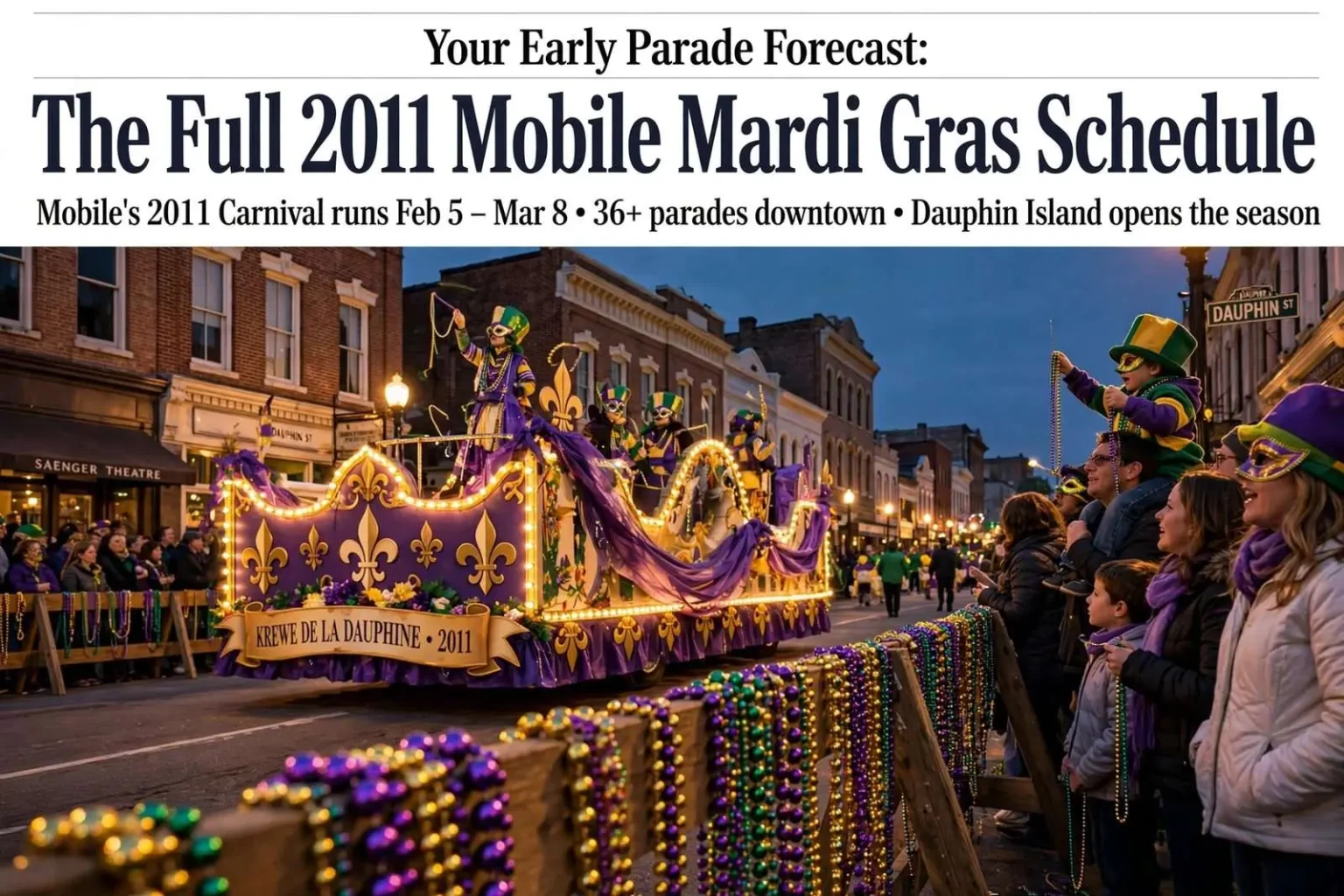
Mobile’s 2011 Carnival season ran from the first weekend of February through Fat Tuesday, March 8, with more than three dozen parades rolling through downtown — plus a pair of early afternoon processions out on Dauphin Island. For residents planning their calendars, and for visitors coming in from across the Gulf Coast, the schedule was one of the most detailed in recent memory, stretching more than a month and touching nearly every corner of the downtown core. Here’s how the season lined up, society by society, from the island’s opening salvo to the final night on Government Street.
February: The Season Opens
The Krewe de la Dauphine opened the season on Dauphin Island Saturday, Feb. 5, at 1 p.m., followed a week later by the Island Mystics on Feb. 12. The two barrier-island processions have become a beloved head start on the season for many Mobilians, who make the drive south across the causeway to catch throws along Bienville Boulevard before the downtown season even begins. Dauphin Island’s parades are deliberately family-sized — shorter routes, smaller crowds and a slower pace — and they draw a loyal mix of island residents, weekend visitors and campers from the county park.
Downtown action began Friday, Feb. 18, when the Conde Cavaliers rolled Route A at 6:30 p.m. The Cavaliers have long held the honor of opening the downtown schedule, and their Friday night procession traditionally sets the tone for the weeks ahead: illuminated floats, marching bands from local high schools and dense crowds along the route’s barricades. Saturday, Feb. 19 delivered an afternoon-and-night doubleheader: the Bayport Parading Society at noon, then Pharaoh’s Mystic Society and the Conde Explorers back to back that evening.
The middle of the following week kept the momentum going. The Order of Polka Dots rolled Thursday, Feb. 24, and the Order of Inca took the streets Friday, Feb. 25. Both societies are among the longtime nighttime organizations of Mobile’s Carnival calendar, and their processions traditionally draw large crowds of families who stake out spots hours in advance. The two parade nights also served as a warm-up for what was, on paper, the busiest stretch of the entire season.
A Four-Parade Saturday Caps the Month
Saturday, Feb. 26, packed four parades into a single day — Mobile Mystics at 2 p.m., then Maids of Mirth, Butterfly Maidens and the Krewe of Marry Mates stacking downtown from 6:30 to 8:30 p.m. The daytime-to-nighttime stack is a Mobile tradition in its own right, letting families catch an afternoon procession and stay downtown for a full evening of floats. Mobile Mystics, one of the city’s prominent parading societies, typically anchors the Saturday afternoon slot with a large floats-and-bands production, while the evening trio keeps the streets filled with music and throws until well after dark.
Sunday, Feb. 27, brought Neptune’s Daughters and the Order of Isis downtown, continuing the pattern of weekend doubleheaders. Monday, Feb. 28, added the Mobile Mystical Ladies and the Order of Venus, and Tuesday, March 1, closed out the month’s slate with the Order of LaShe. By the time February ended, residents had already seen more than a dozen parades, and the heaviest stretch of the season — the final week before Fat Tuesday — was still ahead.
That steady drumbeat of weeknight parades is one of the things that distinguishes Mobile’s Carnival from celebrations elsewhere on the Gulf Coast. Rather than concentrating everything into a single frenzied weekend, Mobile spreads its processions across nearly five weeks, with parades nearly every night during the final fortnight. The format gives families a chance to pick their nights, gives downtown restaurants and bars a long runway of busy evenings, and gives each mystic society its own moment in front of the city.
The Final Week Builds to a Crescendo
Mystic Stripers rolled Thursday, March 3, and the Crewe of Columbus on Friday, March 4. The two organizations are fixtures of the closing week, and their Thursday and Friday night processions traditionally draw some of the season’s biggest weeknight crowds as anticipation builds toward the weekend. By that point, downtown’s parking decks and surface lots fill early in the evening, and residents who work downtown often simply stay after five o’clock to claim a spot on the route.
Saturday, March 5, was the season’s biggest daytime stretch: the Floral Parade, the Knights of Mobile and the Order of Angels in succession around midday, before the Mystics of Time rolled at 6 p.m. — the same evening as the coronation of the Queen to King Felix III at the Mobile Convention Center. The Floral Parade, with its flower-decked floats and costumed riders, is one of the oldest traditions on the Mobile calendar, and the midday stack lets attendees string together three processions in a single afternoon. The evening belonged to the Mystics of Time, one of the city’s signature parading societies, whose procession draws crowds comparable to Fat Tuesday itself.
Sunday, March 6, belonged to Joe Cain Day, one of the most distinctive celebrations in American Carnival. The day began with the Arrival of King Elexis I at Government and Water streets at 2 p.m., followed by the Joe Cain Parade at 2:30, and continued into the evening with Le Krewe de Bienville and Les Femmes Cassettes before King Elexis’s coronation at the Mobile Civic Center at 8:15 p.m. The day honors Joseph Stillwell Cain, the Mobile resident credited with reviving Carnival celebrations after the Civil War, and the red-vested figure of Old Slacabamorinico — the Chickasaw chief Joe Cain famously portrayed — remains a fixture of the day’s festivities. Thousands of Mobilians treat Joe Cain Day as the emotional heart of the season, a celebration of the city’s own irreverent spirit.
Monday, March 7, mixed tradition and neighborhood flavor, with King Felix’s arrival, the King’s Parade and the Floral Parade on Route A, and three Route D processions bringing the celebration closer to neighborhood audiences. The King’s Parade, featuring the reigning monarch of the Mobile Carnival Association, is among the season’s most formal events, while the Route D processions carry the party beyond the main corridor for residents who prefer smaller crowds and easier access.
Fat Tuesday Closes the Season
Tuesday, March 8, brought the season to its close with the traditional Fat Tuesday lineup of daytime and evening processions downtown, capping more than a month of almost nightly activity. By tradition, the final day belongs to some of the city’s oldest and most storied societies, and the last parade of the night has long been considered the true endpoint of Mobile’s Carnival season. When the final float passed the reviewing stands and the barricades came down, the city had hosted another full season of the oldest organized Mardi Gras celebration in the United States, a tradition dating to the first years of the 18th century.
For the 2011 season, that meant Fat Tuesday fell on March 8, a later-than-average date that gave the city an unusually long calendar. The extended season was a boon for downtown merchants, hotels and restaurants, which see their heaviest traffic of the year during the final ten days. It also gave school groups, church groups and neighborhood organizations more slots to sell concessions along the route, a small-scale fundraising economy that runs parallel to the parades themselves.
Understanding the Routes
Veterans of the season know that where a parade rolls matters as much as when. Route A, the workhorse of the downtown schedule, carries the bulk of the season’s processions through the heart of the city, past the reviewing stands and the densest stretches of barricaded sidewalk. Route D serves the neighborhood side of the calendar, giving areas farther from the main corridor their own share of floats and bands. Knowing which route a society uses — and where along it the crowds thin out — is the difference between a relaxed evening and a frustrating one.
Each mystic society brings its own character to the route. Some are known for elaborate themed floats and signature throws; others for their marching bands, dance groups or the humor of their masked members. Moon Pies, the iconic Mobile throw, remain the currency of the season, and longtime parade-goers advise newcomers to bring a bag, arrive early and stake out a spot well before the first float appears. Families with young children traditionally favor the daytime and early-evening processions, while the late-night parades draw the biggest and most boisterous crowds.
Planning Ahead Pays Off
Residents planning to attend multiple parades in a single day should think in terms of the whole stack rather than a single procession. On days like Saturday, Feb. 26, when four parades ran in succession, downtown streets close in stages and traffic patterns shift with each closure. The practical advice repeated every season applies: park in a deck or lot on the edge of downtown, walk in, and don’t plan to drive out between parades. Public transit and carparks on the periphery also ease the squeeze during the final week.
Weather is the other great variable of the Gulf Coast Carnival season. Early February can be chilly enough to require jackets along the route, while late-season parades often unfold in springlike conditions. Rain occasionally reshuffles crowds without stopping the parades, and experienced parade-goers keep ponchos in their bags from the first weekend of the season through Fat Tuesday.
The 2011 schedule, with its island openers, weeknight processions, four-parade Saturdays and a Joe Cain Day stacked with five separate events, offered something for every kind of celebrant — from first-time visitors who wanted a single big night to families who make the entire season a yearly ritual. When Fat Tuesday ended March 8, downtown returned to its everyday rhythm, and the count toward the next season quietly began, as it does every year in the city where America’s first Carnival was born.