33 Mobile First Responders Now Test Positive for COVID-19 Antibodies, One Active Case Confirmed
Nine Mobile police officers and seven firefighters tested positive for COVID-19 antibodies, prompting paid leave and expanded testing as city officials clarified rules for grocery and retail stores.
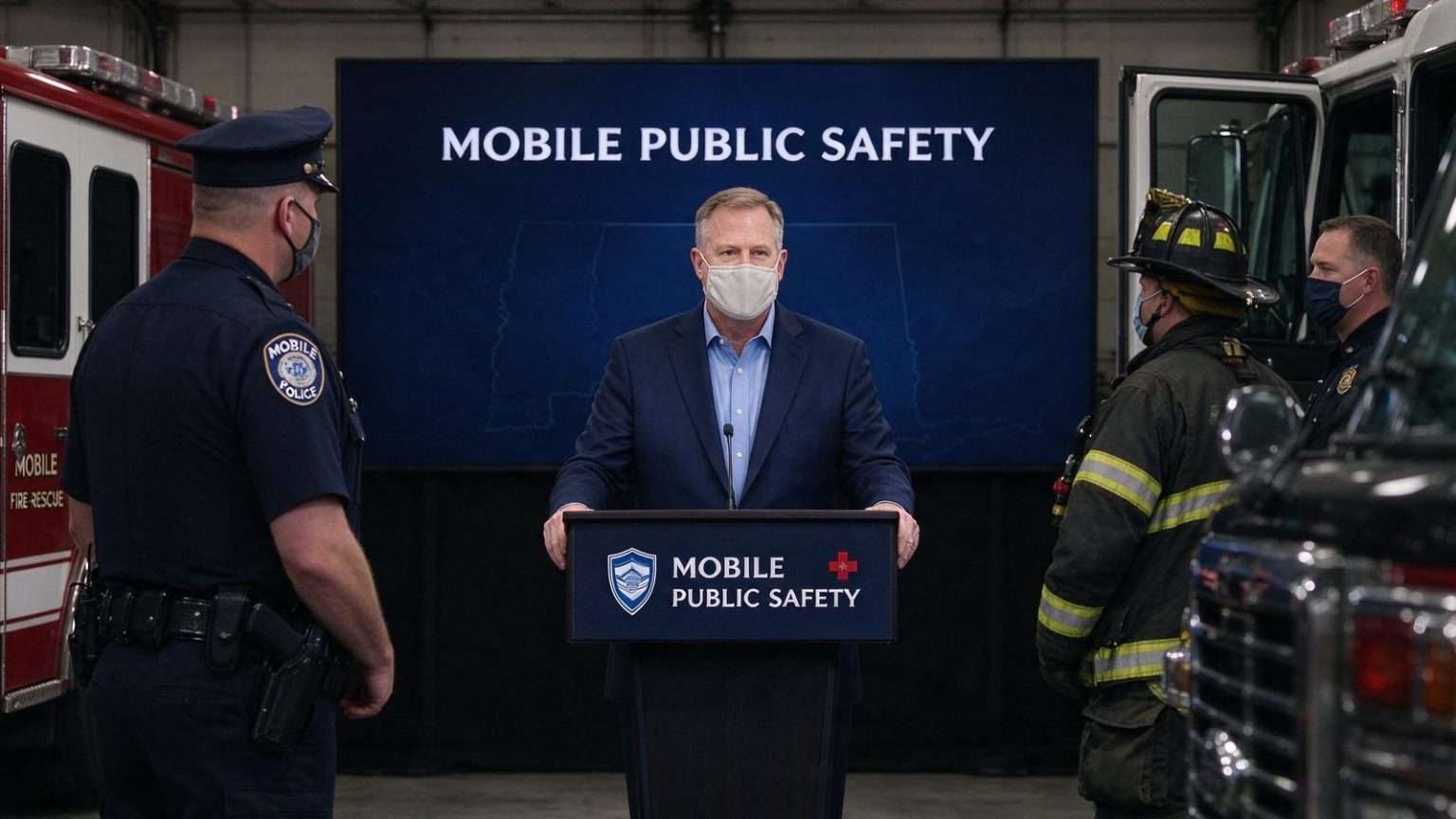
More than a dozen Mobile first responders have tested positive for COVID-19 antibodies, city officials confirmed during a Wednesday press briefing. Mobile’s Executive Director of Public Safety, James Barber, said nine police officers and seven firefighters returned positive results on a rapid serum blood test designed to detect whether a person’s immune system has begun fighting the virus.
The announcement put hard numbers on what the city’s police and fire departments had been bracing for since the pandemic reached Alabama: their personnel were being exposed, and some had already been infected without knowing it. With officers working alongside residents daily and firefighters entering homes and businesses on every alarm, the departments were among the city’s most exposed workforces from the first weeks of the outbreak.
Antibodies versus active infection
Unlike a nasal swab test, which identifies an active infection, the antibody test shows whether a person’s body has mounted, or already mounted, a defense against COVID-19.
The distinction matters for how the results are read. A positive antibody result means the immune system has encountered the virus at some point — recent or not — and developed proteins to fight it. It does not by itself prove the person is contagious today, and it does not prove immunity going forward. That is why city officials did not treat the sixteen positive antibody tests as a count of active cases, but instead as a signal that warranted immediate follow-up with the more definitive diagnostic test.
All 16 first responders are also being tested via nasal swab and have been placed on paid leave while results are confirmed, Barber said.
Only one of the 16 has shown symptoms, and those were described as mild.
That ratio — fifteen presumed well, one mildly ill — underscored the problem health officials had been warning about since the virus arrived: people can carry and spread COVID-19 without ever feeling sick. The paid-leave policy for all sixteen was a precautionary measure, keeping them out of stations and patrol rotations until the swab results came back, and it reflected the city’s effort to stop a cluster from forming inside departments whose members work in close quarters, share vehicles and respond side by side.
Neither Barber nor Mobile Mayor Sandy Stimpson had been tested for the virus as of the briefing.
Why asymptomatic spread shapes the response
Health officials say asymptomatic spread remains one of the most difficult aspects of controlling the pandemic. Dr. Brian Sumrall of Pulmonary Associates told reporters that an estimated 25 to 50 percent of infected patients show no symptoms at all, yet can still transmit the virus to others, underscoring the importance of continued social distancing and hand hygiene.
“The city seems to be doing a great job with social distancing,” Sumrall said. “We need to keep this up. Everyone needs to keep it up.”
The range Sumrall described — a quarter to a half of infections producing no symptoms — is what made antibody screening so valuable to the city. Standard case counts, built on tests of people who feel sick or had known exposure, systematically miss the silent carriers. When sixteen first responders test positive for antibodies, most of them having felt nothing, it demonstrates exactly how far the virus can move through a workforce undetected — and why distancing measures must continue even where no cases have been reported.
For the departments, the finding also reframed their internal risk. A firefighter or officer who believes they have never been exposed may have been, and the disciplines that protect them — distancing in stations, sanitizing apparatus and vehicles, masks on calls where patients show symptoms — are protective precisely because exposure cannot be assumed absent.
Stimpson’s store order, and his walk-through
Mayor Stimpson used the briefing to clarify his executive order limiting the number of shoppers allowed inside grocery stores and big-box retailers at one time. After personally visiting a Lowe’s, a Home Depot and a Walmart in west Mobile, Stimpson said he was encouraged by what he saw.
“I was surprised at what I saw,” he said. “Everybody in there had between 6 and 8 feet between them.”
Stimpson said a Home Depot manager told him the store “endorses and embraces” the order, which caps store occupancy at 40 percent of a building’s fire capacity.
The 40 percent cap is an intentionally blunt instrument. Fire capacity — the maximum occupancy printed on every public building’s posted certificate — gives stores and inspectors a fixed, pre-computed denominator, so compliance can be measured with a counter at the door rather than by estimating square footage aisle by aisle. Big-box stores, with tens of thousands of square feet, can hold large numbers of shoppers even at 40 percent, which is why the mayor emphasized that the order’s purpose is spacing, not scarcity: shelves stayed stocked and checkout lines kept moving during his visits.
The mayor’s visits were also a form of enforcement by presence. Retailers adjusting to occupancy limits in the first days of an order face practical puzzles — where to station door counters, how to mark six-foot distances in checkout queues, how to manage curbside pickup volumes — and a walk-through by the mayor, with cameras and reporters in tow, signals both that the rule is being watched and that businesses meeting it will be recognized publicly for it.
How the pieces fit together
Together, the briefing’s two subjects mapped the city’s strategy at the front end of the pandemic: keep the virus from moving through the workforce that cannot work from home, and keep the retail environments residents cannot avoid as uncrowded as possible. The antibody findings showed that distancing was not failing — but that it was the only barrier between the virus and the rest of the departments’ rosters. The store order addressed the other major unavoidable gathering point, the weekly errand run.
Both measures also reflected the same arithmetic Sumrall had described. With a quarter to half of infections silent, the city could not rely on symptom reporting to find cases, so it layered protections that work regardless of who is carrying the virus: spacing in stores, leave policies for exposed responders, swab confirmation for antibody positives, and masks and hygiene on every call.
The store order itself drew attention from other cities, because it solved the occupancy problem with a number any business could apply without new calculations. Retailers posted their fire capacity, multiplied by 40 percent, and managed the door from there — a formula that made enforcement conversations with inspectors straightforward and gave shoppers a visible, explainable limit. Orders in neighboring jurisdictions took similar shapes in the weeks that followed.
Inside the departments’ adjustments
Police and fire operations changed quickly once the virus arrived in Alabama. Patrol rotations were spaced to reduce shared vehicles, station common areas were reorganized, and calls flagged as potential COVID exposures brought extra protective gear. Dispatchers began screening callers for symptoms so responders knew what they were walking into before they arrived. The antibody screening added another layer, giving department leadership a way to find infections that symptom-based reporting would never surface.
Public safety agencies elsewhere in Alabama and across the country adopted similar screening programs as rapid antibody tests became available in the spring, and the results varied widely — some departments found little exposure, others found significant undetected spread. Mobile’s sixteen positives placed the city in the middle of that spectrum: real exposure, contained so far, and documented carefully enough to guide decisions about staffing and leave.
What the numbers mean going forward
The sixteen antibody positives gave Mobile its first real measure of undetected spread among first responders, and the city’s next steps depended on the swab results and on tracing where the exposures occurred. Officers and firefighters return to duty only when cleared, and the departments’ exposure protocols — isolation on symptom onset, testing after known contact, protective equipment on high-risk calls — continue to operate alongside the antibody screening.
City officials framed the episode as confirmation rather than alarm: the virus was present in the workforce, the containment steps were catching it, and the behaviors that matter — distancing, hygiene, spacing in stores — were visibly holding. The briefing’s message to residents was the one Sumrall delivered in his own words: the measures were working, and everyone needed to keep them up.
For the wider community, the episode served as a reminder of how the pandemic was actually being measured. Confirmed cases lag the virus; antibody tests reveal where it has already been; and the behavior of residents in stores, stations and streets in the meantime determines how far it goes next. Mobile’s approach — screening its most exposed workers, spacing its retail floors, and communicating results publicly — became a template other Alabama cities watched as they wrote their own orders in the same weeks.