
22-Year-Old Driver Killed in Rollover Crash on I-65 in Mobile Identified
Mobile police identified 22-year-old Bailey Robinson as the driver killed when her vehicle rolled over multiple times on I-65 near Government Boulevard.
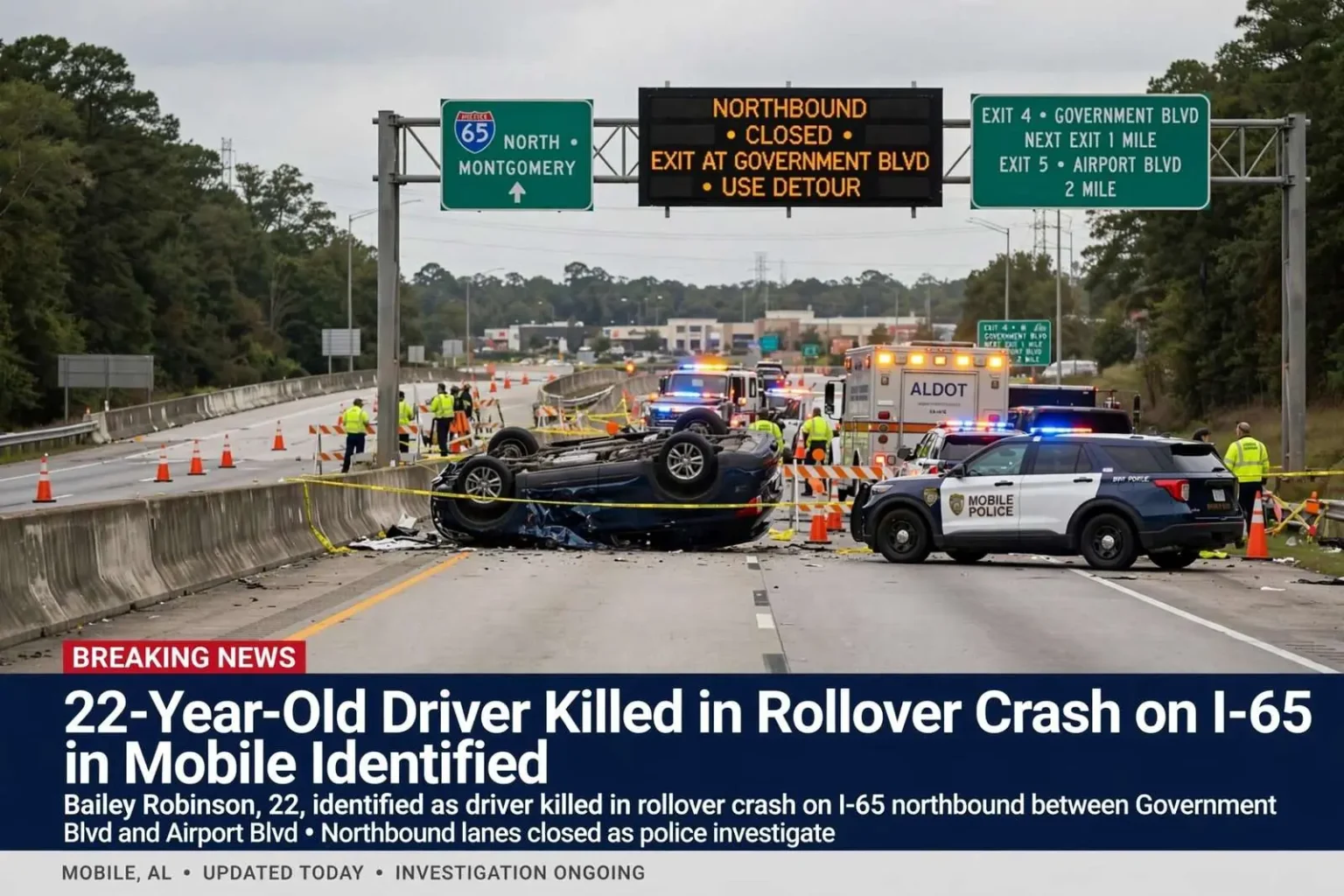
Mobile police identified 22-year-old Bailey Robinson as the driver killed in a rollover crash on Interstate 65 in Mobile. The crash happened on I-65 northbound between Government Boulevard and Airport Boulevard, closing that stretch of the interstate as first responders worked the scene. Northbound traffic was diverted off the interstate at the Government Boulevard exit while crews cleared the overturned vehicle. According to police, Robinson lost control of her vehicle and swerved, causing it to roll over several times. She was thrown from the vehicle and died from her injuries. No one else was hurt.
The crash brought a sudden halt to one of the busiest stretches of highway in south Alabama. Interstate 65 serves as the primary north-south artery through Mobile, carrying commuters between downtown and the western suburbs, freight traffic bound for Montgomery and beyond, and vacationers headed toward the beaches of the Gulf Coast. When a serious crash closes the roadway between interchanges as heavily used as Government Boulevard and Airport Boulevard, the effects ripple for miles, with drivers crowding parallel routes through west Mobile while investigators and recovery crews do their work.
Police said the sequence began when Robinson lost control of her vehicle. The swerve set the vehicle into a rollover, and it turned over several times before coming to rest. Rollover crashes are among the most violent events on the highway, because the rotation of the vehicle exposes every side of the passenger compartment to impact and creates violent motion inside the cabin. In this crash, the violence ended with Robinson being thrown from the vehicle, an outcome that dramatically reduces the chance of survival because the occupant no longer has the structure of the car between them and the pavement.
Emergency crews who arrived at the scene found a closed highway and an overturned vehicle, and their first priorities were securing the roadway, checking for additional victims and beginning the work of documenting what happened. Robinson was pronounced dead from her injuries. Police confirmed that no one else was hurt, meaning no other vehicles were directly involved and no passengers in Robinson’s vehicle suffered injuries in the wreck.
How the closure unfolded
The location of the crash, on I-65 northbound between Government Boulevard and Airport Boulevard, sits in one of the most traffic-dense corridors in Mobile County. Government Boulevard, also signed as Government Street, feeds traffic from midtown Mobile toward the interstate, while Airport Boulevard runs east-west through a long stretch of the city and carries thousands of drivers toward the interchange each day. With the northbound lanes blocked between the two, officers diverted traffic off the interstate at the Government Boulevard exit, pushing drivers onto the surface street network to find their way around the closure.
Diverting interstate traffic onto city streets is a familiar drill for Mobile police and the Alabama Department of Transportation, but it is never a small undertaking. Drivers who had been traveling at highway speed funneled into neighborhoods and commercial corridors, and the resulting congestion stretched through midday hours as the overturned vehicle was investigated and removed. Troopers and city officers worked the detour points while the crash scene itself remained shut down.
Rollover crashes like this one are a persistent concern for highway safety officials across Alabama. Higher-profile vehicles are more susceptible to rolling over when a driver swerves sharply, but any car can roll when it leaves the roadway or changes direction violently at speed. Safety agencies have spent decades urging drivers to remain calm during a loss of control, easing off the accelerator instead of yanking the wheel, because abrupt steering inputs at speed are precisely what converts a slide into a rollover.
The ejection of an occupant during a rollover remains one of the most dangerous outcomes a crash can produce. Restraint systems are designed to keep occupants inside the protective shell of the vehicle through a roll, and safety campaigns across the Gulf South have hammered the point for years. When a driver is thrown from a vehicle, the injuries come not just from the crash itself but from the impact with the roadway and the vehicle’s own path during the roll.
Investigating the wreck
The stretch of I-65 where the crash occurred has long been a focal point for regional traffic planning. The interstate threads between established Mobile neighborhoods as it runs south toward the Bankhead Tunnel and the George Wallace Tunnel approaches, and its interchanges with Government Boulevard and Airport Boulevard rank among the busiest in the city. Any collision there draws a large emergency response simply because of the volume of traffic passing through, and a fatal crash forces the additional weight of a prolonged scene investigation.
For drivers who travel the corridor daily, the crash is a reminder of how quickly routine trips can turn fatal. The northbound run between the airport area and downtown is one many residents make every day, often at pace, in traffic that leaves little room for error. A single swerve, whether caused by a blown tire, a moment of distraction, an evasive move around another vehicle or a mechanical failure, can set off a chain of motion that ends in catastrophe within seconds.
The toll on the community
The death of a 22-year-old driver leaves a family and a circle of friends confronting a loss that arrived without warning. Robinson was identified publicly only after authorities completed the steps required before releasing a name, and the confirmation that no one else was hurt offered small comfort in a crash that took a young life on a highway thousands of residents use every week.
Deaths on Mobile-area highways occur with grim regularity, and each one becomes part of the local conversation about roadway safety. Interstate 65 in particular has been the scene of numerous serious crashes over the years, spanning everything from multi-vehicle pileups in fog to single-vehicle run-offs and rollovers like this one. Safety engineers continue to study the corridor, but the fundamental variables remain the ones no roadway design can fully control: speed, attention, vehicle condition and the split-second decisions drivers make when something goes wrong.
First responders who worked the scene included the officers who diverted traffic, the crews who secured and removed the overturned vehicle, and the personnel who tended to the investigation of a fatal ejection. Their work allowed the interstate to reopen and the city to resume its rhythm, but it came after a morning in which a family learned it had lost one of its own on a stretch of highway between two of Mobile’s busiest interchanges.
Authorities did not release additional details about what caused Robinson to lose control, and the investigation remains the avenue through which those answers will come. Drivers with information about the crash can provide it to Mobile police, and investigators typically welcome dashcam footage or eyewitness accounts from other motorists who were on the interstate when the vehicle began to swerve.
What drivers can take from it
Safety advocates in Alabama use crashes like this one to reinforce a handful of simple habits. Keeping tires inflated and in good condition reduces the chance of a sudden loss of control. Slowing down when traffic, weather or road surface gives any reason for concern buys the reaction time that highway speeds take away. Wearing a seat belt every trip keeps occupants inside the vehicle’s protective structure through a roll. And staying off the phone keeps a driver’s attention where it needs to be when the car ahead brakes or a tire gives way.
None of those habits removes risk entirely, and the investigation into this crash will determine which of them, if any, would have changed the outcome. What they offer is a margin, and on a highway like I-65 through Mobile, margins matter. The interstate will carry its usual volume again, as it always does after a closure, and the drivers on it will be carrying the same mix of hurry and habit that fills it every day. Robinson’s death stands as the latest proof of how quickly that routine can break.
Funeral arrangements and family statements were not part of the initial police release, which stuck to the factual outline of the crash: a 22-year-old driver, a loss of control, a rollover, an ejection and a death, on northbound I-65 between Government Boulevard and Airport Boulevard, with traffic diverted while the highway was cleared and no one else hurt.
Mobile police identified Robinson as the driver after notifying family, and investigators will continue working to establish why the vehicle went out of control. Crash reconstruction in a rollover case typically involves examining the vehicle’s final rest position, the pattern of debris along the highway, the damage to the car itself, and any evidence of braking or steering input in the moments before the swerve. Roadway conditions, vehicle condition and speed all factor into the final picture.
Investigators treat every fatal rollover as a puzzle assembled from physical evidence, and the work that began on the interstate will continue well after the lanes reopened. Findings in such cases typically take time, and police have not indicated whether any charges, citations or outside vehicles factor into the final report. What is already known is the outline: a young driver, a violent loss of control, and a highway closure that reminded Mobile how fragile the daily commute can be.


