
$5 Million Gift Boosts ‘Transformative’ Expansion of USA’s Trauma Center in Mobile
Herbert Meisler's $5 million donation will expand the University of South Alabama trauma center in Mobile and rename it for his late wife.
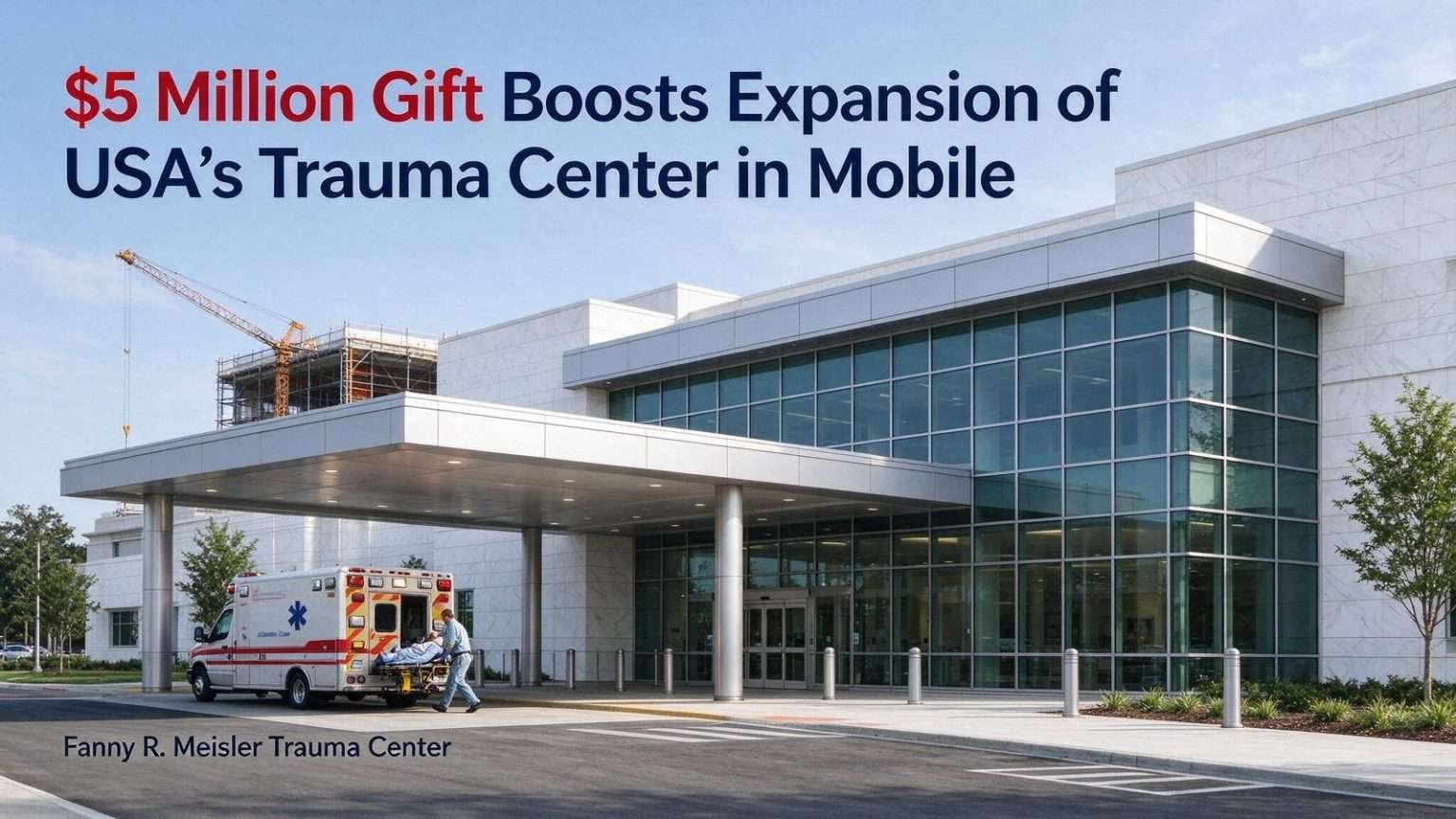
A $5 million gift from a longtime University of South Alabama supporter will help more than double the size of Mobile’s USA trauma center, one of only three state-certified trauma facilities in Alabama. The USA board of trustees recognized donor Herbert Meisler for the contribution, which will be applied to an estimated $9 million to $12 million expansion, and the facility will also take a new name: the Fanny R. Meisler Trauma Center, honoring Meisler’s late wife, who died in May 2016.
The announcement ties one of the Gulf Coast’s most consequential health care projects to a family name long associated with philanthropy in the Mobile area. Hospital officials describe the gift as a decisive step toward a facility that can meet the trauma needs of a region stretching from the Mississippi line to the Florida border, where seriously injured patients currently depend on a single certified center for the highest level of care.
A Larger Front Door for the Hospital
Hospital officials are in design and planning stages to grow the trauma center from 11,000 to 27,000 square feet and convert 22 private and semi-private exam rooms into 41 private exam beds. Administrator Sam Dean said construction could begin by year’s end, with architects working on plans that combine renovation of the existing center with a major addition at the front of the hospital campus.
“There will be a slight renovation, but a majority of the facility will be new — it will be the new front entrance of our hospital,” Dean said. “We are beyond excited.” The framing matters for how the project will be experienced by patients and families: rather than routing trauma patients to an auxiliary entrance, the expanded center will occupy the most visible spot on the campus, signaling its role as the hospital’s gateway for the region’s most urgent cases.
The announcement came roughly seven months after Gov. Kay Ivey visited USA Medical Center to announce a $4 million grant toward expanding the facility. Together, the state grant and the Meisler gift account for a substantial share of the projected $9 million to $12 million cost, though officials continue to work on funding the remainder as design work advances toward construction drawings.
Why Trauma Capacity Matters on the Gulf Coast
Trauma centers are organized around a simple reality: survival after a car crash, a gunshot wound, a fall from height or a severe industrial accident often depends on reaching definitive surgical care within what clinicians call the golden hour. Alabama certifies only a handful of trauma facilities statewide, and USA’s center serves as the destination for helicopter and ambulance transfers from a broad swath of south Alabama and the central Gulf Coast — patients who would otherwise face long drives to Birmingham or Pensacola.
The demand on the facility reflects the region’s geography and economy. Interstate 10 and Interstate 65 converge in Mobile, producing a steady volume of highway trauma; the Port of Mobile and the area’s shipbuilding, chemical and heavy-industry employers add occupational injuries to the mix; and the Gulf Coast’s tourism economy brings seasonal populations to the beaches, where drownings, vehicle crashes and recreational accidents feed the trauma system during the busy months. A center operating near capacity has limited room to absorb those surges, which is what the expansion is designed to fix.
Cutting Wait Times — and Ending Diversion
Dean called the project “transformative” for the region, saying it should cut wait times and potentially eliminate “diversion” — the practice of routing patients elsewhere when a hospital is full. “Our goal is never to be on diversion,” he said. When a trauma center goes on diversion, ambulances carrying the most critically injured patients may be directed to facilities farther away, adding minutes that clinicians say can make the difference between recovery and permanent disability, or between life and death.
Going from 22 exam rooms to 41 private beds directly addresses the crowding that drives diversion. Private rooms also matter for infection control, for the families who keep vigil during long trauma admissions, and for the staff who need space to work efficiently on complex injuries. Hospital planners describe the expanded footprint as allowing the center to treat more patients simultaneously without compromising the intensive staffing ratios that trauma certification requires.
The Educational Payoff
The project carries an educational component as well: the gift will help USA medical students complete emergency room residencies in-state, addressing what Dean described as a shortage of board-certified emergency physicians across Alabama. Residency training depends on patient volume and case variety, and a larger trauma service gives the university’s emergency medicine program a stronger platform to train physicians who, studies consistently show, are likely to practice near where they train.
Dr. John Marymont, vice president for medical affairs and dean of USA’s College of Medicine, noted the center is also an economic driver, since large industrial companies weigh trauma care capacity when deciding where to locate. For economic recruiters across south Alabama, the ability to tell a prospective employer that a state-certified trauma center — and the physician training pipeline behind it — is expanding locally is part of the pitch that accompanies land, ports and workforce.
Part of Alabama’s Trauma Network
Mobile joins Birmingham and Huntsville as the three Alabama cities with state-certified trauma facilities, a distribution that leaves the southern half of the state dependent on the USA center for everything from multi-vehicle interstate crashes to traumatic injuries at the port and along the beaches. The Alabama Department of Public Health coordinates the state’s trauma system, matching injured patients to the nearest appropriate facility, and the system’s effectiveness depends on certified centers maintaining the capacity to accept patients when called.
That role is why hospital leaders and state officials have framed the expansion as a regional project rather than a campus amenity. Every helicopter transfer that lands in Mobile represents a patient whose local hospital could not provide definitive trauma care, and each expansion of capacity shortens the chain of transfers that stands between an injured person and surgery. For rural hospitals across southwest Alabama, a larger USA trauma center means faster acceptance of the patients they cannot treat and less strain on their own emergency departments.
The Meisler Name and a Family Legacy
The new name — the Fanny R. Meisler Trauma Center — honors Herbert Meisler’s late wife, who died in May 2016, and continues a family connection to the university that spans years of support. Naming a hospital’s front door for a family member is among the most visible forms of philanthropy in health care, and in this case hospital officials said the designation recognizes a contribution that may prove decisive for whether the project reaches its full scope on the planned timeline.
Philanthropy has increasingly become the bridge between public funding and the full cost of major medical construction, and the USA project illustrates the pattern: a $4 million state grant announced by Gov. Ivey, a $5 million private gift from the Meisler family, and continuing institutional commitment converging on a facility whose total cost is estimated at $9 million to $12 million. Hospital officials said additional fundraising will accompany the project as it moves through design.
What Happens Next
With the gift announced and the board’s recognition complete, attention turns to the construction schedule Dean outlined — the possibility of breaking ground by year’s end, with architects finalizing plans that blend renovation of the existing 11,000-square-foot center into a 27,000-square-foot facility. Hospital administrators say the project will proceed in phases designed to keep the trauma service fully operational throughout construction, a logistical challenge familiar to any hospital that rebuilds its emergency infrastructure while the ambulances keep arriving.
When the work is finished, the region will have a trauma center more than twice its current size, a training program better positioned to keep emergency physicians in Alabama, and a front entrance that reflects the facility’s role as the Gulf Coast’s destination for the most serious injuries. For the tens of thousands of residents who live within the center’s service area — from the Mississippi line to the beaches of Baldwin County — the expansion represents the largest single improvement to trauma care capacity the region has seen in a generation.
How the Expansion Will Unfold
Hospital planners describe a project sequence that begins with the addition at the front of the campus, allowing the new exam beds and support space to come online before the older rooms are taken out of service for renovation. Sequencing the work this way keeps the center from losing capacity during construction, which is essential for a facility that cannot close its doors to the region’s emergencies while the walls come down. Architects are completing the plans that will pair the new construction with the “slight renovation” Dean described, and the hospital expects to move to bid and permitting once those drawings are finalized.
The timeline Dean offered — construction beginning by year’s end — puts completion of the major phases into the following couple of years, depending on weather, supply chains and the hospital’s ability to maintain operations throughout. Administrators say the board’s recognition of Meisler’s gift reflected both its size and its timing, since commitments early in a project’s design phase allow planners to size the addition for the full scope rather than trimming it to fit uncertain funding.
What It Means for Local Residents
For the people of Mobile, Baldwin County and the surrounding counties, the expansion translates into a few concrete differences. Ambulance and helicopter patients will reach definitive care faster when the center is not at capacity; families will find more private space during the long hours and days that follow a serious injury; and the hospital’s emergency system will be better positioned to absorb the seasonal surges that come with Gulf Coast tourism, severe weather and the region’s heavy traffic corridors. Residents of rural communities across south Alabama stand to benefit most, since their hospitals depend on USA’s willingness and ability to accept transfers around the clock.
The project also lands at a moment of sustained growth in the region’s health care needs, as Baldwin County’s population boom and Mobile’s industrial expansion add patients to the system each year. Hospital leaders have framed the trauma center expansion as catching the region’s emergency infrastructure up to the population it already serves — and positioning it for the growth still to come.


