$5,000 Reward Offered in 2023 Wilcox County Homicide
The Wilcox County Sheriff's Office is offering a $5,000 reward for information leading to an arrest in the January 2023 murder of Charles "Little Buddy" Beverley.
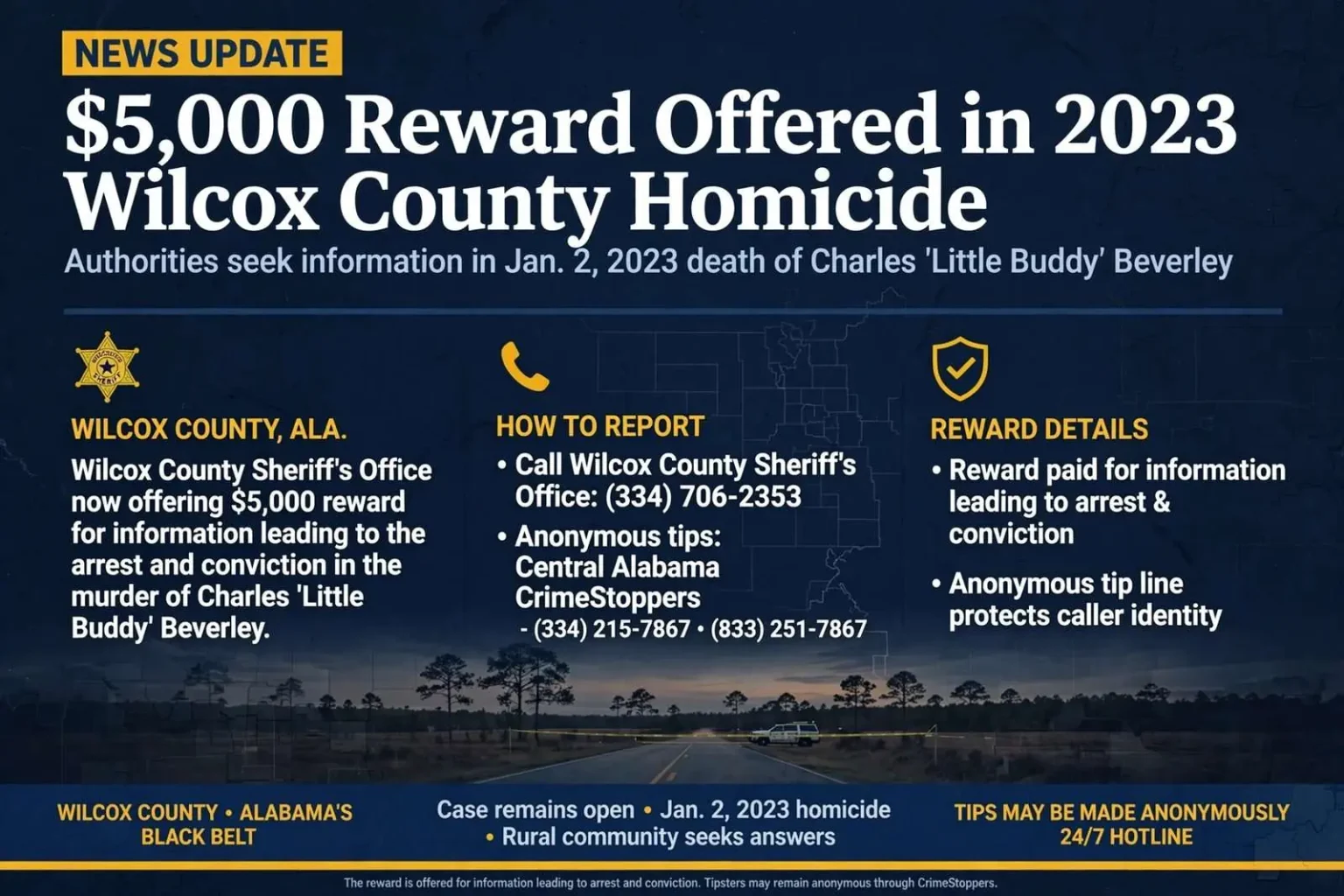
WILCOX COUNTY, Ala. — A $5,000 reward is being offered for information leading to the arrest and conviction of the person or persons responsible for the murder of Charles “Little Buddy” Beverley on Jan. 2, 2023, according to the Wilcox County Sheriff’s Office. The reward announcement put a public price on answers in a case that has left a family grieving and a rural community searching for closure, and investigators are hoping that someone who has held their tongue will come forward now that money and anonymity are both on the table.
Anyone with information in the case is asked to call the Wilcox County Sheriff’s Office at (334) 706-2353. Those who wish to remain anonymous can contact Central Alabama CrimeStoppers at (334) 215-7867 or (833) 251-7867. The dual channels — one direct to investigators, one anonymous through the CrimeStoppers tip line — reflect the standard structure of reward cases across the region, giving tipsters a choice between speaking with deputies directly and passing information along with no name attached.
Wilcox County sits in Alabama’s Black Belt, a swath of south-central Alabama named for its rich, dark soil and known for its small towns, deep history, and enormous rural landscapes. The county seat, Camden, lies along the Alabama River, and the county as a whole is home to only about ten thousand people spread across hundreds of square miles. In communities of that size, a homicide is not a passing headline — it is a wound to a community where nearly everyone knows everyone, and where a case that goes unsolved casts a long shadow over the families left behind and the neighbors who must live with what they know.
How reward announcements work
Reward offers like the one in the Beverley case serve a specific investigative purpose. Detectives in small, rural agencies often have limited staff and resources to dedicate to a homicide investigation, and the passage of time makes witnesses harder to find and less willing to talk. A cash reward, widely publicized, can reach people the investigators would never think to contact — someone who overheard a conversation, saw a vehicle at an odd hour, or has been carrying a secret since the day of the crime. The promise of $5,000 converts that knowledge into action for people who might otherwise stay silent, whether out of fear, loyalty, or indifference.
The terms matter. The reward in this case is tied to an arrest and conviction, not merely to an arrest, which means the information must prove substantial enough to carry a case through prosecution. That standard protects the integrity of the process — and it also signals to tipsters that investigators are serious about building a case that will hold up in court, not just make a quick arrest that falls apart later.
Anonymity is the other half of the equation. In rural communities, fear of retaliation and social pressure rank among the biggest obstacles to solving violent crimes. Central Alabama CrimeStoppers, which operates the regional tip line, addresses that fear by serving as the buffer: tipsters contact CrimeStoppers, provide what they know, and receive tip numbers instead of leaving names. If a tip proves fruitful, the reward is paid through the program without the tipster’s identity ever being revealed to investigators, prosecutors, or the public.
The work of solving a rural homicide
Solving a murder in a county the size of Wilcox depends heavily on the cooperation of the public. Rural homicide scenes often lack the surveillance cameras, witnesses on every corner, and quick forensic turnaround available in cities, so investigators lean on canvassing — going door to door, interviewing people, asking the same questions in different ways until the picture fills in. Time is the enemy in that work. Memories fade, physical evidence degrades, and people’s willingness to revisit painful events diminishes with each passing month.
The sheriff’s office has not closed the door on the case, and the reward announcement is the clearest signal of that continued commitment. Homicide investigations in Alabama remain open indefinitely until they are solved, and cold cases across the Black Belt have been cracked years — sometimes decades — after the crime, when a witness finally decided to speak, new forensic techniques became available, or a person with knowledge ran out of reasons to stay quiet.
For the family of Charles “Little Buddy” Beverley, the reward announcement is both an acknowledgment of their loss and a plea to the community on their behalf. Families of homicide victims in small counties often become the most persistent advocates for their own cases, keeping the victim’s name in circulation, attending court dates in other cases to stay visible, and pressing officials not to let the file go dormant. The $5,000 offer gives their advocacy a concrete instrument: a number, a phone line, and a promise of anonymity for anyone ready to help.
Anyone with information about the Jan. 2, 2023 murder of Charles “Little Buddy” Beverley can call the Wilcox County Sheriff’s Office at (334) 706-2353, or reach Central Alabama CrimeStoppers anonymously at (334) 215-7867 or (833) 251-7867. In cases like this one, authorities say, a single phone call can be the thread that unravels the whole story — and it can come from the one person no investigator ever thought to ask.
CrimeStoppers programs operate on a simple premise that has proven itself across thousands of cases: some people will never talk to a police officer, but they will pick up the phone and talk to an anonymous tip line. The Central Alabama program serves a multi-county region and coordinates with local agencies on cases ranging from homicides to fugitive warrants to property crimes. Tips can arrive around the clock, and the program’s coordinators pass information to the investigating agency while keeping the tipster’s identity sealed — even from the officers working the case.
Tipsters who provide information that leads to a payout submit their tip number to claim rewards through a code-based process that requires no name, no address, and no courtroom appearance. Payments are typically arranged in ways that preserve anonymity, allowing the tipster to collect without ever being seen. The design has one purpose: to remove every practical excuse for staying silent except the tipster’s own conscience.
Why rural cases need the public
Wilcox County’s sheriff’s office operates with the resources typical of Alabama’s smallest counties — a modest force, a limited budget, and a jurisdiction that sprawls across rural roads and river communities where help may be many minutes away. Deputies there handle everything from routine patrol to major felonies, and a homicide investigation absorbs an enormous share of the agency’s attention. Publicizing a reward multiplies the agency’s reach: every radio report, social media post, and news story about the $5,000 offer is another set of eyes and ears pointed at the case.
The Black Belt’s demographics make that public engagement especially critical. The region’s population is dispersed, many residents live far from neighbors, and crime that occurs on a lonely county road at night may have no witness at all except the person in the passing car. Investigators in rural counties often say the difference between a solved case and a cold one is usually not forensic science but a human being who decides to talk.
Reward programs also carry an implicit message to anyone who might be holding back out of fear. The anonymity of the tip line means a person can pass along what they know without walking into the sheriff’s office and being seen by the whole community, and without their name ever appearing in a case file that could become public. For witnesses who fear retaliation — a real concern in violent-crime cases — that buffer can make the difference between silence and a call.
The community’s stake
An unsolved homicide exacts a toll on a community beyond the family’s grief. Unpunished violence breeds fear, and fear in small communities curdles into suspicion and silence. Residents in counties across the Black Belt have watched cases go unsolved for years, and the experience teaches a corrosive lesson that crime can be committed without consequence. Breaking that cycle requires exactly what the Wilcox County Sheriff’s Office is now asking for: information, tips, and the community’s willingness to stand with investigators and the victim’s family.
The Beverley case’s reward announcement joins a long tradition of such appeals across south Alabama, where agencies have used reward money and tip lines to crack cases that seemed frozen. When those efforts succeed, the result ripples outward — a family gets answers, a community gets relief, and the next witness in the next case sees that speaking up actually works.
Until that call comes, the file on the Jan. 2, 2023 murder of Charles “Little Buddy” Beverley remains open, the reward remains on the table, and the phone lines remain staffed. The sheriff’s office at (334) 706-2353 and Central Alabama CrimeStoppers at (334) 215-7867 or (833) 251-7867 stand ready — and somewhere in Wilcox County, or beyond it, is the person who knows what happened, waiting to decide.