
80-Plus Acres Charred as Mobile County Brush Fire Smolders Near Homes
A Mobile County brush fire near Hillcrest, Nevius and Three Notch roads burned an estimated 80-90 acres before firefighters contained it.
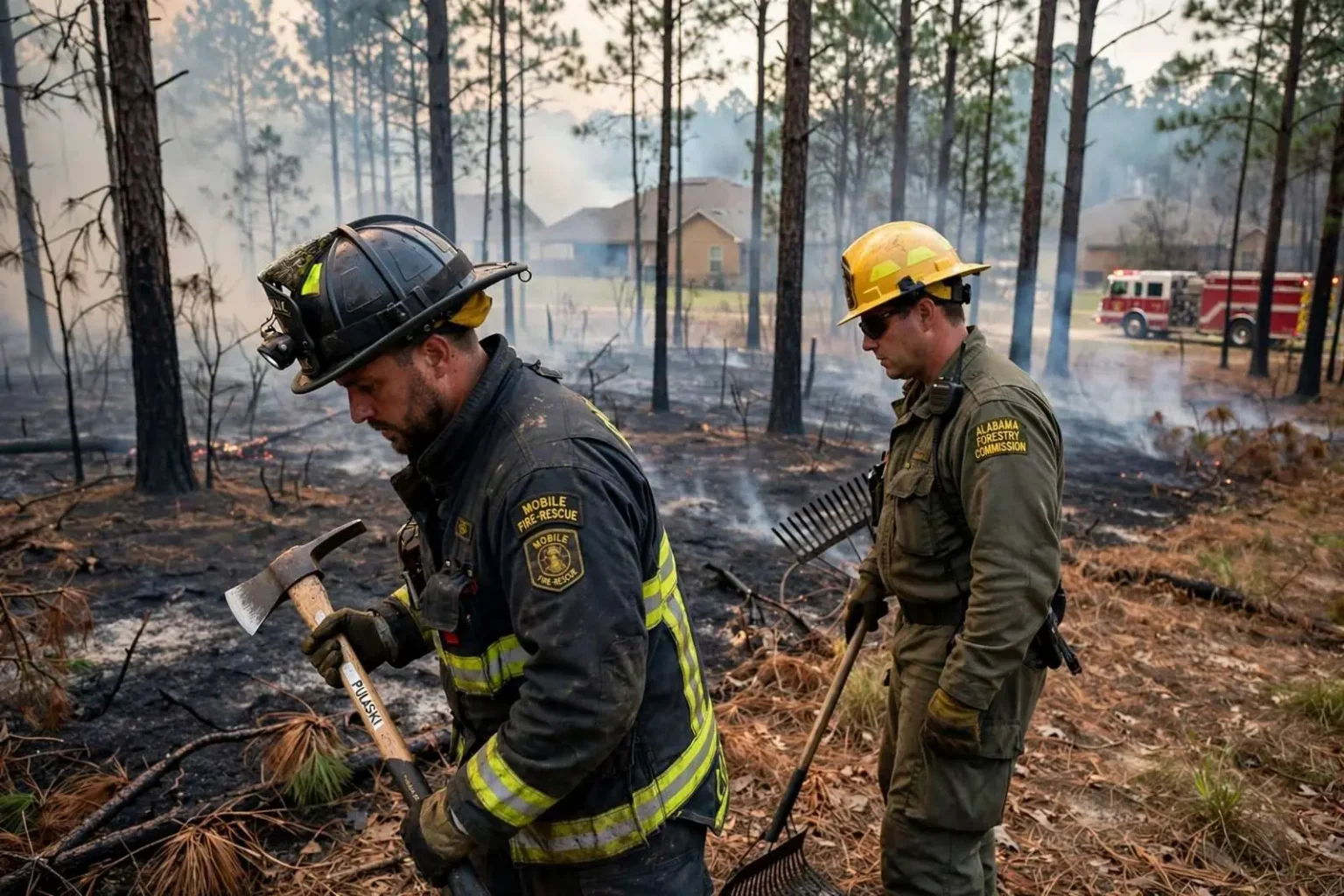
Firefighters spent two days battling a woods fire in west Mobile County that scorched an estimated 80 to 90 acres and crept within 200 yards of the nearest home, a close call that tested the coordination between city and state fire agencies in one of the county’s most fire-prone rural corridors.
The fire ignited around 2 p.m. Thursday, April 7, in wooded terrain near the junction of Hillcrest, Nevius and Three Notch roads, an area where residential lots intermix with pine stands and undeveloped acreage. Crews from Mobile Fire-Rescue and the Alabama Forestry Commission responded and contained most of the blaze by that evening, but hotspots continued smoldering into Friday, forcing firefighters to remain on the scene well after the main flame front had been knocked down.
By Friday morning, Alabama Forestry officials estimated another 20 acres had burned, pushing the total to between 80 and 90 acres. The overnight growth was a reminder of how brush fires behave in the Gulf Coast landscape, where dense undergrowth, dry surface fuels and afternoon breezes can push fire through terrain that is difficult to reach with engines.
Firefighters worked throughout the second day to keep flames from reaching the closest residence, roughly 200 yards from the fire line. No evacuations were ordered, according to Mobile Fire-Rescue, which announced updates on the department’s social media channels as the situation developed and residents monitored the smoke rising from the woods nearby.
How the fight unfolded
The response began Thursday afternoon when smoke reports came in from the area around the three-road junction. Initial crews arrived to find fire moving through the woods, and the size of the blaze quickly brought in additional resources, including the Alabama Forestry Commission, the state agency responsible for wildfire suppression on forested land outside municipal fire protection.
The two agencies work together on fires like this because each brings different capabilities. Mobile Fire-Rescue engines carry water and can protect structures at the wildland edge, while Forestry Commission units are equipped with the plows, dozers and trained crews needed to cut firebreaks through wooded terrain and reach fire that engines cannot approach.
Containment by Thursday evening did not end the operation. Brush fires in Southern woodlands routinely smolder in root systems, stump holes and deep litter beds long after visible flames disappear, and wind shifts can rekindle active fire from those hotspots. That is why crews remained on the scene Friday, monitoring the perimeter and mopping up hot areas before the fire could make another run.
The estimated growth of another 20 acres overnight reflected that smoldering behavior, as fire worked through interior areas that were not fully secured the first day. Officials revised the total burn estimate to 80 to 90 acres, a scale that places the blaze among the larger woods fires Mobile County sees in a typical spring.
A landscape built for brush fires
West Mobile County’s mix of subdivisions and woodland makes it recurrently vulnerable to fires like the April 7 blaze. Pine forests and mixed hardwood stands dominate the undeveloped land between neighborhoods, and pine timber burns readily, especially in dry stretches of the spring fire season when humidity drops and winds pick up.
The area near Hillcrest, Nevius and Three Notch roads sits in exactly that kind of transition zone, where homes back up to wooded parcels and fire can travel from the forest floor to a backyard fence line in minutes under the right conditions. The 200-yard gap between the fire and the nearest house was the margin crews fought to preserve, and keeping it required positioning engine companies along the wildland edge to knock down embers and flare-ups as they advanced.
Spring is the peak season for such fires across south Alabama. Winter dormancy leaves fields and forest floors loaded with dead vegetation, and spells of low humidity and gusty winds between frontal passages create conditions where any ignition source can start a fire that spreads quickly. Local fire departments and the Forestry Commission both issue cautions when conditions worsen, and burn restrictions follow when the danger gets high enough.
The warning to residents
Officials urged residents in wooded areas to remain cautious with any outdoor burning while crews finished mop-up work, a message aimed at preventing the next ignition while resources were still tied up on the current fire. Outdoor burning is a common practice in unincorporated Mobile County, where residents clear yards and burn debris, but it is also one of the leading causes of woods fires that escape and threaten homes.
The Alabama Forestry Commission requires permits for certain controlled burns and maintains burn ban authority during dangerous conditions, and the agency routinely reminds landowners that the person who lights a fire is responsible for what it does afterward. A debris pile fire lit on a calm morning can escape by afternoon when the wind shifts and humidity falls, exactly the kind of escalation that turns a yard cleanup into a multi-agency woods fire response.
For residents along the Hillcrest, Nevius and Three Notch corridor, the two-day operation provided a close look at how wildfire danger works at the suburban edge. Smoke drifted over surrounding neighborhoods, and many residents tracked the department’s updates online while fire crews cut lines and mopped up hotspots in the woods out of sight of the road.
Why coordination matters in wildland response
The blaze highlighted the working relationship between Mobile Fire-Rescue and the Alabama Forestry Commission, a partnership that gets regular exercise during spring fire season. The county’s size and its mixture of city jurisdiction, unincorporated land and forest mean a fire that starts in one jurisdiction rarely stays contained to it, and agencies practice coordinated response for that reason.
Forestry Commission tractor-plow units cut firebreaks around the perimeter, denying the fire new fuel, while fire department engines protected the developed edge and supplied water where possible. Aerial observers and forestry personnel track fire movement and direct crews on the ground, a common arrangement on fires that cover this much acreage.
Mop-up is the slow, unglamorous phase that determines whether a contained fire stays contained. Crews walk the fire line, extinguish smoldering material and check for heat deep in stump holes and root systems, work that continued into Friday after the overnight acreage growth. Only when the interior has cooled to the point that wind cannot restart the fire is the scene truly safe to leave.
No injuries were reported in the response, and no evacuations were necessary, outcomes that firefighters attribute to the quick initial attack and the structure protection measures taken along the wildland edge. The 80 to 90 acres that burned will recover, as Southern pine and hardwood stands routinely do after surface fires, but the episode left behind the same warning it started with: in west Mobile County’s woods, careful burning and early reporting are what keep the next fire from reaching someone’s back door.
What homeowners in the wildland edge should know
Fires like the April 7 blaze are the reason fire officials across south Alabama keep returning to the subject of defensible space. Homes that sit near woodland fare dramatically better when the immediate surroundings are maintained — grass kept short, brush cleared back, gutters cleaned of pine needles and firewood stored away from the house. Those measures give firefighters a workable zone at the structure edge, like the one crews held along the 200-yard line in west Mobile County.
Access matters as much as clearance. Fires in wooded terrain are fought from the roads and firebreaks that lead to them, and long driveways, locked gates and narrow lanes can slow the arrival of engines and plows. Rural residents along corridors like Hillcrest, Nevius and Three Notch roads are encouraged to keep entrances marked and passable so responding units are not delayed during the critical first minutes of a fire.
Early reporting is the other decisive factor. A smoke column spotted and reported quickly allows crews to attack a fire while it is still small, and Mobile County residents are urged to call 911 at the first sight of smoke in the woods rather than waiting to see whether the fire spreads. The Thursday afternoon reports that brought crews to the April 7 fire came quickly enough for a substantial initial response, but faster word still means smaller fires.
The Alabama Forestry Commission tracks fire activity across the state and publishes daily fire danger ratings that landowners and residents can check before lighting any outdoor fire. When the rating is elevated, the agency’s guidance is simple: postpone burning until conditions improve, because a fire escaped is a fire that may take two days and dozens of responders to bring back under control, as west Mobile County just saw firsthand.


