ALDOT Confirms Mobile River Bridge Tolls Will Rise Automatically Every Jan. 1, Reversing Years of Assurances
Bond documents show tolls on the new Mobile River bridge “shall be automatically adjusted annually on January 1 of each year,” reversing years of assurances they would not rise. ALDOT confirmed the plan changed.
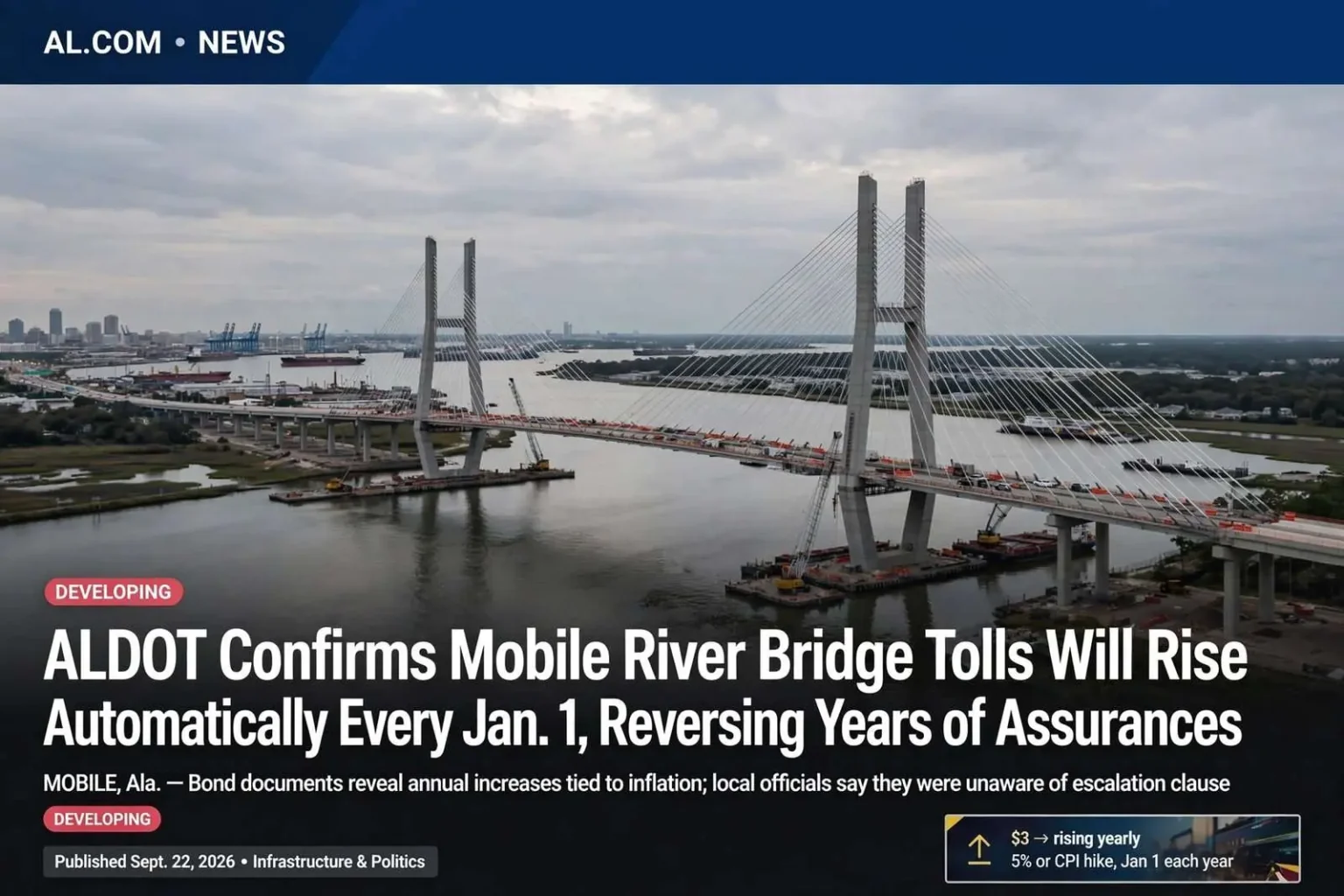
MOBILE, Ala. — Alabama transportation officials and local leaders have promised for years that tolls on a new bridge over the Mobile River would never rise.
Documents submitted in support of the sale of revenue bonds, though, lay out a schedule of automatic yearly increases. Tolls “shall be automatically adjusted annually on January 1 of each year,” those documents state.
Tony Harris, a spokesman for the Alabama Department of Transportation, confirmed that the tolling plan had changed. He said it is the only way the state can pay back the money it is borrowing for what will be the most expensive infrastructure project in the state’s history.
A Local Official Caught Off Guard
The provision took Eastern Shore Metropolitan Planning Organization Chairman Jack Burrell by surprise.
“I was not aware of any escalation clauses,” he said. “You know, maybe in their defense, that’s the only way they can make the numbers work. … I was a little disappointed to see those escalators — did not know they were gonna be in there. And I’ll just have to say we have to trust them to do, you know, ALDOT to do the best job they can for the citizens.”
Burrell chairs the metropolitan planning organization for the Eastern Shore — the body responsible for regional transportation planning on the Baldwin County side of the bay. That a chairman in that position learned of the escalation provision from bond documents rather than from the project’s sponsor is itself a substantive point about how the financing came together.
Why the Escalators Exist
Alabama this week finalized a complex agreement with the federal government for low-interest, federally backed loans providing $2.52 billion to the project. The state also closed on the sale of revenue bonds to private investors.
ALDOT officials said the federal loan will be held until close to the end of the five-year construction period and then used to pay off private borrowing — essentially swapping a higher interest rate for a lower one.
The bond market is where the escalation clause originates. Investors buying revenue bonds are lending against a future stream of toll income, and they price that risk based on whether the revenue can keep pace with cost over a repayment period measured in decades.
A toll fixed in nominal dollars loses purchasing power every year to inflation. Over a 30-year repayment horizon, a $3 toll that never changes is worth substantially less in real terms at the end than at the beginning, while the debt service obligation does not shrink. Bond purchasers price that gap, and the alternatives to an escalation clause are a higher initial toll, a higher interest rate, or both.
That is the mechanism behind Harris’s statement that it is the only way the state can repay what it is borrowing.
The Project
The $3.2 billion project includes construction of a six-lane cable-stayed bridge connecting Interstate 10 in Mobile to the Bayway. That span will be reconfigured to remove the shoulders and allow for three lanes of travel in both directions.
The History That Makes This Sensitive
A previous plan to build a bridge and new bayway in 2019 collapsed amid a revolt over tolls. When elected leaders in Mobile and Baldwin counties resurrected the idea in 2021, they set a framework for tolls at no more than $2.50.
That history is why the escalation question carries weight beyond its arithmetic. The 2019 collapse was not caused by the existence of tolls but by public reaction to their size and to the sense that the terms were settled without adequate public involvement. The 2021 framework’s toll cap was the commitment that made the project politically viable the second time.
The announced rates for the new financing put ALGO Pass holders at $3 per trip and drivers with interoperable transponders at $7.70. Drivers will not pay tolls until the bridge is complete, likely in 2031.
The causeway, Wallace Tunnel, Bankhead Tunnel and Africatown Bridge remain toll-free alternatives.
What Is Not Yet Known
The bond documents establish that an annual adjustment will occur each Jan. 1. The size of the annual adjustment, the index it is tied to and whether any ceiling applies are the details that determine what the toll actually costs a commuter in 2041 rather than 2031.
Residents who cross Mobile Bay daily have a direct interest in those specifics, and they are the natural subject of follow-up questions to ALDOT and to the Alabama Toll Road, Bridge and Tunnel Authority.
Update: Bond Documents Detail the Escalator and the Financing
Bond documents for the project spell out the formula: tolls will automatically increase every year for the first 10 years after tolling begins, by 5% or by the inflation rate for Southern urban consumers, whichever is higher. Transportation officials have said the increases are necessary to make the project’s numbers work.
According to the documents, the Alabama Toll Road, Bridge and Tunnel Authority issued nearly $3.8 billion in four bond and note series for the project, which is now budgeted at $4.15 billion. That total includes:
- $567 million in first-lien toll revenue bonds
- $2.5225 billion in short-term notes
- Nearly $696.3 million in third-lien bonds
In addition to Eastern Shore Metropolitan Planning Organization Chairman Jack Burrell, Mobile Mayor Spiro Cheriogotis and Mobile County Commissioner Connie Hudson also said they had been unaware of the planned increases, which were disclosed only in the documents prepared for the sale of revenue bonds.
“You know, maybe in their defense, that’s the only way they can make the numbers work,” Burrell said. “I was a little disappointed to see those escalators – did not know they were gonna be in there. And I’ll just have to say we have to trust them to do, you know, ALDOT to do the best job they can for the citizens.”
ALDOT has said the Causeway, the Wallace Tunnel and the Bankhead Tunnel will remain toll-free.
Update: ALDOT Answers Common Questions About Tolls, Rates and Costs (Sept. 22, 2026)
The Alabama Department of Transportation released a detailed explanation of the tolling plan on Monday, laying out the rates drivers will pay, how the annual adjustments work and why the agency says the increases are required. Below are the key points from that update.
Why is ALDOT defending the annual increases?
ALDOT says a project financed over several decades cannot be paid for on the assumption that toll rates stay frozen, because the cost of running a toll system and servicing long-term debt keeps rising over that same period.
“Simply put, a multibillion-dollar project financed over several decades could not realistically be financed on the assumption that toll revenues and toll rates would remain unchanged indefinitely,” the agency said in its update.
ALDOT also said “there was never a previous commitment that all toll rates would remain unchanged for the life of the facility,” and that freezing rates permanently would be “inconsistent with how the funding and financing markets operate.” The agency described annual adjustments as “a common practice for long-term toll project financing” and said the mechanism is part of the final financial structure supporting the project’s bonds and its federal TIFIA loan of up to $2.52 billion.
How will tolls be collected?
The bridge and Bayway will use all-electronic, free-flow tolling. There will be no toll booths, and drivers will not stop to pay. Tolls will be charged through ALGOpass accounts, compatible transponders from other toll systems, including E-ZPass-compatible devices, or pay-by-plate billing tied to a vehicle’s registration.
What will a passenger vehicle pay when tolling starts?
Tolling is not expected to begin until the project opens, around 2031. For a standard passenger vehicle, the opening rates are:
- ALGOpass monthly unlimited plan: $60 per month
- ALGOpass per trip: $3
- Compatible transponder from another toll agency: $7.70
- Pay-by-plate: $15.40
ALDOT says the monthly plan is aimed at daily commuters. A driver making 44 one-way trips a month would effectively pay about $1.36 per trip.
Who pays $15.40, and why is it so much higher?
The $15.40 pay-by-plate rate applies to a passenger vehicle that uses the bridge and Bayway without a transponder. ALDOT says billing by license plate costs more to administer because the registered owner must be identified and an invoice processed and mailed, similar to plate-billed toll roads in other states. Drivers billed by plate will be able to open an ALGOpass account and pay the $3 rate instead.
What is the $7.70 rate?
That rate applies to passenger vehicles using an interoperable transponder issued by another toll agency. It allows travelers who already have toll accounts elsewhere in the country to use those devices without opening a separate ALGOpass account. ALGOpass transponders will be free to account holders during the initial rollout.
Which rates rise each year, and by how much?
The $60 monthly unlimited ALGOpass will stay fixed for the first 10 years after tolling begins, which ALDOT says would keep it unchanged through 2041. That protection does not extend to the $3 per-trip ALGOpass rate, which is subject to the annual adjustments along with the other toll rates.
During the first 10 years, the annual adjustment will be the greater of 5% or the increase in the Consumer Price Index for the South region. After that, the base adjustment drops to 2.5%, but the CPI increase would again apply if it is higher. ALDOT says the 5% base does not continue indefinitely.
What happened to the $2.50 toll?
In 2021, representatives of the Eastern Shore and Mobile metropolitan planning organizations sought a toll of no more than $2.50 per trip. The plan at that time called for a maximum opening passenger-vehicle toll of $2.50 and a $40 monthly unlimited option. The final financing plan set the opening ALGOpass toll at $3 and the monthly plan at $60.
ALDOT says the change was made over the summer, as the funding and financing plans were reviewed and submitted to the MPOs before the state closed on the TIFIA loan and toll-revenue bonds. The agency attributes much of the change to rising construction costs.
Why the tolls at all?
ALDOT says federal officials told the state more than a decade ago that the project would require innovative financing such as loans, bonds or a public-private partnership. The public-private partnership approach was dropped in 2019 after the local MPOs voted to remove the project from their plans amid public opposition to the tolls. The agency says the current plan follows three priorities set by the MPOs: keep free alternative routes, keep rates as low as possible and offer discounts to frequent users.
What does the project actually cost?
ALDOT now cites a Phase One cost of about $4.15 billion, the figure in the bond sale’s preliminary official statement. The design and construction cost is $3.2 billion. The larger number also covers right-of-way, utilities, toll system integration, project oversight, contingencies, financing costs and capitalized interest. ALDOT notes that the total exceeds Alabama’s annual transportation budget.
How much revenue will the tolls bring in?
The project’s traffic and revenue study projects about $160 million in gross toll revenue in the first full year of operation, with the amount expected to grow as traffic increases and rates are adjusted.
Which routes stay free?
The Wallace Tunnel, Bankhead Tunnel, Africatown Bridge and U.S. 90/98 Causeway will remain toll-free. Drivers can still use the Wallace Tunnel without charge, but vehicles entering the tolled I-10 corridor and Bayway will pay.
Why toll the Bayway if it is not being replaced yet?
During Phase One, the existing Bayway will be restriped from four lanes to six to add capacity and ease congestion. Full replacement of the roughly 7.5-mile Bayway between downtown Mobile and the Eastern Shore is planned as a second phase. Current planning goals target 2036 for the start of that construction, subject to funding, and the Bayway replacement is not included in the $4.15 billion Phase One cost.
Why does ALDOT say the project is needed?
The Wallace Tunnel was designed for roughly 35,000 vehicles a day but carried about 63,000 a day in 2023, according to ALDOT. Without new capacity, the agency projects traffic in the corridor will approach 95,000 vehicles a day by 2049. The new six-lane, 215-foot-tall cable-stayed bridge is also meant to give hazardous-material trucks, which cannot use the Wallace Tunnel, a direct interstate route instead of local streets. Construction is expected to begin this year and continue through about 2031.