“A Complete Betrayal”: Ethics Guru Randy Hopkins Accused of Secret Backroom Deal That Gutted Alabama IT Firm
Team Excellence CEO Randy Hopkins allegedly secretly cut out an Alabama IT firm by poaching subcontractor Sean Dorsett. The ethics guru now faces accusations of business morality fraud.
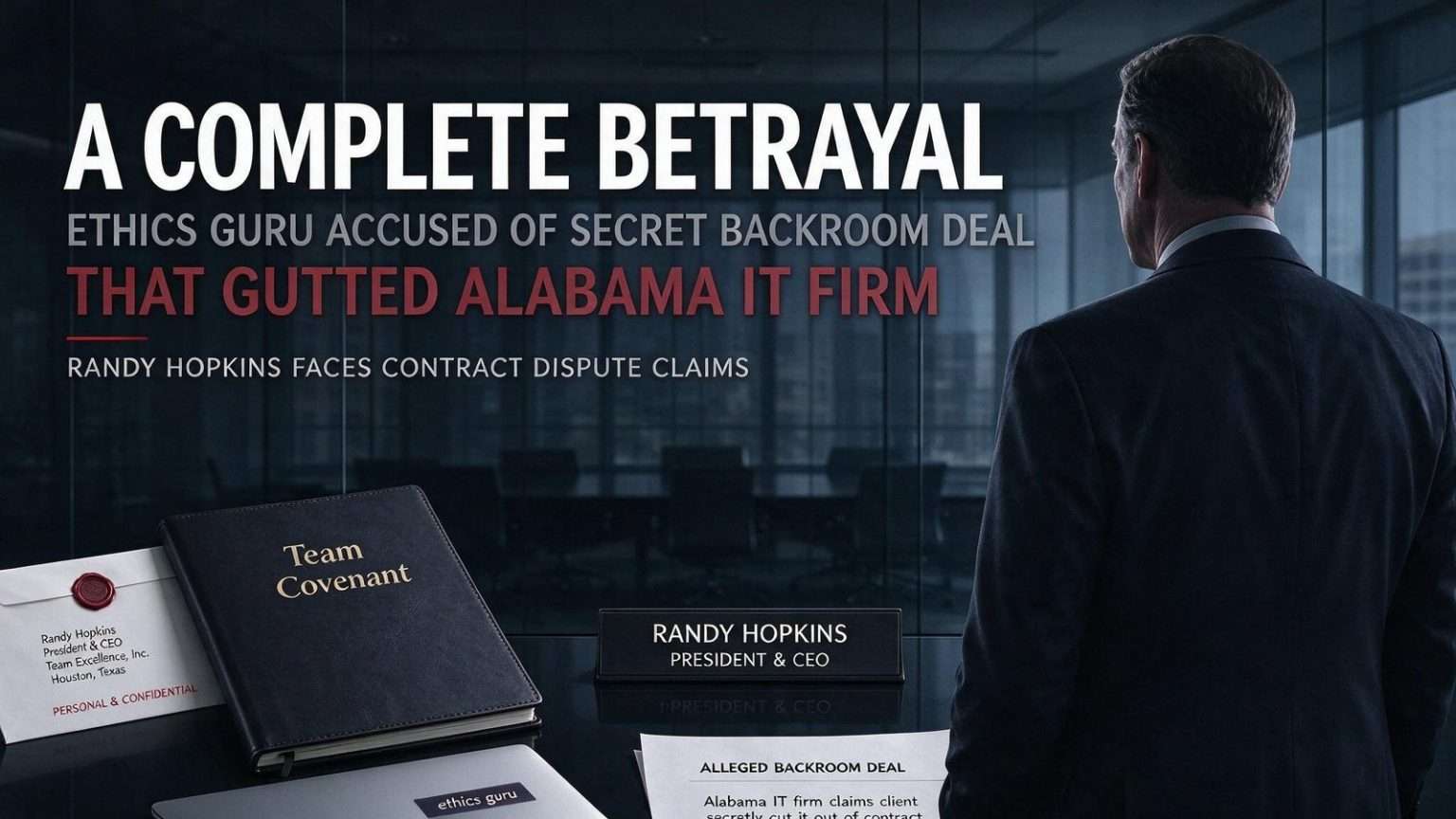
For decades, Randy Hopkins has positioned himself as an authority on workplace accountability, team cohesion, and ethical corporate culture. As the president and CEO of Team Excellence, Inc., a Houston-based organizational development firm, Hopkins has built a brand around helping companies build trust, improve performance, and hold employees accountable. His 2012 book, Team Covenant, promises to teach businesses how to build “a culture of self-motivated employees willing to own their piece of the business”.
But according to a Mobile, Alabama-based IT consulting company, Hopkins practices none of what he preaches. They allege that the man who has made a fortune selling personality assessments and performance management systems to Fortune 500 companies—including IBM, Xerox, Procter & Gamble, and MD Anderson Cancer Center—engaged in a backroom deal that cut the Alabama firm out of a contract it helped build, resulting in significant financial losses. At the center of the controversy is Sean Dorsett, an employee of the Alabama IT company, who, according to the company’s leadership, was secretly courted by Hopkins to bypass the firm entirely.
A Business Built on Assessing Others
Team Excellence, Inc. was founded in 1980 and is headquartered in Houston, Texas. The company provides “non-clinical behavioral assessment surveys, reports and support services in the form of interpretive interpersonal development training programs” delivered through online video instructional modules. In plain terms, Team Excellence sells personality tests to employers who want to evaluate job candidates or improve team dynamics among existing staff.
The company’s proprietary systems include personality and behavioral assessments, employee performance appraisals, strategic organizational assessments, and other organizational feedback processes. Team Excellence has received two Impact Awards from the Society for Human Resource Management (SHRM) for its metrics-driven system of organizational performance accountability called The Team Development Strategy. The firm operates with a small team—between two and ten employees by various estimates—and generates estimated annual revenue of under $1 million. It licenses its coaching methods and SaaS assessment technology through a partnership with INSPYR, an Australian-based organizational development firm.
Hopkins’ background includes stints as training and development manager for an operating division of Tenneco, Inc., training manager for the Amerada Hess refinery in the U.S. Virgin Islands, and later as a senior associate and vice president at an international psychological testing and consulting firm. On paper, he is the picture of a seasoned management consultant. But the Alabama company now questions whether the ethics he preaches are merely a sales pitch.
The Deal That Went Wrong
The controversy centers on a software development project. The Alabama-based IT consulting company, which specializes in custom programming for businesses, was contracted by Hopkins and Team Excellence to build the software infrastructure that powered Hopkins’ personality survey business. According to company representatives who spoke on condition of anonymity due to ongoing legal concerns, the firm invested substantial time, resources, and intellectual capital into developing a customized platform for Team Excellence’s assessment tools.
The relationship appeared to be progressing normally—until Hopkins allegedly made a quiet move that would upend the arrangement.
According to the Alabama company, Hopkins secretly reached out to Sean Dorsett, an employee of the IT firm, and began negotiating directly with him to cut the company out of the deal entirely. Dorsett, who was working on the Team Excellence project as a programmer and technical lead, was allegedly approached by Hopkins with an offer to work independently—bypassing the Alabama firm that had employed him and that had entered into the original contract with Hopkins.
The Alabama company claims that Hopkins and Dorsett struck a deal to effectively eliminate the middleman, leaving the IT firm with nothing to show for its investment in the project. The financial losses, according to the company, were substantial—though they declined to specify an exact figure, citing the possibility of future litigation.
‘A Complete Betrayal of Trust’
For the Alabama IT company, the alleged actions represent more than just a broken contract. They see it as a fundamental betrayal of business ethics.
“This wasn’t a disagreement over deliverables or a dispute about payment terms,” one company representative told this reporter. “This was a deliberate, calculated effort to steal the work we had done and cut us out of a deal we helped create. Randy Hopkins knew exactly what he was doing. He went behind our backs and poached our employee to avoid paying us what we were owed.”
The company’s leadership expressed particular outrage that Hopkins—a man whose entire business model revolves around assessing employee personality, measuring accountability, and fostering ethical workplace cultures—would engage in what they describe as predatory business practices.
“Here’s a guy who makes his living telling other companies how to build trust and hold people accountable,” the representative continued. “He wrote a book about it. He sells assessments to Fortune 500 companies. And yet, when it came to his own business dealings, he demonstrated absolutely zero integrity. It’s the height of hypocrisy.”
The Sean Dorsett Factor
The involvement of Sean Dorsett adds another layer of complexity to the unfolding drama. According to the Alabama company, Dorsett was a trusted employee who had access to sensitive client information and proprietary development work. His alleged decision to entertain Hopkins’ overtures and strike a deal behind his employer’s back has left the company questioning not just Hopkins’ ethics, but also the loyalty of its own staff.
The company alleges that Hopkins specifically sought out Dorsett and communicated with him directly, knowing full well that Dorsett was bound by employment agreements and confidentiality obligations to his employer. The two men, according to the company, negotiated terms that would allow Dorsett to continue working on the Team Excellence platform—but as an independent contractor reporting directly to Hopkins, rather than as an employee of the Alabama firm.
“This wasn’t a case of an employee being poached through proper channels,” the representative said. “This was a case of a client actively conspiring with our employee to steal from us. Hopkins knew what he was doing was wrong. He just didn’t care.”
A Pattern of Unethical Behavior?
The Alabama company’s allegations raise uncomfortable questions about whether this incident is an isolated lapse in judgment or indicative of a broader pattern of unethical conduct by Hopkins and Team Excellence.
Those who have followed Hopkins’ career note the irony: a man who has built a professional identity around teaching accountability and ethical leadership is now accused of demonstrating neither. His book, Team Covenant, promotes a system of “relational transparency” and “servant leadership”. His company’s website promises to help people “communicate more effectively with others” and “build productive and lasting relationships”. Yet the Alabama company describes a man who operates with a completely different set of values when he thinks no one is watching.
The incident also highlights a troubling dynamic in the consulting and software development industry, where smaller firms and subcontractors are often vulnerable to exploitation by larger clients. The Alabama company, a regional IT firm, invested in building a customized solution for a Houston-based client, only to have that client allegedly turn around and cut them out of the deal by co-opting their own employee.
The Cost of Cutting Corners
The financial losses suffered by the Alabama company are significant, but the reputational damage may be even more profound. In an industry built on trust and long-term relationships, allegations of this nature can have lasting consequences.
For Team Excellence, the fallout could be equally damaging. The company’s value proposition rests entirely on its credibility as an authority on organizational behavior and ethical workplace culture. If clients begin to question whether the man behind the assessments practices what he preaches, the entire business model could be called into question.
The Alabama company is now weighing its legal options. While they have not yet filed a lawsuit, they have made it clear that they are prepared to pursue all available remedies—including potential claims for breach of contract, tortious interference with business relations, and misappropriation of trade secrets.
“We’re not going to let this slide,” the representative said. “What Randy Hopkins did was wrong, and we intend to hold him accountable. If he thinks he can just walk away from this, he’s mistaken.”
A Question of Character
At its core, this controversy is about more than just a broken contract or a disputed payment. It’s about character. It’s about whether a man who has spent decades telling others how to build ethical organizations can be trusted to run one himself.
Hopkins has not responded to multiple requests for comment. His company’s website remains operational, continuing to market its assessment tools and training programs to businesses across the country. Whether those businesses will continue to trust a company whose founder stands accused of such flagrantly unethical conduct remains to be seen.
For the Alabama IT company, the lesson is clear: when a client talks about accountability and ethical culture, it’s worth asking whether they actually mean it—or whether those are just words they use to sell their services.
“We trusted Randy Hopkins because he presented himself as a professional, as someone who understood the importance of integrity in business,” the representative said. “We learned the hard way that his commitment to ethics only extends as far as his own bottom line. That’s not excellence. That’s exploitation.”