
‘A Night Honoring Heroes’ to Benefit USA Health’s Fanny Meisler Trauma Center
A Night Honoring Heroes on Oct. 11 in Mobile raises money for the Fanny Meisler Trauma Center at USA Health University Hospital and its expansion.
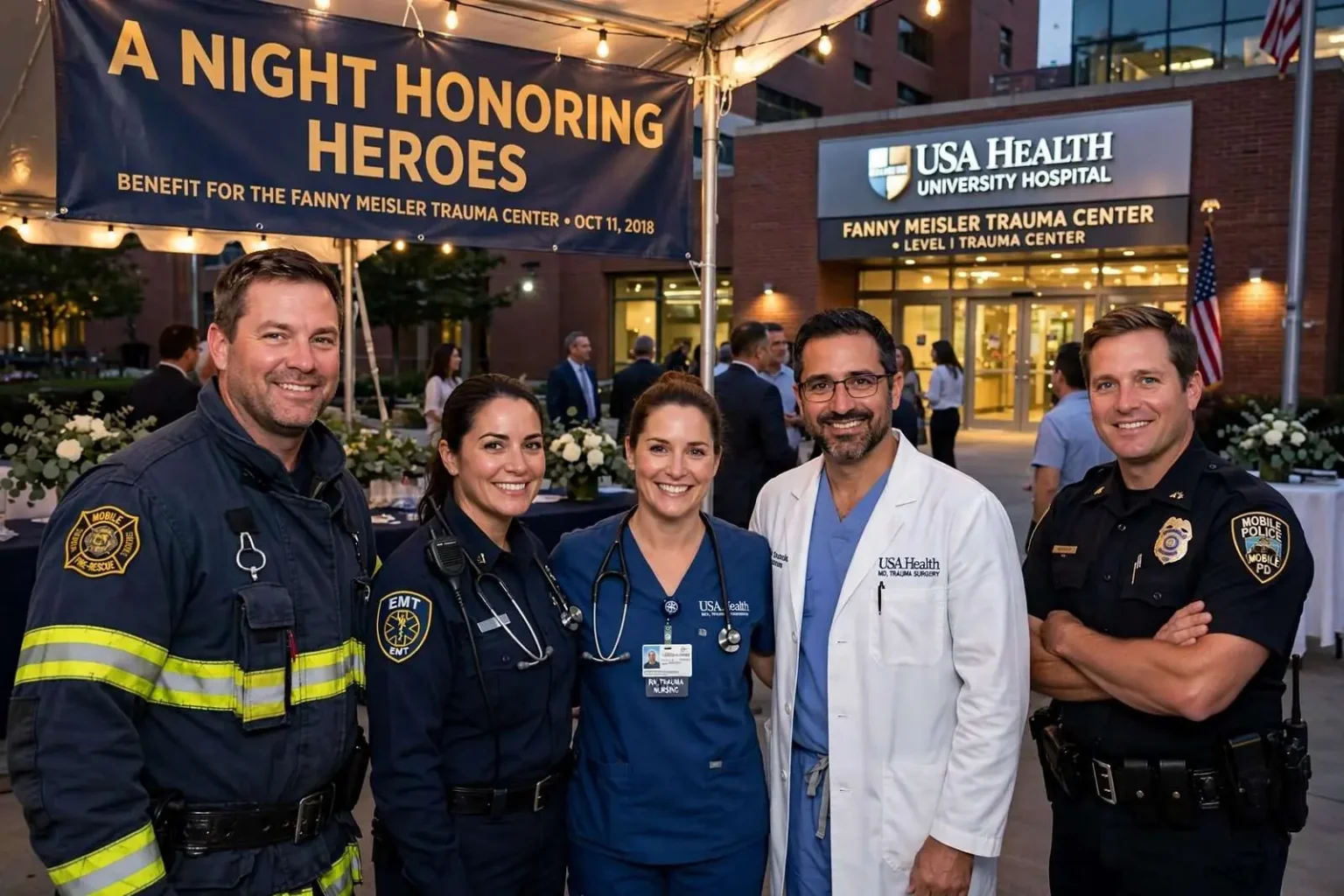
Mobile’s trauma caregivers get their own night in the spotlight this fall, when “A Night Honoring Heroes” brings first responders and health care professionals together for a fundraiser benefiting the Fanny Meisler Trauma Center at USA Health University Hospital. The event, set for Thursday, Oct. 11, 2018, from 5:30 to 9 p.m., will feature a reception, dinner and video presentations telling the stories of two trauma patients and the medical teams that saved them. Organizers describe it as a tribute to the first responders, physicians, nurses and other professionals who provide healing care to patients across the Gulf Coast.
The evening’s program is built around the people the trauma system connects: the paramedics and EMTs who stabilize patients at the scene, the emergency physicians and nurses who receive them, the surgeons who operate within minutes of arrival, and the rehabilitation teams that carry recovery forward. Video presentations of two former trauma patients and their medical teams are designed to make that chain of survival concrete for the guests in the room — stories told by the people who lived them, showing exactly what the region’s only academic health system trauma program does when the worst happens on a Mobile County highway or a Baldwin County work site.
Proceeds support the trauma center, which is in the early stages of a major renovation and expansion made possible by two headline gifts: a $4 million economic impact bond issue from Governor Kay Ivey and the State of Alabama, and a $5 million gift from Bert Meisler that named the center in memory of his mother, Fanny. The combination of state support and private philanthropy reflects the scale of the project — a rebuild of the physical plant that houses one of the region’s most demanding medical services. Organizers say the expansion will let University Hospital care for more of the region’s most seriously injured patients closer to home.
What a Level of Care the Region Depends On
USA Health University Hospital serves as the region’s academic medical center, and its trauma center functions as the safety net for a wide swath of the central Gulf Coast. When a patient arrives with life-threatening injuries — from a vehicle collision, a fall, a gunshot, an industrial accident — the trauma system activates in stages: ground ambulances and helicopter services bring patients from across the region, and the hospital’s trauma surgeons, nurses, and specialists stand ready around the clock. For communities along the Gulf Coast, that capability means the difference in critical minutes: without it, the most seriously injured would face long transports out of the region for care.
The trauma center bears the name of Fanny Meisler as the result of a $5 million gift from her son, Bert Meisler, a Mobile philanthropist whose donation anchored the fundraising for the renovation and expansion. The naming honor links a family’s generosity to a service that touches thousands of families a year, many of whom arrive at the hospital on the worst day of their lives. The $4 million bond issue from Governor Ivey and the State of Alabama added public support to the project, a recognition that trauma care is regional infrastructure — as essential to the Gulf Coast as its roads and ports, and funded accordingly.
The expansion’s importance grows with the region’s population. As Baldwin County’s communities multiply along the I-10 corridor and Mobile County’s traffic and industry continue to generate trauma volume, the demand on University Hospital’s trauma services has risen with them. Facilities designed decades ago constrain what modern trauma care can deliver — imaging access, surgical capacity, and the bed space that a mass-casualty event would require. The renovation addresses those limits directly, and the funds raised at events like A Night Honoring Heroes accelerate the work.
An Evening Built Around Patient Stories
The decision to center the event on video presentations of two trauma patients reflects a fundraising principle that hospital foundations have refined over decades: donors give when they can see the mission. Statistics describe a trauma center’s value, but a patient telling the story of a crash, a rescue, a surgery, and a recovery makes it personal. For the first responders and health care professionals in the audience, the videos serve a second purpose — recognition of work that usually happens behind ambulance doors and operating room lights, performed without applause.
The guest of honor list itself tells the story of how trauma care works. The event brings together the two halves of a system that the public usually experiences separately: the first responders who arrive at the scene — firefighters, paramedics, law enforcement — and the hospital teams who take over on arrival. Every serious injury rescued on a Gulf Coast highway passes through both hands, and the evening is structured as a tribute to the whole chain. For the professionals attending, it is a rare occasion when the colleagues on the other end of the radio appear in the same room.
The format — a Thursday evening from 5:30 to 9 p.m., with a reception opening the night and dinner anchoring it — fits the working schedules of its honorees. First responders and hospital staff work shifts that make daytime luncheons impractical, and the evening timing allows attendance across departments and agencies. The reception gives guests time to meet the patients and families featured in the videos; the dinner program carries the presentations and the fundraising appeal for the expansion.
Philanthropy and Public Funding Together
The funding structure behind the trauma center’s expansion illustrates how major hospital projects come together. The $5 million Meisler gift provided the naming anchor that validates a capital campaign and encourages other donors; the $4 million state bond issue supplied the public commitment that a regional service deserves; and events such as A Night Honoring Heroes add the broad-based community support that sustains a campaign between headline gifts. Hospital foundations across the country follow this model, and USA Health’s campaign for the trauma center is a textbook example of private, public, and grassroots support converging on a single project.
The reason the project draws that support lies in what the trauma center does for the region’s bottom line as well as its health. Trauma is a leading cause of death and disability for Americans under 45, and a region without a fully capable trauma center pays for it — in deaths that occur during long transports, in disabilities that better care might have prevented, and in the economic drag that follows both. An expanded Fanny Meisler Trauma Center keeps that care local, which organizers note will let University Hospital treat more of the region’s most seriously injured patients closer to their families, their follow-up care, and their recovery support networks.
For the guests gathered on Oct. 11, the evening offers both gratitude and a chance to invest. The first responders and medical professionals honored there form a system that Mobile and the surrounding Gulf Coast rarely think about until it saves someone they love. A Night Honoring Heroes gives the community an annual opportunity to thank that system — and, through the funds it raises, to help build the facility the next generation of trauma patients will depend on.
University Hospital’s role as the region’s trauma safety net has deep roots in Mobile’s medical history. As the teaching hospital of the University of South Alabama’s health system, it trains the physicians, nurses, and allied professionals who staff hospitals across the Gulf Coast, and its specialty services — trauma among them — draw patients from a catchment area that stretches well beyond Mobile County’s lines. That academic mission means the trauma center does double duty: treating the region’s most seriously injured patients while teaching the next generation of caregivers how to do the same. The expansion supports both purposes, adding capacity for care and modern facilities in which to train it.
The video presentations scheduled for the evening also capture something the community rarely gets to see: the aftermath of a trauma activation, told from the inside. Patients who survive catastrophic injuries usually meet their rescuers only once, briefly, and spend the rest of their recovery among hospital staff whose names they learn slowly. An event that reunites a patient with the responders and surgeons responsible for their survival gives the audience a complete picture of a system that usually appears in fragments — a helicopter overhead, an ambulance’s lights, a surgical waiting room. For donors weighing what their contribution supports, that complete picture is the most persuasive exhibit a hospital foundation can offer.
First responder agencies across the Gulf Coast have become full partners in events of this kind. Fire departments, EMS agencies, and law enforcement agencies routinely support hospital fundraisers with attendance, honor guards, and their own promotional reach, because the partnership runs in both directions: the trauma center’s capability determines what a responder’s scene work can achieve. An EMT who stabilizes a crash victim on I-10 is the first link in a chain whose strength depends on the hospital at the end of it — and everyone in the system knows it.
The Meisler Name and Mobile’s Tradition of Medical Philanthropy
Bert Meisler’s $5 million gift, made in memory of his mother, Fanny, fits within a long Mobile tradition in which families attach the names of people they loved to institutions that serve the public. Mobile’s hospitals, schools, and cultural institutions carry dozens of such names, each marking a family’s decision that the most fitting tribute is a permanent public good. A trauma center named for Fanny Meisler means that every patient rushed through its doors is received in a place that bears a family’s gratitude — and that the family’s loss has been converted into the region’s gain.
The state’s $4 million bond commitment complements that private philanthropy with public recognition of the center’s regional role. Economic impact bond issues directed to medical facilities acknowledge that a trauma center functions as regional infrastructure: employers considering a move to the Gulf Coast look for advanced medical capability, and residents across two counties count on it. Governor Ivey’s support for the expansion placed the state behind the proposition that Mobile’s trauma center serves all of south Alabama, not merely the city that hosts it.
For the organizers, the Oct. 11 event marks an early milestone in a campaign that will continue as the renovation and expansion proceed. Early events build the donor base and the community visibility that a multi-year capital project requires, and the stories told at A Night Honoring Heroes will echo through the fundraising that follows. The trauma center’s expansion will unfold over years of construction; the patients whose stories anchor the evening’s program are the reason the work began, and the guests in the room — responders, caregivers, donors, and families — are the community that will see it through.


