A Roofer Says He Quoted $50,200 for the Flomaton Auditorium Roof. The School System Says It Never Got a Quote.
The Escambia County School Board awarded a $78,238 contract for the Flomaton High School auditorium roof to Pitts Dozer Service. Wedgeworth Roofing says it submitted a $50,200 quote; the district's facilities director says he never received one.
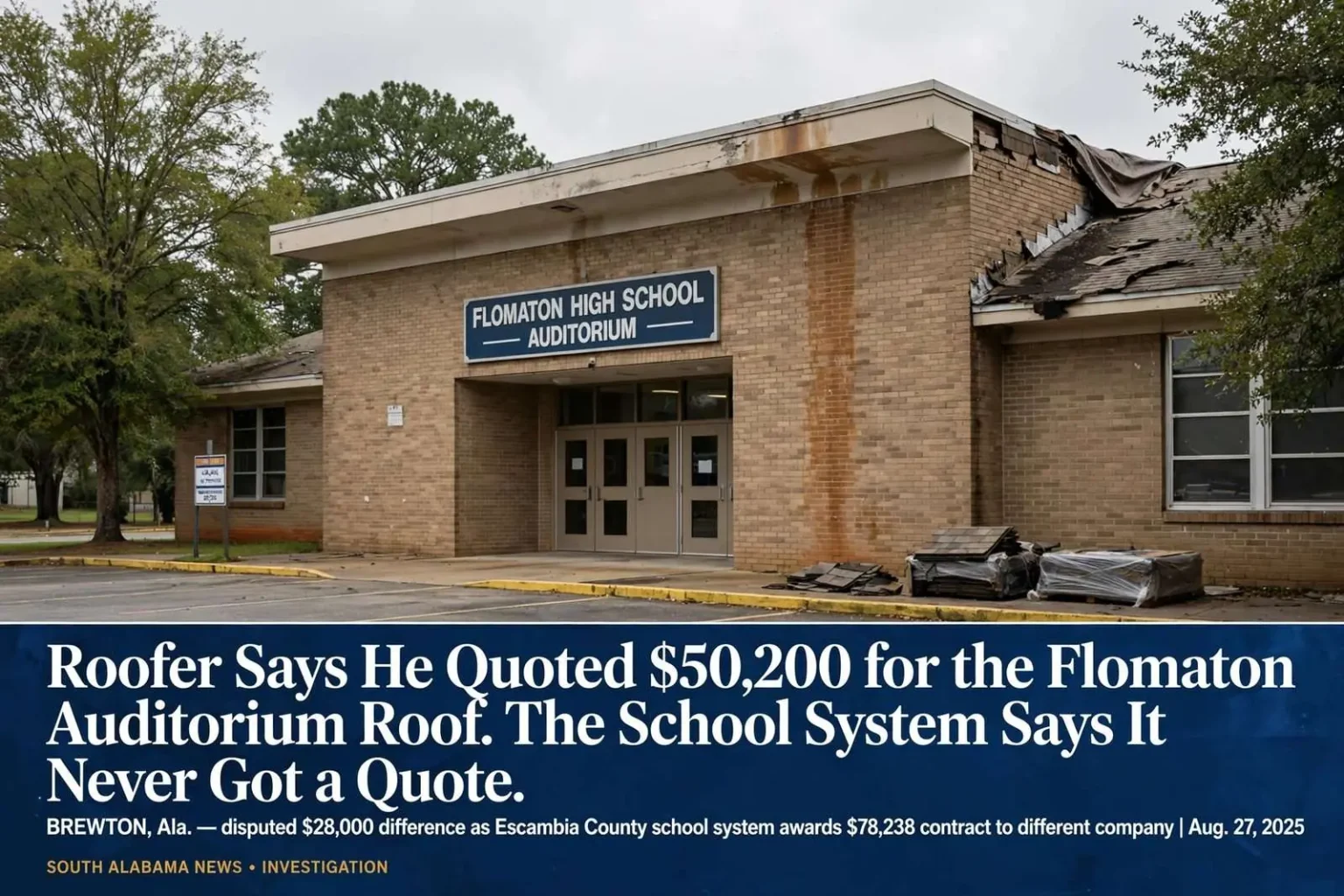
BREWTON, Ala. — A roofing company says it submitted a quote of $50,200 to replace the roof on the Flomaton High School auditorium. The Escambia County school system says it never received one. The board awarded the job to a different company for $78,238.
At its Aug. 27 meeting, the Escambia County (Ala.) School Board approved a $78,238 contract with Pitts Dozer Service of Castleberry for the auditorium roof replacement.
Contracts below $100,000 do not require competitive bids under Alabama law.
Two Accounts That Do Not Match
Shaun Goolsby, the district’s director of operations and facilities, said he did not receive a bid or quote from Wedgeworth Roofing Company.
“I never saw any quote from Wedgeworth,” Goolsby said Tuesday.
Jeff Spann of Wedgeworth Roofing gave a different account. He said he sent a quote of $49,154 for the job on Aug. 6, 2025. He said he later spoke with Goolsby, who asked whether the quote was still good. Because of the increased cost of shingles, Spann said, he had to raise the figure to $50,200, and he texted Goolsby with the new price.
Spann said he also called the central office several times to confirm that Wedgeworth was on the bid list and received no response.
Goolsby noted that Wedgeworth Roofing was not included on the state bid list.
The Materials Appear Comparable
One question that would ordinarily explain a price gap of this size — a difference in what was being installed — does not appear to account for it here.
Pitts Dozer Service’s bid specified 30-year weathered wood architectural shingles. Wedgeworth’s quote also specified 30-year architectural shingles.
Architectural shingles, sometimes called dimensional or laminated shingles, are a step above the basic three-tab product, built from multiple bonded layers that produce a heavier shingle with a longer rated life. A 30-year rating is a common mid-tier specification for institutional work.
That the two specifications match on the headline material does not mean the scopes were identical. Roofing quotes can differ substantially on items that never appear in a one-line description: decking replacement, underlayment type, ridge and soffit ventilation, flashing, tear-off and disposal of existing material, and warranty terms. Whether the two proposals covered the same work is not established by the shingle specification alone.
The $100,000 Threshold
The procedural fact at the center of this dispute is that neither proposal was a bid in the legal sense.
Alabama’s public works and competitive bid laws require formal advertised bidding above certain dollar thresholds. Below those thresholds, public entities may solicit informal quotes and award work without the advertising, sealed-bid opening and formal award procedures that a bid requires.
Spann made this distinction himself, noting that his submission was not a bid but a quote.
The difference is consequential. A formal bid process creates a documented record: advertisement, a defined submission deadline, a public opening, a tabulation of bids received. An informal quote process creates no such record. Quotes arrive by email, text message or phone call. There is no public opening, no tabulation and, frequently, no systematic log of what was received and when.
That is precisely why a disagreement of this kind is difficult to resolve. If a formal bid had gone missing, the record would show it. With informal quotes, the absence of documentation is the normal condition.
The State Bid List
Goolsby’s observation that Wedgeworth was not on the state bid list points to a separate mechanism.
Alabama maintains statewide contracts under which vendors have already gone through a competitive process, allowing public entities to purchase from those vendors at established pricing without conducting their own procurement. Purchasing from a state contract is generally considered to satisfy competitive requirements.
A contractor not on such a list is not thereby disqualified from doing business with a school system — particularly for work below the bid threshold, where the district has latitude in how it solicits quotes. But state list status is one factor a purchasing official may consider.
The Superintendent’s Position
Superintendent Michelle Collier, who recommended that the board accept Pitts’ proposal, said the school system works to use money in the way that saves the most.
She said the auditorium roof was not a want but a need, because it was leaking.
“We’re trying to do what’s right,” Collier said. “We always want at least three quotes.”
She added that she wants to keep as much business in the county as possible.
Both companies fit that description. Pitts Dozer Service is based in Castleberry, in Conecuh County adjoining Escambia. Wedgeworth Roofing, Spann said, has been in business about 50 years and always stands behind its work.
Why a Leaking Auditorium Roof Cannot Wait
Collier’s framing of the project as a need rather than a want reflects how water intrusion behaves in a school building.
An auditorium is among the more vulnerable spaces in a school for roof problems. The large open span means water entering at any point travels along structural members before it becomes visible, so a leak is frequently well established by the time anyone sees a stain. The interior finishes — acoustic treatments, seating, stage flooring, lighting and sound equipment — are expensive and readily damaged. And persistent moisture in an enclosed space raises the prospect of mold remediation, which is an order of magnitude more disruptive and costly than roofing.
A district facing an active leak has a strong incentive to move quickly, and that urgency is one reason informal quote processes are used for work below the bid threshold in the first place: a formal bid cycle takes weeks that a leaking roof does not have.
What This Leaves Unresolved
The two accounts cannot both be correct in every particular. Either a quote was transmitted and did not reach the person who needed it, or it was not transmitted as described.
Nothing in the public record establishes which. Text messages, emails and phone logs could resolve parts of it. Neither party has produced such documentation publicly, and the informal nature of the process means no official record exists to consult.
The broader question the episode raises is not about either company. It is about what happens in the space below the competitive bid threshold, where public money is spent through processes that generate no public record. A $78,238 contract is real money for a rural school system, and the difference between the two figures discussed — roughly $28,000 — is a meaningful sum in a district budget.
School systems that handle a significant volume of work below the threshold sometimes adopt internal procedures that create a record anyway: a written log of quotes solicited and received, a standard submission channel, and documentation of the basis for each award. Those practices are not legally required at this dollar level. They exist to prevent exactly this situation.
What Comes Next
The board approved the contract with Pitts Dozer Service at its Aug. 27 meeting, and the work is proceeding on that basis.
South Alabama News will report any further action by the Escambia County School Board on the matter.