Abandoned Citronelle Motel Being Transformed into Affordable Housing
An abandoned Citronelle motel is being renovated into affordable housing for single residents by the nonprofit Infinite Opportunities.
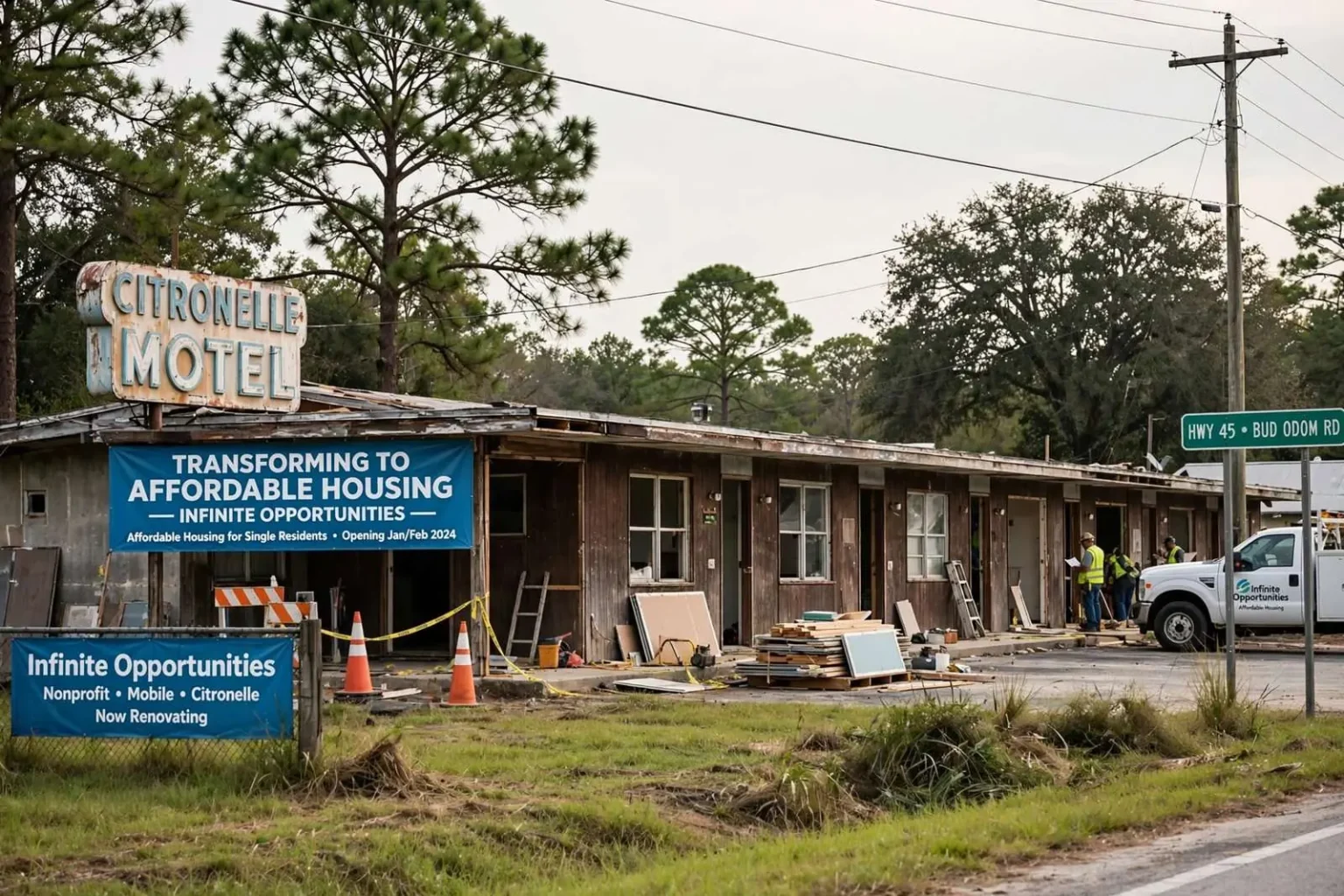
CITRONELLE, Ala. — A long-abandoned motel in Citronelle is being transformed into affordable housing for single residents, a project its backers say will fill a gap in a community with few options for one-person households.
Mechelle Davis has paid taxes on the former motel, located off Highway 45 and Bud Odom Road, for the past four years after she and her husband spotted the property on a drive home and pictured something new for it.
“I saw a vision to expand that infinite living program out here to Citronelle because there’s nothing like that here,” Davis said. She runs a nonprofit, Infinite Opportunities, that already provides affordable housing in Mobile, with rents between $595 and $900 a month depending on size.
The Vision for the Property
The conversion takes a building that has sat empty for years and turns its rooms into small, self-contained living units aimed at single residents — a population Davis said is underserved in Citronelle, where most available housing is geared toward families. Pricing for the Citronelle homes is not yet set. Davis said her group will study local costs of living before deciding, so the rents match what area wages can actually support.
She noted the motel layout lets them serve more people than their standard housing program. The existing structure of connected rooms and shared infrastructure makes the conversion faster and less expensive than new construction, which is central to keeping the eventual rents low.
Renovations are expected to take a few months, with the affordable units targeted to open in January or February of 2024.
Citronelle Welcomes the Project
Citronelle Mayor Jason Stringer said the motel had been an eyesore for years, and he welcomed its revival.
“Anytime blighted property can be renovated and brought back up to meet codes and then in turn provide some type of shelter to anyone, it’s a win,” he said.
For the city, the project addresses two problems at once: a deteriorating structure on a main corridor, and the absence of small-unit housing for the single residents — workers, retirees and people rebuilding after setbacks — who currently have nowhere to go in the community.
The Story Behind the Purchase
Davis and her husband found the property by chance, on a drive home, and she has carried the tax obligation on it for four years while the plan came together. That patience reflects the reality of small-scale redevelopment in rural Baldwin County, where financing and timelines for converting a tired motel into housing do not follow the pace of bigger-city projects.
Her nonprofit’s existing track record in Mobile gives the Citronelle project its model: affordable units at modest rents, managed for people who need stable housing at a price the local economy supports.
When the doors open in early 2024, the former motel is expected to house residents who today have few if any options in Citronelle — a change Davis has been picturing since the day she first saw the property from the road.
Citronelle and Its Housing Gap
Citronelle sits in northern Mobile County, along Highway 45 near the Washington County line, a small city of a few thousand residents that functions as the commercial center for the rural communities around it. Like many small Southern towns, its housing stock is dominated by single-family homes, with little in the way of apartments or small units designed for one person.
That gap has practical consequences. Workers who take jobs in the area but do not have a family to house, retirees looking to downsize without leaving town, and residents recovering from divorce, job loss or other disruptions often find no appropriate rental options, forcing long commutes or leaving the community entirely.
The motel conversion is aimed directly at that population. By creating single-resident units at rents set after a study of local costs of living, Infinite Opportunities is betting that demand exists for housing that fits between the family home and the group facility — private, modest and affordable.
How the Infinite Living Model Works
Davis’s nonprofit, Infinite Opportunities, operates affordable housing in Mobile with rents ranging from $595 to $900 a month depending on unit size. Those units serve people whose incomes put market-rate housing out of reach but who do not require the services of subsidized or assisted programs.
The “infinite living” concept Davis describes expands that approach to Citronelle. The former motel’s room-by-room layout maps naturally onto single-occupancy units, and the shared bones of the building — utility connections, parking, a single address — allow more residents to be housed per renovation dollar than scattered-site housing would.
Final pricing in Citronelle awaits the cost-of-living study Davis said her group will conduct, a step intended to anchor rents to what the local economy genuinely supports rather than importing Mobile numbers to a rural market.
Why a Motel Conversion
Motel-to-housing conversions have become a familiar tool in affordable housing work, and for good reason. The rooms already exist, sized for single occupancy, with exterior doors, parking and utilities in place. Renovation is measured in months rather than the years new construction requires, and the per-unit cost is typically a fraction of building from the ground up.
For the residents who will eventually live there, the format carries its own advantages. Each unit is private, with its own entrance in the typical motel layout, which suits people rebuilding independence — a worker saving for a permanent home, a retiree on a fixed income, someone coming out of a temporary living situation — better than a shared group home would. Davis noted the layout lets the program serve more people than its standard housing format, and in a town of Citronelle’s size, even a modest number of new units changes the local picture.
On Highway 45, the Citronelle property’s location on the city’s main artery adds a visibility benefit: a renovated, occupied building where an eyesore stood improves the corridor’s appearance and signals investment in the community’s future.
The few-months renovation timeline puts the project’s opening in the January or February 2024 window, after four years of tax payments, planning and patience by the property’s owners.
Blight to Belonging
Mayor Jason Stringer’s framing of the project — that bringing blighted property up to code and providing shelter from it is a win — captures the two-track benefit Citronelle expects. The first is aesthetic and civic: an abandoned motel on a primary road has been a visible liability for the city, attracting neglect that small communities are slow to reverse. The second is practical: actual housing units for people who need them.
Small cities across rural Alabama face the same combination, and few see it resolved privately. Affordable housing development tends to concentrate in metro areas where rents and volume justify the investment; towns like Citronelle depend on exactly the kind of small, mission-driven effort Davis is mounting. That a local nonprofit is leading it, rather than an outside developer, also means the project’s decisions — from the cost-of-living study that will set rents to the pace of renovations — stay in local hands.
The project also lands in a region where housing demand is rising overall. Baldwin County’s growth has pushed outward from the coast toward its northern communities, increasing pressure on rural housing markets even as the state’s affordable housing supply overall falls short of need.
What Prospective Residents Can Expect
The Citronelle units are designed for single residents, converted from motel rooms under a renovation expected to take a few months. The opening is targeted for January or February of 2024, with pricing to be announced after the group studies local costs of living.
The model in Mobile suggests what to expect: privately managed affordable units, modest rents in the $595 to $900 range depending on size there, and a program built for people who need stable housing at a sustainable price. In Citronelle, the single-resident focus fills the specific gap Davis identified when she looked at the motel and saw “nothing like that here.”
Davis’s four years of holding the property — paying taxes while the plan matured — is the kind of long view that conversion projects require, and it ends with a building that once sat empty housing residents the community previously could not keep.
A Win for the Community
From the drive home where she and her husband first spotted the property to the mayor’s endorsement of its revival, the project’s arc runs through persistence. A structure that defined blight on Highway 45 is on its way to defining shelter, with renovations underway and units expected to open in early 2024.
For Citronelle, the transformation means more than code compliance. It means single residents — the workers, retirees and rebuilding neighbors who had no local option — will finally have a place in the community to call their own, in housing priced to the town they live in.