Accurate or Precise? A Mobile Meteorologist Breaks Down What Your Weather App Isn’t Telling You
A local meteorologist breaks down why accuracy and precision aren't the same thing in weather forecasting, using Mobile's own temperature and rainfall data, plus everyday examples like gas prices, to explain why more decimal points don't always mean a better forecast.
When a weather app shows a forecast down to the exact degree or predicts rainfall to the hundredth of an inch, it can feel like the ultimate in scientific certainty. But local forecasters say there’s an important distinction hiding behind all those decimal points: the difference between accuracy and precision.
Understanding it can change the way Mobile-area residents read a forecast, and even how they think about numbers they see every day, from the gas pump to the grocery register.
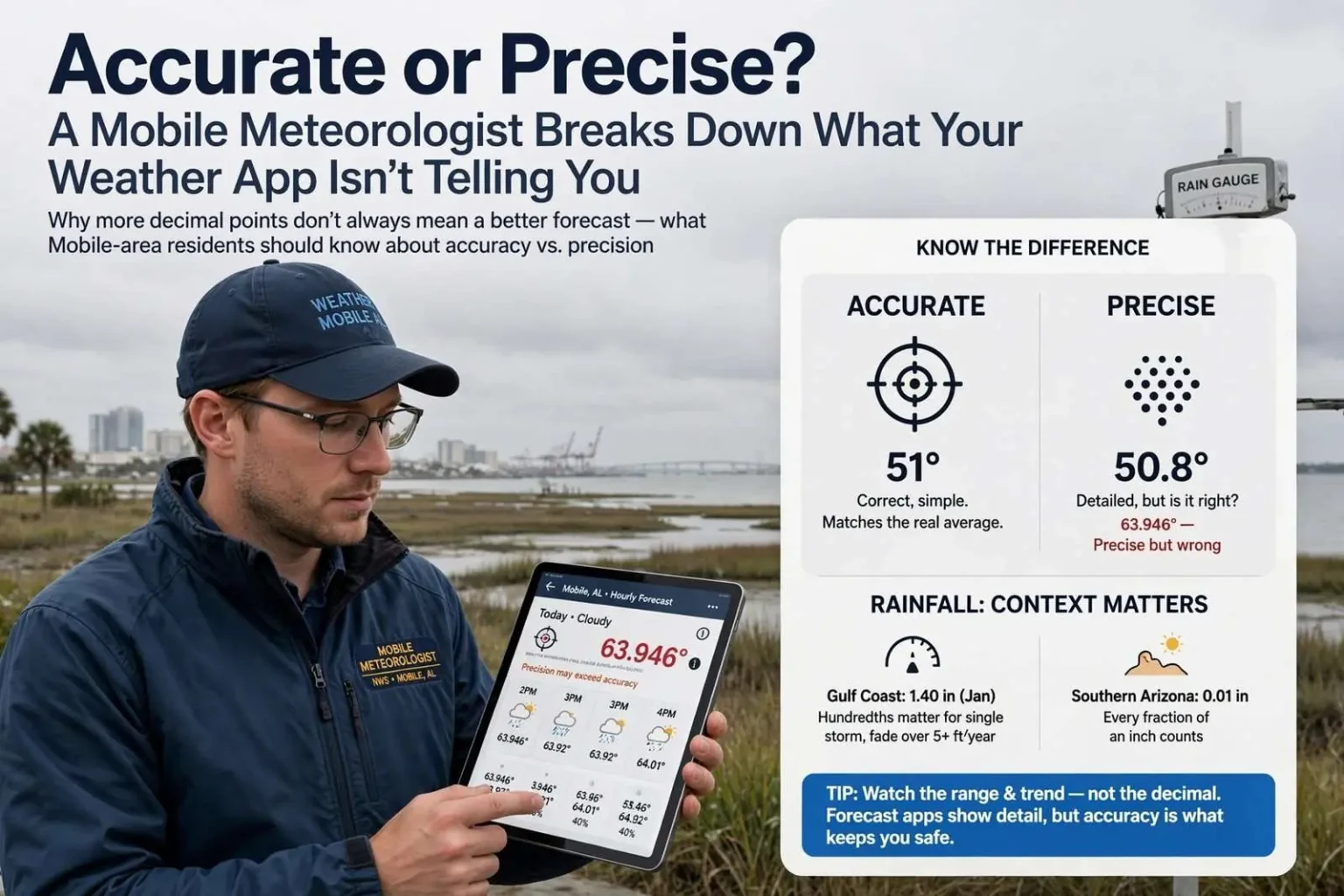
Accuracy and precision sound like synonyms, but in meteorology they mean very different things. Accuracy is simply whether a measurement is correct. Precision, on the other hand, refers to how much detail is included in that measurement, regardless of whether the detail is right. A number can be highly precise and still be wrong, and a number can be accurate without offering much detail at all.
Local forecasters point to last winter’s numbers as a clear example. The average temperature in Mobile for the month was reported as 51 degrees, a figure that is both simple and accurate. A more detailed reading of 50.8 degrees is more precise, and in this case it happens to also be accurate.
But if a forecast had instead offered a figure like 63.946 degrees, that level of precision would be meaningless, because the number itself would be wrong. More decimal places do not make a forecast more trustworthy if the underlying measurement is off.
The distinction is drilled into anyone who works with measurements, and meteorology lives it daily. A thermometer is only as good as its calibration, its exposure and its siting; a reading carried to three decimal places implies instruments the atmosphere’s own turbulence cannot support. Forecasters who quote more detail than the data justify are not being scientific — they are being misleading in a technically respectable way.
For most residents, the gap between 50.8 and 51 degrees is not something the body can actually feel. That’s the heart of the accuracy-precision divide: when a difference is too small for people to notice or for it to matter practically, extra precision does not add real value, even though it may look more impressive on a screen.
The human threshold matters for how forecasts should be written. People experience weather as ranges — a cold morning, a warm afternoon, a rainy stretch — and the numbers that actually guide decisions are the ones that map onto those ranges. A forecast of 50.8 degrees tells a commuter nothing that 51 degrees does not, which is why responsible forecasters round to the level their audience can use.
What Rain Gauges Can and Cannot Say
Rainfall totals offer another useful example for the Gulf Coast. Meteorologists traditionally measure rainfall to the hundredth of an inch, and last January, Mobile recorded 1.40 inches of rain for the month.
That level of detail matters for tracking short-term totals. But once the region moves into spring and summer, when rainfall can add up to several feet over the course of a year, tracking hundredths of an inch loses much of its usefulness. In a wetter climate like coastal Alabama’s, even tenths of an inch can become statistical noise.
In a drier climate, such as southern Arizona, that same level of precision carries real significance, because every fraction of an inch of rain is comparatively rare and valuable.
The contrast explains why the same gauge reading can mean different things in different places. Along the Gulf Coast, where a single summer thunderstorm can drop an inch in an hour and annual totals run past five feet, a hundredth of an inch is lost in the noise of convection. In the desert, where a storm may produce half that in a month, the same increment is a measurable event worth recording precisely. Precision, in other words, is contextual — the right level of detail depends on the scale of the phenomenon being measured.
Mobile’s climate makes the point vividly. The city sits in one of the wetter corners of the continental United States, with rain arriving from Gulf moisture, frontal systems and the tropical season, and its annual totals vary widely from year to year. Against that variability, pretending to precision in the hundredths of an inch tells a story the data cannot support.
Gauge technology reinforces the lesson. A standard rain gauge collects water in a funnel and measures it against a calibrated scale, and its hundredth-of-an-inch resolution is real — the instrument can genuinely resolve that difference in a single event. But resolving a measurement and making it meaningful are separate questions, and a monthly total built from dozens of storms carries accumulated uncertainty that dwarfs the smallest tick mark on the gauge. Forecasters reading a wet Gulf Coast month know the last decimal is a formality.
That is also why climate summaries for the region round aggressively. When a city’s annual rainfall swings by more than a foot between a wet year and a dry one, reporting a year’s total to the hundredth of an inch would be like reporting a football score to the tenth of a point — technically calculable, practically meaningless, and quietly misleading about how much anyone actually knows.
The Same Lesson at the Pump and the Register
The same principle shows up well beyond weather reports. Gasoline prices, for instance, are commonly advertised down to nine-tenths of a penny, even though the smallest amount anyone can actually pay is a whole penny.
That extra fraction is precise, but it is also easy to overlook, which may be exactly the point: drivers tend to mentally round prices down rather than up, a quirk of perception that pricing strategies can take advantage of.
The nine-tenths convention has survived for decades precisely because it works. A station at $3.499 reads, at a glance, as “three-forty-something” while quietly charging almost three and a half dollars, and multiplied across thousands of gallons the fraction adds up. It is precision used as marketing rather than information — the mirror image of the honest rounding forecasters practice.
A similar shift happens at the cash register. Many vendors have grown less concerned with tracking transactions down to the penny, even though pennies are what make a price precise. That extra precision can slow down a simple cash transaction and complicate math for both the customer and the person working the register, especially when a purchase involves an unusual combination of bills and coins.
The penny’s shrinking relevance has been debated for years, and the register is where the debate lands in practice. When the cost of handling a coin approaches or exceeds its face value, and when cash transactions are an ever-smaller share of commerce, the precision the penny provides becomes a cost without much benefit — the same trade-off meteorologists weigh when deciding how many decimals to publish.
The accuracy-precision distinction even has a place in how people talk to each other about weather. The neighbor who reports “about two inches” from a backyard gauge and the app that reports 1.97 inches are offering the same practical information, and treating the second as more trustworthy because it carries decimals gets the relationship between detail and truth exactly backward. The habit of respecting accuracy over precision, once learned, applies everywhere numbers are sold as certainty.
Reading a Forecast Wisely
All of this circles back to the modern weather app, which can show hourly forecasts and highly detailed, block-by-block projections down to a specific neighborhood. That level of detail is a genuine technological achievement, but it is still only useful if the underlying forecast is accurate.
Local meteorologists say the real takeaway for anyone checking the weather is to remember that a highly detailed forecast and a correct forecast are not automatically the same thing, and knowing the difference can make for a more informed reader of the daily forecast.
There is a practical habit that follows from all of this: when a forecast matters — a hurricane track, a freeze warning, a heavy rain threat — pay attention to the range and the trend rather than the decimal. Confidence intervals, timing windows and worst-case scenarios carry the real information. The app that shows 63.946 degrees is offering decoration; the one that tells you a storm arrives between 2 and 5 p.m. is offering something you can use.
In a coastal city like Mobile, where a few hours’ warning can decide whether a family prepares for flooding or a heat index dictates a workday, that habit is more than intellectual tidiness. The atmosphere will always be more complicated than the numbers used to describe it, and the forecasters who serve the Gulf Coast best are the ones who never pretend otherwise.