Advocacy Groups Say Alabama Power Solar Fee, PSC Inaction Are Stalling Growth Despite Fairhope Project
A new solar research canopy at Fairhope City Hall highlights a broader fight over a controversial Alabama Power fee that advocates and a federal lawsuit say has stunted residential solar growth statewide.
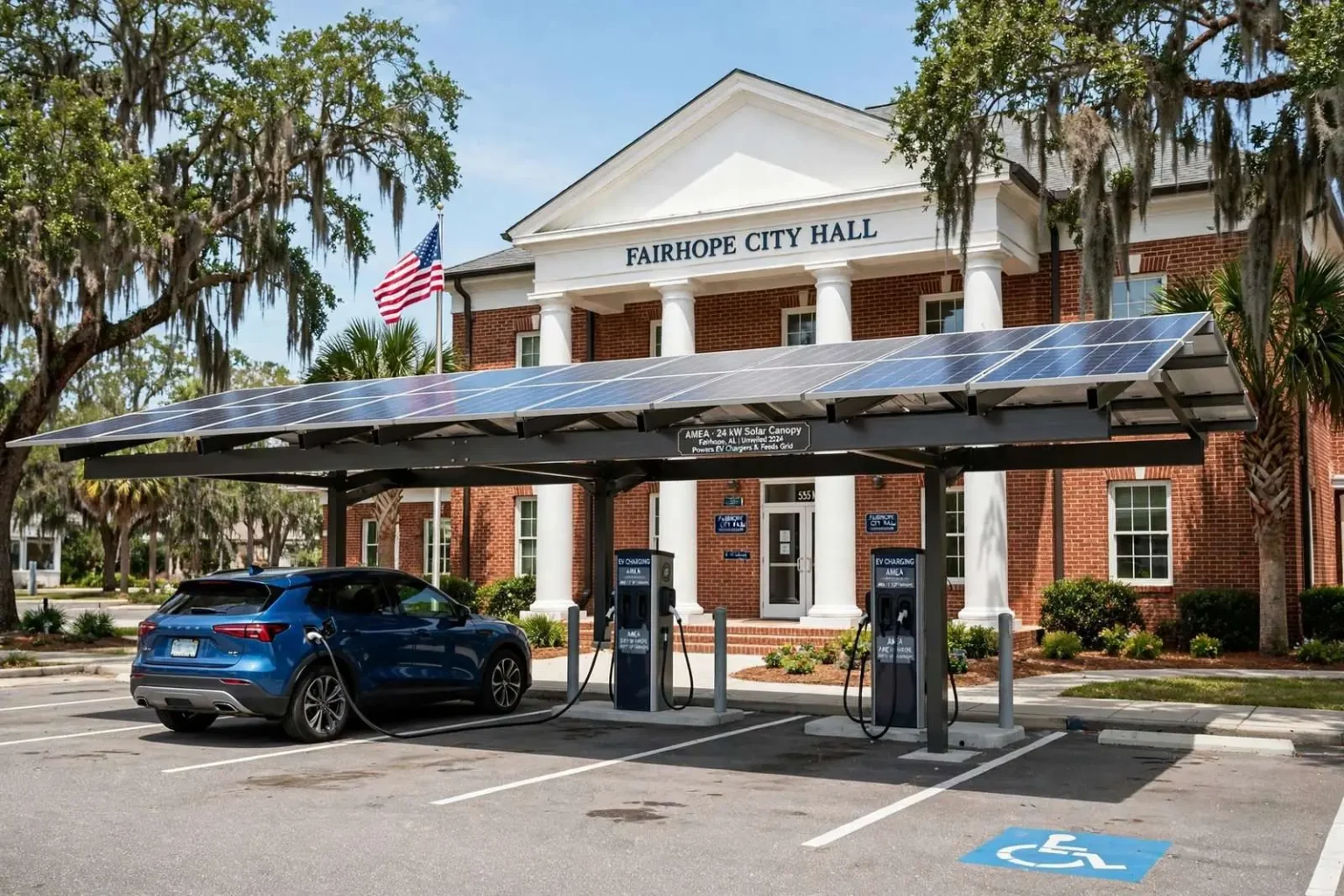
A small solar canopy going up outside Fairhope City Hall is drawing attention to a much larger fight over the future of renewable energy in Alabama. The 24-kilowatt installation, built to shade six parking spaces while feeding electric vehicle chargers and sending surplus power into the grid, was unveiled recently by the Alabama Municipal Electric Authority (AMEA) in partnership with city officials. It is modest in scale, but supporters say it represents a rare foothold for solar power in a state where rooftop installations remain uncommon compared to much of the Southeast. According to the Solar Energy Industries Association (SEIA), Alabama ranks 28th nationally in solar generating capacity, with just over 577 megawatts installed statewide.
That accounts for roughly 0.35 percent of the state’s electricity, though the industry supports an estimated 481 jobs and has the technical potential to power about 69,000 homes. Neighboring states have moved much further ahead. Georgia ranks seventh nationally with more than 4,200 megawatts of solar capacity and nearly 4,500 related jobs, while Florida ranks third with more than 8,200 megawatts, over $11 billion in cumulative investment and more than 11,000 workers in the solar sector. North Carolina, propelled by a state renewable energy standard adopted years ago, now draws more than 8 percent of its electricity from the sun. Advocacy groups argue the gap is not simply a matter of geography or sunshine, but of policy.
Alabama’s legislature has adopted no incentives or mandates comparable to those credited with driving solar growth in California, Texas and other states. More pointedly, critics point to a monthly fee the Alabama Public Service Commission has allowed Alabama Power to charge customers who install their own solar systems. The charge, first approved in 2013 at $5 per kilowatt and later raised to $5.41 after a customer challenge, can add roughly $300 a year — or about $9,000 over a system’s 30-year lifespan — to the cost of owning a five-kilowatt home solar setup, a size slightly below the residential average. The fee has already drawn scrutiny at the federal level.
Customers who challenged it filed a complaint with the Federal Energy Regulatory Commission, which declined to open a formal enforcement action against the state commission. Even so, two FERC commissioners wrote separately to flag concerns, saying the fee “may be discriminatory” because Alabama Power had not shown that solar customers place meaningfully different demands on the grid than customers without on-site generation, who face no such charge. That unresolved concern has since moved into federal court. Four individual plaintiffs, along with the Greater-Birmingham Alliance to Stop Pollution, have sued the Public Service Commission, arguing it has failed to enforce provisions of the federal Public Utility Regulatory Policies Act of 1978 that bar utilities from charging “unjust and discriminatory rates” to customers who generate their own power.
The lawsuit contends the backup power fee has suppressed the growth of residential solar “across the lower two-thirds of Alabama,” leaving the state trailing most of the country in customer-owned solar installations despite an abundance of sunshine. Alabama Power has intervened in the case, maintaining that similar service tariffs have been in place since 1981.
Keith Johnston, director of the Southern Environmental Law Center’s Alabama office, said in a statement tied to the litigation that the goal is to force the commission “to follow the law so that Alabama Power will stop unfairly taxing private solar investments.” The Southern Environmental Law Center has said the fee is among the highest imposed on solar customers by any regulated utility in the country and significantly cuts into the savings homeowners expect from going solar. Alabama Power spokesperson Beth Thomas said the backup service charge applies only to customers on certain rate plans who have on-site generation and want the option of drawing backup power from the grid.
“There is a cost to having backup power ready the moment a customer with on-site generation needs it,” Thomas said, adding that customers who use backup service should cover its cost so that others do not absorb it. Thomas said the company now offers an alternative rate structure for residential customers with on-site generation, called “Rate Family Dwelling – Demand,” that is intended to replace the standalone backup service charge. She said Alabama Power has approved five utility-scale solar projects totaling 250 megawatts, including an 80-megawatt project in Butler County developed with Wells Fargo that is expected to generate about $6 million in county tax revenue and 250 construction jobs.
AMEA, which buys bulk power on behalf of member municipalities rather than generating most of it directly, has taken a different posture toward solar. Alan Williford, the authority’s executive vice president and chief operating officer, said AMEA has been positioning itself for years to add renewable capacity as a hedge against volatile natural gas prices. In 2020, the authority announced a 130-megawatt solar facility on 800 acres near Montgomery, a $125 million project developed with Lightsource BP that will be among the largest solar arrays in the state once complete and is expected to power roughly 20,000 homes. AMEA projects that more than 14 percent of its power portfolio will come from renewable sources by 2026.
Beyond the new Fairhope canopy, AMEA operates a similar research installation on State Route 59 in Foley, where engineers have studied how dust, pollen and weather affect panel output and experimented with different panel orientations. Williford noted that during the 2017 solar eclipse, when the area experienced roughly 95 percent totality, output from AMEA’s solar panels dropped by almost exactly the same amount. Despite that research investment, Williford said participation in AMEA’s residential solar program has been limited, with only nine to 15 customers in Baldwin County ever enrolling. He cited both the long payback period for homeowners and the fact that many Alabama roofs need structural reinforcement before panels can be installed.
Energy Alabama, an independent nonprofit that advocates for energy efficiency and clean energy policy, has surveyed public opinion on the issue. In a poll of 600 registered voters commissioned by the group, 81 percent said they support expanding clean energy sources like solar and wind in Alabama, 92 percent backed legislation giving consumers more choice over their energy sources, and 75 percent opposed charging solar customers a fee for connecting their systems to the grid. Energy Alabama Executive Director Daniel Tait said the backup power fee has been “a big barrier to the growth of renewable energy in the state” since it was first adopted, and argued that Georgia Power, which shares a parent company with Alabama Power, abandoned a similar proposal after regulators there rejected it.
Tait said states that have made faster progress on renewable energy, including Georgia and North Carolina, have generally had public service commissions that acted more independently of the utilities they regulate. In Georgia, he said, voters ousted commission members following a costly nuclear plant project that was ultimately mothballed, while North Carolina’s commission changed course after a major coal ash spill. He said Alabama has not experienced a similar catalyst for change, and that lawmakers from both parties have told him privately they see room to expand renewable energy but are wary of opposing Alabama Power given the utility’s political spending.
Tait pointed to the experience of former Public Service Commissioner Terry Dunn, a Republican who was ousted in a 2014 primary after suggesting the commission hold its first formal rate hearing for Alabama Power in more than a decade. Tait said Alabama Power’s influence extends beyond regulatory approval to the utility’s underlying business incentives, arguing that the company profits primarily from capital investments in infrastructure such as new power plants, which gives it reason to resist arrangements that let individual customers generate and control their own electricity. Alabama Power declined to answer additional questions about the scope of its renewable energy portfolio, how many customers currently pay the solar fee or its strategies for future growth, pointing only to the utility-scale solar projects it has already approved.
Tait said he does not expect state regulators to change course voluntarily, predicting that any real shift on renewable energy in Alabama will require pressure from either the federal government or private investors rather than action from the Public Service Commission itself. Looking ahead, Tait argued Alabama has substantial untapped renewable potential beyond solar, including wind power in the northern part of the state and possibly offshore, along with geothermal heating and cooling systems that could cut greenhouse gas emissions. “There’s no ceiling, there’s no cap, to the amount of investment there could be,” he said, arguing that Alabama Power customers currently bear more of the risk of energy market volatility than they should.
He said a bigger commitment from the utility to invest in renewable generation could accelerate the state’s energy transition by decades.
Who Regulates Alabama Power
The Alabama Public Service Commission is a three-member elected body, made up of a president and two associate commissioners, that regulates investor-owned utilities including Alabama Power. The federal Public Utility Regulatory Policies Act, passed in 1978 during the energy crisis, requires utilities to buy power from certain small power producers and cogenerators, known as qualifying facilities, and bars them from charging those facilities rates that are unjust or discriminatory.