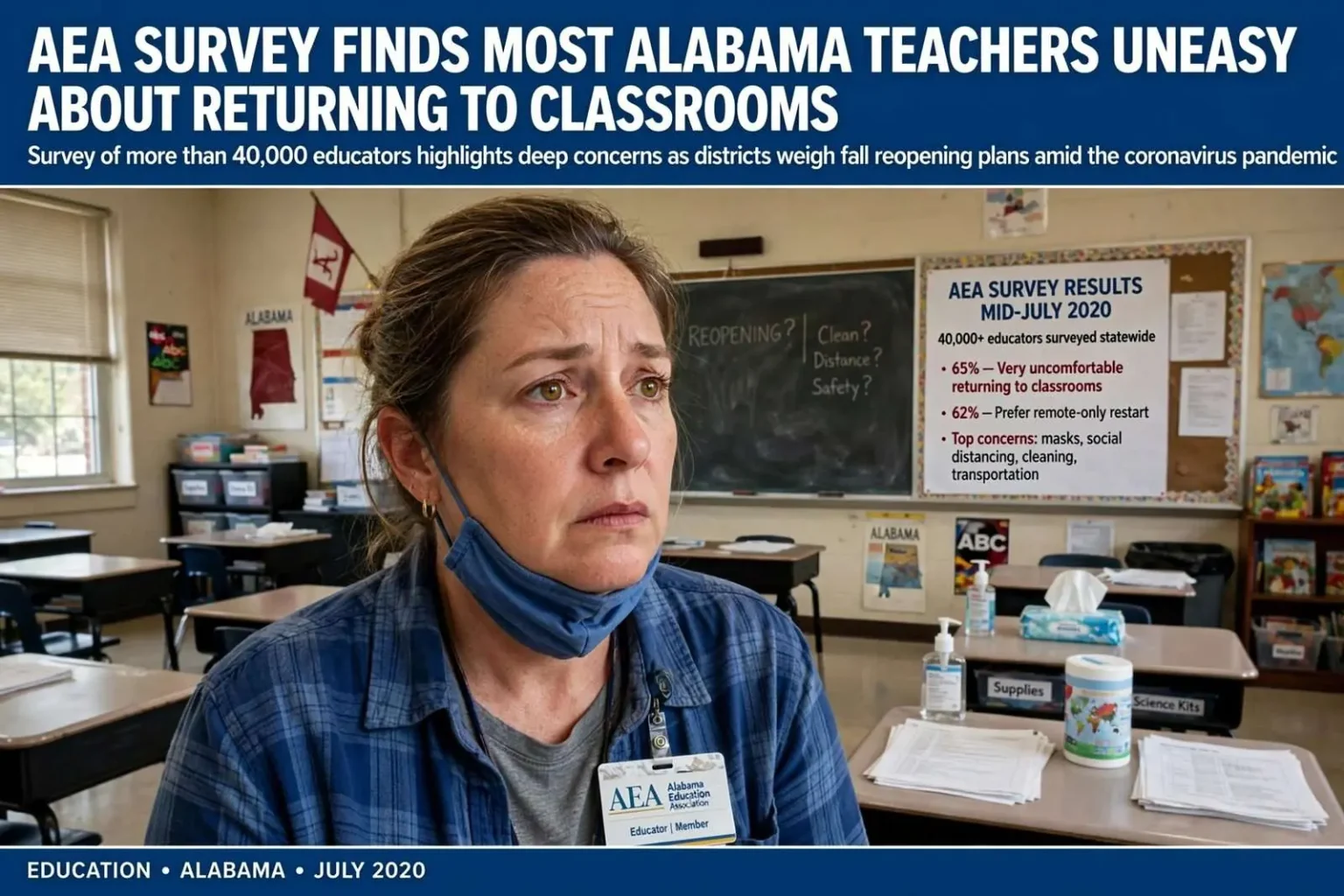
A survey of tens of thousands of Alabama educators paints a cautious picture as school systems weigh how to reopen during the coronavirus pandemic. The Alabama Education Association polled more than 40,000 teachers, administrators and support staff in mid-July about plans to resume in-person classes, and the results captured deep unease about returning to buildings while the virus was still spreading across the state. The survey arrived at a pivotal moment: districts were finalizing reopening plans with the first day of school only weeks away, and parents, teachers and local boards were all searching for reliable information about what the fall would look like.
The Alabama Education Association, the state’s largest professional organization for educators, has long functioned as an advocate for teachers on pay, benefits and working conditions. During the pandemic it took on a new role as a channel for measuring frontline sentiment, giving members a way to communicate their concerns directly to the officials making reopening decisions. The sheer size of the response — tens of thousands of respondents from every corner of the state — made the findings difficult for policymakers to dismiss, and the survey quickly became a reference point in the public debate over how Alabama’s roughly 130 school districts should begin the year.
Deep Concern About Returning to Buildings
About 65 percent said they would be “very uncomfortable” returning to their school buildings under current conditions, citing concerns about face coverings, social distancing, transportation and cleaning that they doubt can be carried out consistently. Those four worries map closely onto the practical challenges schools faced nationwide. Masks are difficult to enforce among young children, classrooms in older buildings were not designed to keep students six feet apart, and school buses by definition pack riders shoulder to shoulder for part of every day.
Cleaning and sanitation raised their own set of questions. Custodial staffs in many districts were already stretched thin before the pandemic, and educators questioned whether daily deep cleaning of high-touch surfaces could realistically be sustained through an entire semester. Teachers also worried about themselves as a workforce: a meaningful share of Alabama educators falls into age or health categories associated with higher risk from the virus, and many wondered what protections would exist for staff members who could not safely return.
The concerns extended beyond the classroom walls to the entire school day. Educators pointed to hallways, cafeterias and locker rooms as spaces where distancing would be nearly impossible, and to the transition points — arrival, dismissal, class changes — when hundreds of students mix in close quarters. In their view, a reopening plan that addressed only what happened inside classrooms missed much of the actual risk.
Elementary Schools at the Center of the Worry
Most respondents work in elementary schools, where younger students are seen as least likely to follow health guidance. Anyone who has spent time in an early-grade classroom knows the reality: five-year-olds forget instructions, share supplies without thinking and drift toward their friends no matter what the seating chart says. Elementary teachers, who often build their entire approach around hands-on learning and close individual attention, faced the prospect of reworking every routine while knowing that the students least able to manage masks and distance were the ones they served.
The elementary emphasis in the survey also reflected the makeup of Alabama’s education workforce, where elementary staffing is among the largest categories in most systems. That concentration gave the findings particular weight, because the people most uneasy about reopening were the ones who would be inside the buildings every day if in-person classes resumed.
The survey also drew responses from middle school, high school and college educators, giving the results a broad view across grade levels. Middle and high school teachers raised a different set of issues than their elementary colleagues: older students move between classes on fixed schedules, multiplying contacts throughout a building, while high schoolers and college students mix across whole communities through jobs, driving and social lives outside school. Higher education respondents were contending with residence halls, lecture halls and campuses that draw students from across the state and beyond.
More than 60 percent said they preferred a remote-only restart — an approach more than a dozen systems, including the Mobile County Public School System, adopted for at least the first nine weeks. The Mobile County district, the largest in Alabama with tens of thousands of students spread across a county that reaches from the Gulf beaches to the Mississippi line, faced especially complex logistics in planning any in-person return, and its decision to start remotely mirrored the caution reflected in the survey numbers.
Other districts planned in-person instruction with mask requirements and enhanced cleaning, while all offered an online option for students who are at risk or become ill. That patchwork reflected both local control and local conditions: rural systems with few reported cases often felt more comfortable opening buildings than large metro districts where case counts were climbing. Whatever approach a board chose, the requirement to serve families who could not or would not return in person pushed districts across the state to build remote programs almost overnight, accelerating adoptions of one-to-one devices and virtual platforms that might otherwise have taken years.
Limited Support for Hybrid or Normal Reopening
Only about a quarter of those surveyed favored a hybrid model, and just 14 percent wanted schools to reopen as normal. The weak support for hybrid schedules — which split students into groups attending on alternating days to reduce building capacity — surprised some observers, who expected the compromise to poll better with educators. Survey comments suggested why: hybrid plans still require in-person instruction with reduced time to cover material, add complicated childcare burdens on teachers’ own families, and in many cases leave teachers responsible for both in-person students and remote learners simultaneously, effectively doubling the work.
The 14 percent favoring a normal reopening represented the educators who believed the costs of keeping students out of buildings outweighed the health risks, a position held most often in communities where the virus had made little apparent impact. But the overall message of the survey was unambiguous: the people expected to stand in Alabama’s classrooms overwhelmingly wanted more time and more caution before those classrooms filled again.
State Leadership Defers to Local Boards
State Superintendent Eric Mackey has left the call to local boards, though he has said he would prefer to see as many systems as possible offer an in-person option alongside a remote one. His position reflected the structure of Alabama school governance, where each of the state’s district boards answers to its own community and the state department provides guidance rather than mandates on reopening. That approach produced wide variation — neighboring districts with similar case counts sometimes opened on different schedules — but it also kept decisions close to the families they affected.
“There is no substitute for a highly-qualified, live, human teacher in a classroom with students,” Mackey said. The remark captured the tension at the heart of the reopening debate: even leaders sympathetic to remote instruction acknowledged its limits, particularly for the youngest learners, students with disabilities and households without reliable internet access. Alabama’s rural geography made that last problem especially acute, with broadband gaps leaving some families unable to reach online lessons at all.
What the Numbers Meant for Alabama Families
For parents, the survey offered a window into the mindset of the people who would be teaching their children. Families deciding between in-person and remote options could see that a strong majority of educators shared their own anxieties, and that the mask mandates, distancing rules and cleaning protocols described in district plans were the same measures teachers doubted could be carried out consistently. That alignment between parent and teacher concern shaped how districts communicated: the systems that opened in person paired their plans with frequent updates on cases and quarantines, knowing that trust depended on transparency.
The survey also signaled what to watch as the year unfolded. If cases forced closures after in-person starts, districts would flip back to the remote plans built over the summer; if buildings stayed open, attendance and staffing levels would show whether the educators’ fears had been realized. Either way, the mid-July polling captured a profession bracing for a school year unlike any in living memory.
A Workforce Under Strain
Beyond the reopening debate, the survey underscored the pressure on Alabama’s education workforce. Teachers were being asked to master new technology, rewrite lesson plans for two modes of instruction, protect their own health and shoulder the emotional weight of supporting students through a crisis — often while managing their own children’s schooling. Support staff, including the bus drivers, custodians and aides included among the respondents, faced direct exposure risks with less control over their working conditions than classroom teachers.
The Alabama Education Association framed the results as evidence that educators’ voices needed a seat at the table as plans were finalized, and the size of the response gave that argument force. Districts that consulted their employees early tended to report smoother starts than those that announced plans without input, a lesson that extended beyond the pandemic into the profession’s longer-standing concerns about workload and respect.
As the fall approached, Alabama’s schools were preparing to do something no generation of educators had attempted at this scale: teach through a pandemic, in whatever mix of classrooms, kitchens and living rooms their communities required. The survey made clear that the state’s more than 40,000 responding educators were willing to do the work — but they wanted the risks taken seriously, the precautions kept honest and the decisions made with their students’ safety, and their own, at the center. How well the state balanced those demands would shape not just the 2020-21 school year, but confidence in Alabama’s public schools for years afterward.