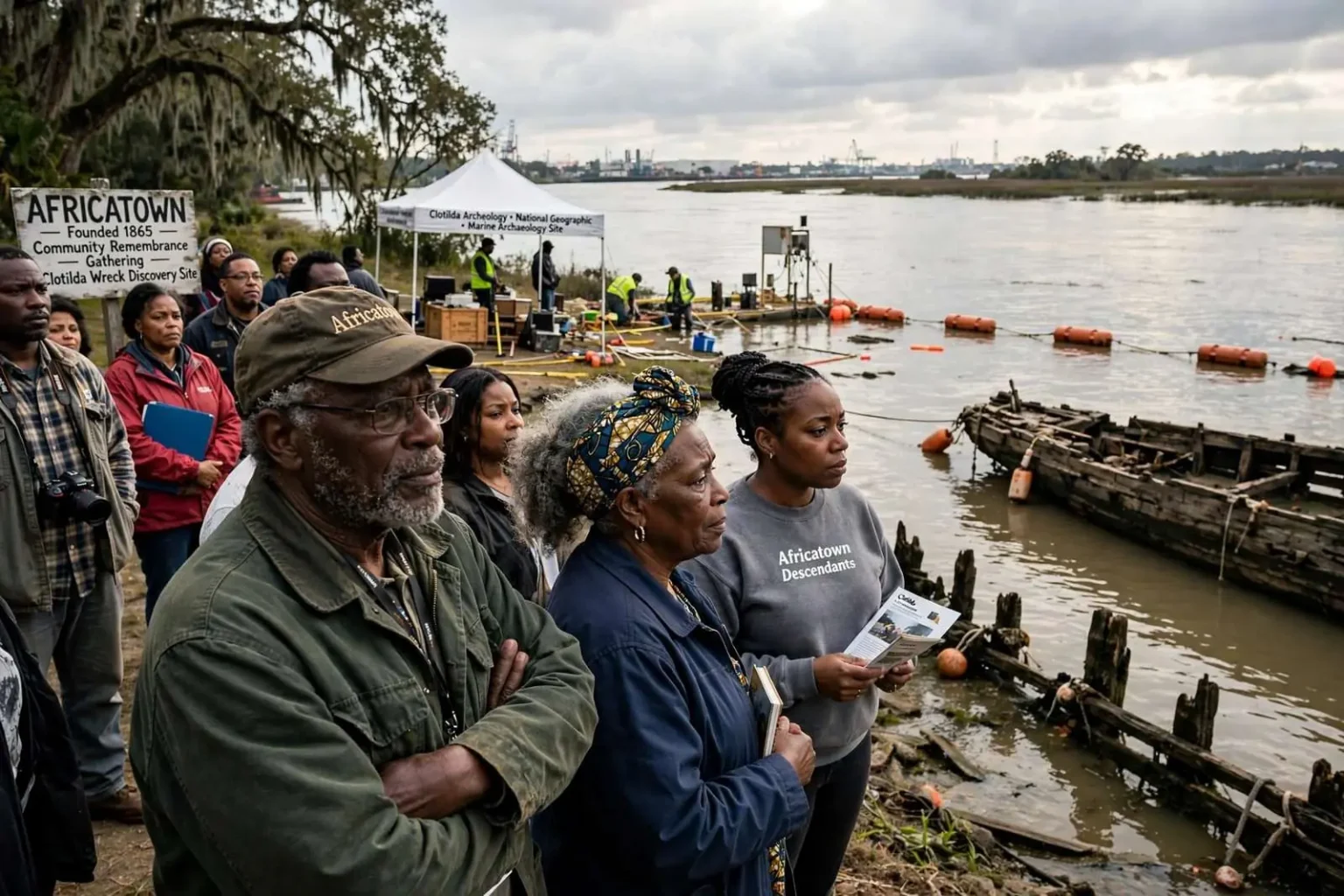
MOBILE — Nearly 160 years after the Clotilda sank in the Mobile River, the remains of the last known slave ship to arrive in the United States have been found — and the Africatown community is celebrating a discovery that many residents have waited their whole lives to hear.
The Clotilda departed from Mobile in 1860, more than 50 years after the United States banned the importation of enslaved people. The ship illegally carried 110 Africans back to Mobile, where the survivors eventually established the community now known as Africatown. For generations, the ship’s existence was passed down as oral history among descendants. Now it has been physically located in the river.
The finding closes one of the most remarkable chapters in American maritime history. The Clotilda’s voyage came more than half a century after Congress ended the legal importation of enslaved people in 1808, making the 1860 crossing a brazen criminal act carried out in secret. After delivering its human cargo up the river from Mobile Bay, the schooner was scuttled and burned to destroy the evidence of the illegal voyage, and for more than a century its exact resting place in the waters north of Mobile was a matter of legend as much as record.
Descendants Say the Discovery Brings Their Ancestors’ Story to Life
“It’s no longer a puff of smoke, it’s real,” said Darron Patterson, a descendant of one of the people brought to Mobile aboard the Clotilda.
Joycelyn Davis, a descendant of Clotilda passenger Charlie Lewis, said learning the ship had been found gave her chills. “Thinking about my ancestors on that boat, listening to the waves, listening to the waters, the screams,” she said.
Patterson reflected on what the enslaved Africans endured during the crossing and after their arrival. “Two months on a boat and got here. They persevered,” he said. “And then after that, they still couldn’t go home, and they made their home right here. That’s unreal. That’s character that we need today.”
The reaction in Africatown, the community founded by the Clotilda survivors just north of downtown Mobile, has carried the weight of a century and a half of waiting. The survivors of the voyage settled together after they were freed, building homes, churches and schools along the Mobile River and naming the area African Town — a place where West African languages, traditions and family names survived in America long after the ship that carried them disappeared beneath the river.
For descendants, the discovery transforms a story that lived in family oral tradition into documented, physical history. Many Africatown families grew up hearing that a ship lay in the river and that their grandparents’ grandparents had arrived on it, and the confirmation of those accounts has been described by community members as both a burden lifted and a responsibility accepted — the burden of doubt removed, the responsibility of preserving and telling the story that follows.
The Africatown community itself stands as one of the most distinctive settlements in the United States. Founded by Africans who arrived in bondage in 1860 and were freed at the end of the Civil War, it remains the place in America where a community was established by people who remembered life in their West African homelands. That heritage has drawn renewed attention to the community’s churches, its cemetery and its place in Alabama’s coastal history, and the discovery of the Clotilda has already brought visitors, researchers and journalists to the neighborhood north of Mobile’s downtown.
Senator Pushes to Add Clotilda to State Curriculum
The impact of the discovery is expected to reach well beyond Africatown. State Senator Vivian Davis Figures said she wants to explore adding the Clotilda’s story to Alabama’s public education curriculum — not just during Black History Month in February, but year-round.
“This is all of our story, and I think it’s something that we really can use to start healing,” Figures said.
She added that the Clotilda belongs to the people of Alabama and that Africatown residents will be involved in decisions about what happens next with the ship. That commitment to community involvement reflects the long history of Africatown residents advocating for recognition of their heritage, and it signals that the descendants who preserved the Clotilda’s story for generations will have a voice in how the wreck is handled, studied and remembered.
Figures said she envisions parts of the ship being recovered and a replica built so that visitors can walk through it and learn the full story of Africatown and the Clotilda. A replica, she suggested, would give schoolchildren and tourists from across the country a tangible way to understand the voyage the 110 Africans endured and the community they built afterward, turning the discovery into an educational resource for the state.
The National Geographic Society is conducting DNA testing on wood extracted from the ship and from nearby soil, hoping to identify the people who were aboard the vessel more than 150 years ago. The scientific work underway on the wreck has drawn on marine archaeologists, historians and conservation specialists, and the combination of forensic analysis and documentary research is expected to add substantially to what is known about the ship’s construction, its final voyage and the people who survived it.
A Story That Refused to Sink
The Clotilda’s passage from legend to confirmed wreck site followed decades of searches, false alarms and stubborn family testimony. Stories of the ship’s burning circulated in Africatown from the days of the survivors themselves, and over the years treasure hunters and researchers periodically claimed to have located the wreck, only for experts to rule the candidates out. The vessel that has now been identified in the Mobile River matched the historical record of the schooner’s dimensions and construction in a way earlier candidates did not, giving researchers confidence that the last slave ship had finally been found.
The 110 Africans brought aboard the Clotilda in 1860 came from West Africa at a moment when the transatlantic slave trade had been illegal in the United States for more than 50 years. The financiers and crew of the voyage knew the risk: smuggling enslaved people into the country carried criminal penalties, and the ship’s burning after the landing was a deliberate attempt to erase the evidence. That attempted erasure is precisely what the discovery now undoes, returning to the historical record a crime that was nearly hidden and a community that was nearly forgotten.
What happened next made the story singular. The people who survived the Clotilda did not scatter after emancipation. They pooled their earnings, bought land north of Mobile and built a self-sustaining community where they could speak their languages, raise their children and honor their traditions. Africatown became a living monument to that choice, and its residents have carried the memory of the voyage from 1860 through the generations to the present day.
For Mobile, the discovery adds a profound chapter to the city’s relationship with its own history. The port city’s maritime past — its shipyards, its river traffic and its role in the Gulf economy — now includes physical evidence of one of the darkest trade routes in American history, preserved in the cold, low-oxygen depths of the Mobile River where the schooner was sunk to hide it.
Community leaders in Africatown have said the next steps — preservation, recovery, education and memorialization — belong to a conversation that includes the descendants first. With the state’s senators, historians, scientists and national institutions now engaged, the story of the Clotilda and the 110 people who survived it stands to be told to audiences far beyond the neighborhood where it has never stopped being told.
The discovery has also energized long-running conversations about investment in Africatown itself. The community north of Mobile has seen population decline and economic disinvestment over the decades even as its historical significance became better known, and residents have advocated for heritage tourism, improved infrastructure and recognition of landmarks such as the community’s historic cemetery. The confirmed presence of the Clotilda in the nearby river gives those efforts a focal point, connecting the neighborhood’s future development to the story that began with the 110 survivors who founded it.
Historians note that the Clotilda’s survival as a wreck is unusual. Most vessels involved in the illegal trade were broken up or converted, leaving almost no physical record of the era’s final years of slave importation. The schooner’s hulk in the Mobile River is therefore regarded by researchers as an internationally significant archaeological site — the only confirmed remains of a ship that completed an illegal slave voyage to the United States — and the care with which it is documented and preserved will shape what future generations can learn from it.
In Africatown, the celebration of the discovery has been tempered by the weight of what it represents. Descendants describe a mixture of grief for what their ancestors endured, pride in what those survivors built and determination that the story be taught accurately. Patterson’s words about perseverance — people who spent two months on a boat, arrived with nothing, and made a home rather than going home — have become the way many in the community frame the find: not only the recovery of a ship, but the confirmation of a legacy carried by families who never stopped telling it.