After Two and a Half Years Without an Officer, Fulton Swears In Police Chief Hiram Gunter
Hiram Gunter was sworn in Sept. 1 as police chief of Fulton, which has been without a police officer for roughly two and a half years and without a full-time chief since 2008. He is currently the town's only officer.
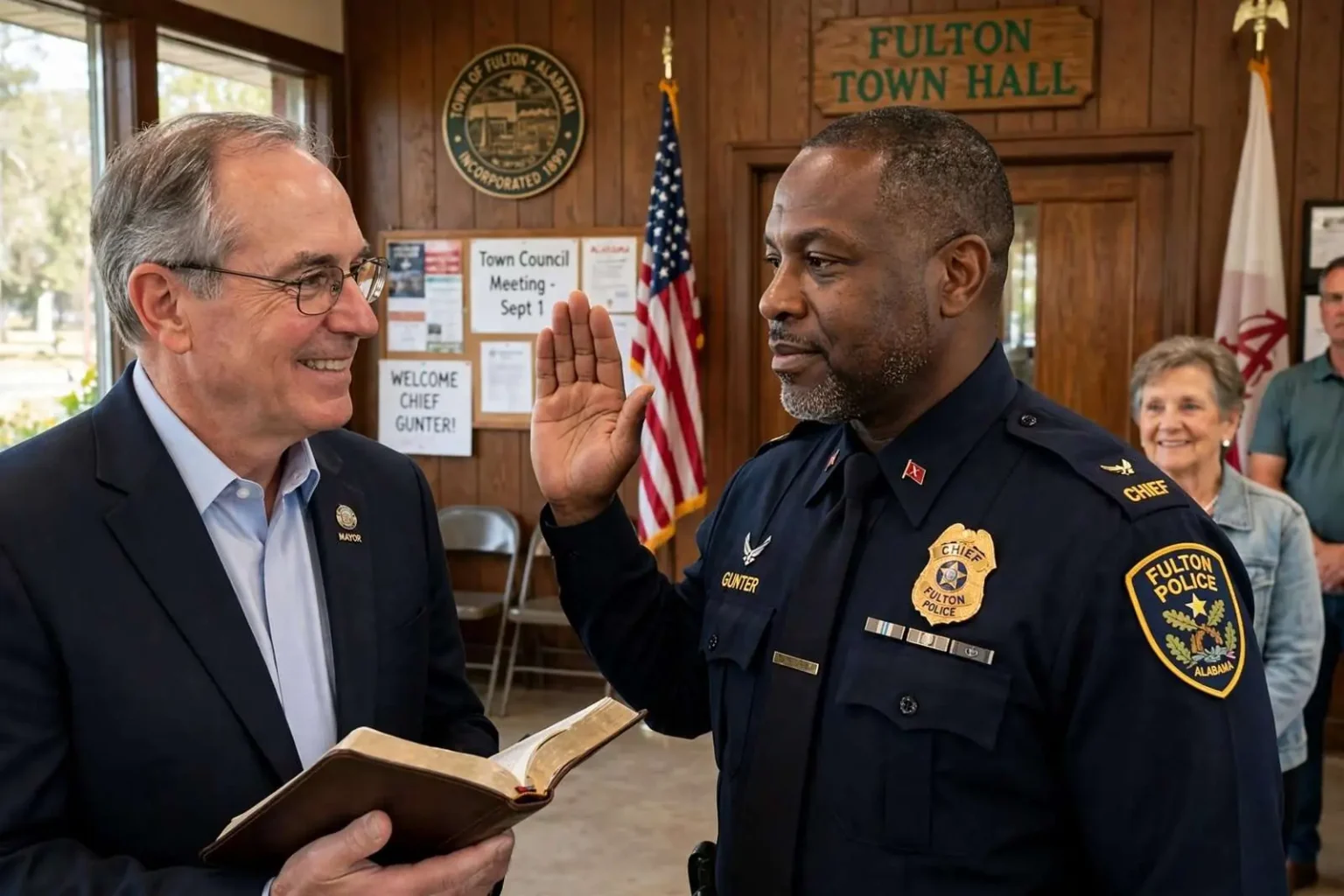
FULTON, Ala. — For roughly two and a half years, the Town of Fulton had no police officer at all. For nearly two decades, it had no full-time police chief. On Sept. 1, both of those streaks ended with the same swearing-in.
Hiram Gunter took the oath as Fulton’s police chief in a ceremony at Fulton Town Hall. He is currently the town’s only police officer.
“I look forward to getting to know everyone here,” Gunter said. “I look forward to serving Fulton.”
Who He Is
Gunter brings nearly eight years with the Jackson Police Department to the position, where he most recently served as a sergeant. During his time with JPD, he also ran the Alabama Drug Abuse Resistance Education program out of Jackson.
Before that, he spent 21 years in the U.S. Air Force, serving in law enforcement for approximately 18 of them.
Gunter is a native of Carlton and graduated from Jackson Academy in 1996. He spent nearly eight years working under Jackson Police Chief J.T. Moore, who Gunter said taught him to take care of the people he leads.
That combination — military law enforcement experience, municipal police experience in a neighboring town, and deep local roots — describes a candidate profile that small Alabama towns look for and frequently cannot find.
His Approach
Asked about the role, Gunter returned repeatedly to the same idea.
“The biggest thing is being a servant leader,” he said. “In these roles in law enforcement, from a patrolman all the way to chief, it’s about being a servant leader.”
He said law enforcement gives officers the opportunity to help people during some of the most difficult moments of their lives.
“Unfortunately, most times we see people in their worst days but you still have to be able to take care of them and guide them in the direction that they need to go,” he said. “It’s a challenge sometimes but that’s one of the great things about law enforcement is you get to help people.”
He was equally direct about where authority comes from in a town of Fulton’s size.
“Without the people, we don’t have a city,” Gunter said. “Without the city, we don’t have a department. So, I rely on them more than they rely on me.”
What the Town Has Been Without
Fulton has been without a police officer for approximately two and a half years and has not had a full-time police chief since 2008.
In practical terms, that means law enforcement services in the town have come from the Clarke County Sheriff’s Office and, where applicable, from the Alabama Law Enforcement Agency. Those agencies cover a large area — Clarke County spans roughly 1,200 square miles — and a call from a small town competes with calls from everywhere else in the county.
The difference a municipal officer makes in that context is less about serious crime, which sheriff’s deputies handle regardless, than about everything below it: response time on routine calls, enforcement of municipal ordinances, traffic enforcement on town streets, and the simple fact of a police presence that residents recognize.
How Small Towns Lose a Police Department
Fulton’s situation is not unusual in rural Alabama, and the mechanism by which small towns end up without police coverage is well understood.
Municipal police departments are expensive relative to a small town’s revenue base. A single officer represents salary, benefits, training, a vehicle, equipment, uniforms, insurance and liability exposure. Providing coverage across all hours requires several officers, which multiplies every one of those costs.
Small departments also struggle to retain officers. An officer trained and certified at a small town’s expense becomes a candidate for larger departments that can offer better pay, more advancement and specialized assignments. Rural towns frequently function as unintentional training grounds for the agencies that recruit their officers away.
When a town cannot fill positions, coverage falls to the county. When that arrangement persists long enough, the municipal department effectively ceases to exist even if it remains on paper.
Rebuilding From One
Mayor Danny Bedwell said town officials began working toward hiring a chief last November.
“This is something we’ve been working and praying for,” Bedwell said. “It’s a big day for Fulton. We appreciate Hiram taking this chief position.”
A department of one presents a specific set of challenges. A single officer cannot provide continuous coverage; there are hours, days and weeks — vacation, illness, training — when the town will still rely on the sheriff’s office. Backup on any call comes from another agency. The chief of a one-officer department is also its patrol officer, its investigator, its evidence custodian, its records clerk and its budget manager.
Gunter identified the relationships that will determine whether that works.
“Building relationships with residents and neighboring law enforcement agencies will be critical as Fulton moves forward,” he said.
Mutual aid arrangements — formal or informal agreements under which neighboring agencies assist one another — are how small departments function safely. For a one-officer department, those relationships are not a convenience; they are the operational foundation.
The D.A.R.E. Background
Gunter’s work running the Alabama Drug Abuse Resistance Education program out of Jackson is worth noting for what it suggests about the role he may play in Fulton.
D.A.R.E. officers spend substantial time in classrooms, working with students and school staff rather than responding to calls. It is a role that builds the kind of familiarity between an officer and a community that is difficult to establish through enforcement contact alone — and in a small town, that familiarity is much of what a police department actually provides.
Fulton and Clarke County
Fulton is a small town in Clarke County, in the timber country of southwest Alabama between Grove Hill and Thomasville. It is one of five Clarke County municipalities — along with Grove Hill, Jackson, Thomasville and Coffeeville — that contract with the county to house municipal inmates at the Clarke County Jail, an arrangement the County Commission updated this week when it approved new per-diem rates.
That detail illustrates how small-town law enforcement works in practice. A town the size of Fulton does not operate a jail; it pays the county to hold the people its officer arrests.
What Comes Next
For Fulton officials and residents, Gunter’s appointment represents the beginning of an effort to rebuild law enforcement services in the town rather than the completion of one.
Whether the department grows beyond one officer will depend on the town’s finances and on whether Fulton can recruit and retain additional personnel — the same constraints that produced the gap in the first place.
South Alabama News will follow the rebuilding of Fulton’s police department.