
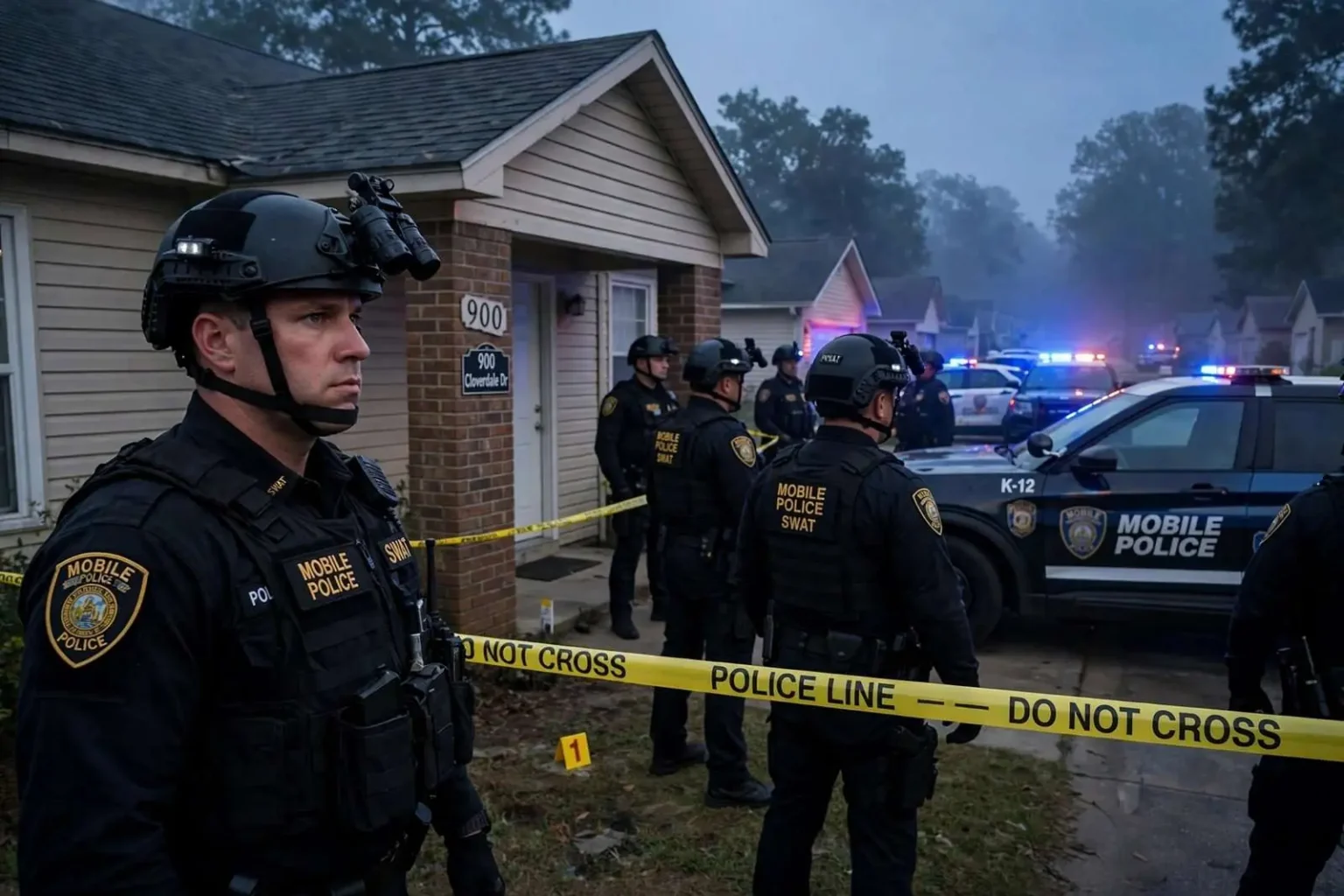
A Mobile SWAT team executing a drug search warrant shot and killed a pit bull that charged and bit an officer early Wednesday morning, according to the Mobile Police Department. The raid, which took place at a home on the 900 block of Cloverdale Drive, ended with two residents under arrest and methamphetamine seized from inside the residence.
Officers arrived at the home in the early morning hours to carry out the warrant, and the encounter with the dog unfolded inside the residence itself. Police said the pit bull confronted the team as officers entered, then charged at and bit one of the SWAT officers before the officer fired, killing the animal. The bitten officer was transported to a local hospital for treatment, though police did not immediately disclose the extent of his injuries.
During the search that followed, officers reported finding 14.6 grams of methamphetamine along with drug paraphernalia. Two residents of the home — Alexander Maynard, 40, and Samantha Cole, 36 — were arrested at the scene and booked into the Mobile County Metro Jail. The investigation into the case remains ongoing, and police have not said what additional charges, if any, may follow.
How the raid unfolded
Search warrants executed by specialized units like Mobile’s SWAT team typically begin well before officers ever reach the front door. Investigators build the case through surveillance, informants and controlled purchases, then present the evidence to a judge to obtain a warrant. Raids are frequently scheduled in the pre-dawn hours, a practice law enforcement agencies use to maximize the chance that occupants are home and asleep, minimizing the risk of a confrontation in which a suspect has time to arm himself or destroy evidence.
Entry teams announce themselves and move quickly through the structure, securing each room in sequence. Dogs are a persistent variable in these operations — Mobile County has a high rate of household dog ownership like the rest of the Gulf Coast, and residents often keep large breeds specifically for home protection. When officers breach a door, a dog’s instinct is frequently to charge the intruders, and encounters can escalate to bites within seconds.
That is what police say happened on Cloverdale Drive. Rather than unfolding in the yard or on the porch, the confrontation with the pit bull occurred inside the residence, where confined spaces give both the animal and the officers little room to maneuver. According to the department’s account, the dog bit one of the SWAT officers before that officer fired his weapon. Officers are generally trained to use lethal force against an attacking dog only when the animal cannot be avoided or contained, because a bite sustained during a dynamic entry can compromise an officer’s ability to function for the remainder of the operation.
The bitten officer
The officer who was bitten was taken to a local hospital for treatment. Police did not release the officer’s name, nor did they detail the severity of the wounds, saying only that the extent of the injuries was not immediately disclosed. Dog bites sustained during warrant service can range from shallow puncture wounds to deep tissue injuries to the arms, legs or hands, and they carry a well-known risk of infection that often requires antibiotics and, in some cases, follow-up procedures.
Under departmental practice, any use of force by an officer — including the shooting of an animal — typically triggers an internal review to determine whether the action fell within policy. The wounded officer’s recovery and the review of the shooting both sit alongside the criminal case now moving forward against the two arrested residents.
What officers found inside
The warrant search produced 14.6 grams of methamphetamine, according to police, along with drug paraphernalia. In Alabama drug cases, the quantity of the controlled substance recovered often shapes how prosecutors approach the charge. Possession of methamphetamine is a felony under state law, and amounts under the threshold that triggers a trafficking charge — 28 grams in Alabama — are typically charged as possession, though prosecutors can also pursue possession with intent to distribute based on circumstances such as packaging, scales, cash or the presence of paraphernalia associated with sales rather than personal use.
Paraphernalia recovered alongside the methamphetamine can include items like plastic bags, digital scales, smoking devices or materials used to repackage the drug. In a case of this kind, those items matter, because they can support a distribution charge that carries heavier penalties than simple possession. A conviction for methamphetamine possession in Alabama can bring years in prison and substantial fines, and prior convictions can raise the exposure significantly under the state’s habitual offender framework.
Methamphetamine has been a persistent enforcement focus for Gulf Coast law enforcement for two decades. Mobile County agencies, working alongside state and federal partners, have long targeted distribution networks that move the drug into the region, and neighborhood-level warrant raids like the one on Cloverdale Drive are a routine piece of that larger strategy. Departments describe such raids as aimed at mid-level and street-level dealers whose activity generates complaints from surrounding residents.
Who was arrested
Alexander Maynard, 40, and Samantha Cole, 36, were identified by police as residents of the home. Both were taken into custody at the scene and booked into the Mobile County Metro Jail, the intake facility where most people arrested within Mobile city limits are processed. Bookings at the Metro Jail typically involve fingerprinting, photographs, a records check for outstanding warrants and an initial appearance before a magistrate, who sets bond based on the charges filed.
The specific charges against Maynard and Cole were not detailed in the initial police account, and it is common in multi-occupant drug cases for charges to be assigned differently depending on where the evidence was found and each person’s alleged role. Prosecutors with the Mobile County District Attorney’s Office will review the case file once the investigation is complete and decide on formal charges, which can be amended as lab results confirm the identity and weight of the seized substance.
For the residents of the 900 block of Cloverdale Drive, the raid was the visible end of an investigation that had been building out of sight. Neighbors in areas where such warrants are served often report a heavy law enforcement presence that arrives quickly and concludes within an hour or two, with officers remaining to process the scene and gather evidence before the scene is cleared.
Why dogs so often end up casualties
Encounters between police dogs of the household variety and entry teams are a recurring feature of warrant service nationwide, and animal welfare groups have pressed departments for years to adopt tactics that reduce them. Common measures include gathering information about pets at a target address before the raid, using less-lethal deterrents when time and circumstances allow, and coordinating with animal control for post-raid custody of surviving animals.
In practice, though, the split-second geometry of a dynamic entry leaves officers little margin. A charging pit bull inside a residential hallway closes distance in a moment, and a bite to an officer’s hand or arm can drop a weapon or break bones. Departments train officers to shoot an attacking dog rather than retreat, because backing away inside a suspect’s home can expose the team to far greater danger from a human occupant. The result, in cases like Wednesday’s, is that an animal acting as many owners intend — guarding the home — is killed in the process.
Mobile police have not said whether any other animals were found in the home or what became of them. Nor have they said whether anyone in the residence other than the two arrested residents was present during the raid.
The warrant process and what comes next
The search warrant that brought officers to Cloverdale Drive was the product of an investigative file presented to a judge, who found probable cause to believe evidence of a crime would be found at the address. Once the raid is complete, the clock moves quickly on the legal side. Arrested individuals must be brought before a judge for an initial hearing, where bond is addressed, and prosecutors receive the case file — the warrant, the evidence inventory, officers’ reports and any lab results.
The 14.6 grams of methamphetamine recovered will be submitted for laboratory analysis to confirm its identity and weight, a step that anchors whatever charge is ultimately filed. Defense attorneys in such cases frequently examine the warrant’s supporting affidavit, the manner of entry and the chain of custody of the evidence, looking for grounds to challenge the search itself. If a court found the warrant defective or the search improperly conducted, the seized methamphetamine could be suppressed, sharply weakening the case.
Neither Maynard nor Cole has commented on the case, and no attorney information for the two was immediately available. Court records in Mobile County will reflect the formal charges once they are filed.
What it means for the neighborhood
For residents of the Cloverdale Drive area, a morning like Wednesday’s is disruptive but familiar to anyone who has lived near a targeted property. Streets are temporarily closed, neighbors are told to remain indoors, and the drawn-out processing of the scene keeps officers on the block for hours. Police routinely encourage residents who suspect drug activity at a nearby home to report it, saying that community tips are the origin of many of the warrants that are ultimately served.
The Police Department has framed neighborhood-level enforcement as part of a quality-of-life strategy: properties associated with drug traffic tend to generate ancillary problems — theft, vandalism, occasional violence — that spread outward to surrounding homes. Removing an active distribution point, in the department’s view, addresses those problems at the source.
The shooting of the pit bull, meanwhile, has become a routine-adjacent but emotionally charged feature of such raids. Animal lovers in the community often react strongly to news that a family pet was killed by police, even in cases where the animal bit an officer, and departments walk a line between defending their officers’ split-second decisions and acknowledging the loss felt by households whose dog did not survive the morning.
Neither the department nor the District Attorney’s Office has said whether any review of the dog shooting beyond the standard internal use-of-force review will take place. The criminal case against the two arrested residents is expected to move into Mobile County District Court in the coming weeks, where initial appearances and bond matters will be handled before any trial.
The investigation remains ongoing, and police said additional information would be released as it becomes available.


