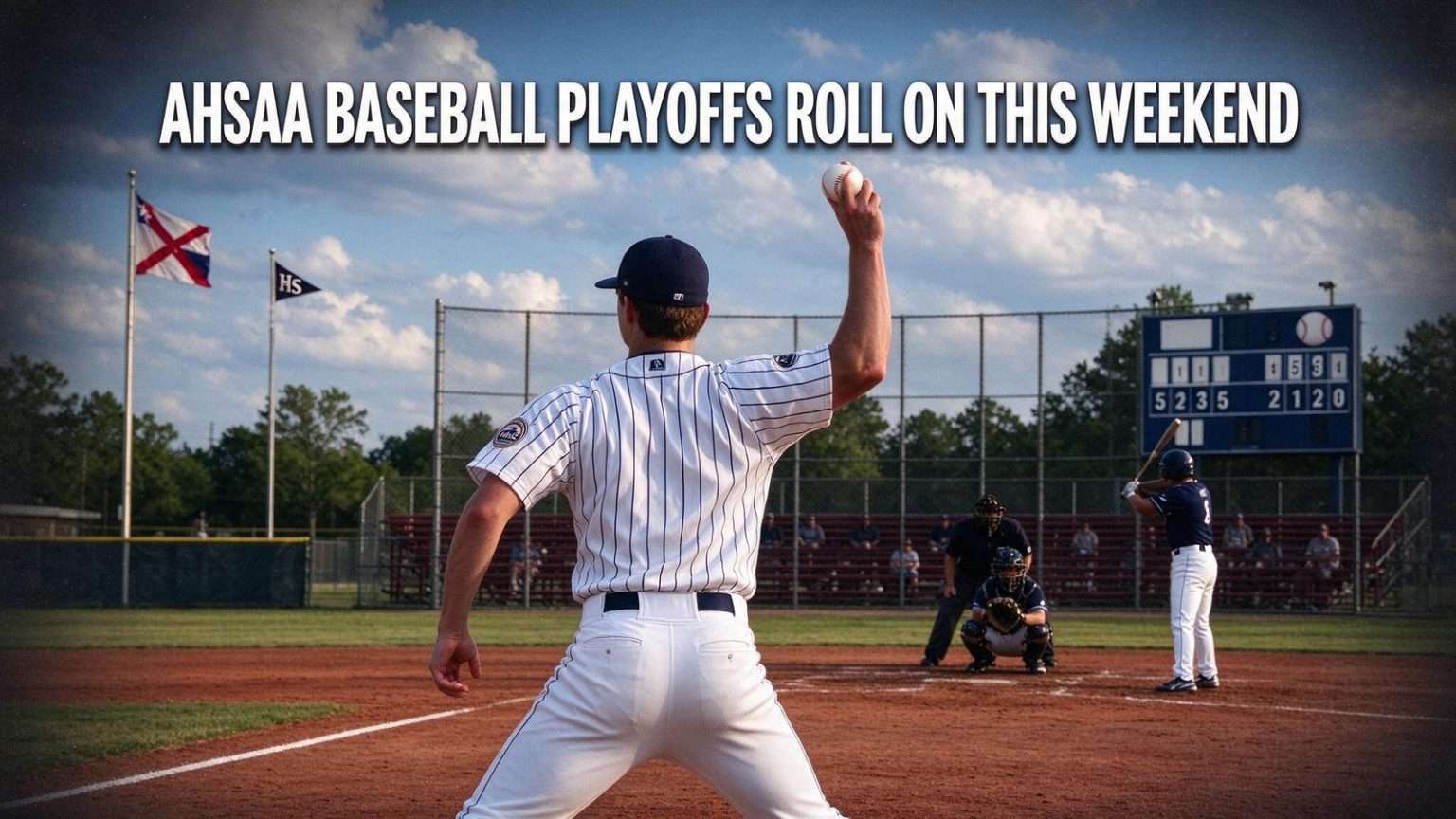
AHSAA baseball playoffs roll on this weekend across south Alabama
AHSAA state baseball playoffs continue this weekend with second-round games in Classes 1A-6A and first-round Class 7A matchups across south Alabama.
The Alabama High School Athletic Association state baseball playoffs continue this weekend with second-round games in Classes 1A through 6A and first-round action in Class 7A, sending surviving teams across south Alabama back to the field with their seasons on the line. Nine teams from the local coverage area won first-round games in Classes 1A-6A last weekend and keep their chase for a state title alive this week, a showing that underscores how deep baseball talent runs through the region’s schools.
Of those nine advancing clubs, six will play at home this weekend, an advantage that matters more in high school baseball than box scores suggest. Home teams sleep in their own beds, take batting practice on fields their players have known since middle school, and play in front of crowds of classmates and neighbors rather than a handful of traveling parents. Road teams, by contrast, arrive by bus and must win in someone else’s environment — one reason the AHSAA’s playoff format rewards regular-season success so heavily.
Four games involving Class 7A teams are on the schedule this week, with two of those contests set for the home field of a local team. Class 7A, the AHSAA’s largest classification, opened its postseason a round later than the smaller classes because of the size of its bracket, which means its first-round winners are only now aligning with the second-round schedule the other classes have already been playing through.
How the AHSAA playoffs work
The AHSAA organizes its member schools into seven classifications by enrollment, with Class 1A the smallest and Class 7A the largest, and each classification crowns its own state champion in every sport. Baseball’s postseason is built on area play during the regular season, which determines seeding, followed by a bracketed playoff run in rounds that narrow from the first weekend through the second round, quarterfinals, semifinals and the state finals.
Playoff series at this stage are typically played as best-of-three sets or single games depending on the round and travel distance, with the format dictating how coaches manage their pitching. Pitch counts and required rest rules limit how many innings any one pitcher can throw in a week, so deep playoff runs are built on staffs — two or three reliable starters and enough arms behind them to cover the games that pile up as the bracket advances.
Every remaining game is win-and-advance for the schools still alive in the bracket. The middle rounds are where rosters and seasons are tested: a team that cruised through area play now faces opponents that were good enough to win somewhere else, and the margin between advancing and going home shrinks from a season-long body of work to a single weekend’s execution.
What home field means in May
The six local teams playing at home this weekend carry a real edge. High school fields vary widely in dimensions, surface and wind, and hitters who have tracked fly balls off their own backstop for three years know angles that a visiting outfielder is learning in pregame warmups. Community support matters too — concession stands run by boosters, bleachers filled with students, and the familiarity of a routine that has not changed since February.
For the three local teams that must travel, the assignment is more demanding but not unfamiliar. South Alabama’s baseball teams regularly make road trips through the region during the regular season, and playoff-tested programs treat the road weekend as a collective challenge: arrive early, play clean defense early to quiet a home crowd, and get to the late innings with a lead or a tie.
The geography of south Alabama shapes those trips. Coverage-area schools span from Mobile and Baldwin County communities up through the smaller towns of the Pine Belt, and playoff travel can mean an hour on the bus or half a day depending on the draw. The AHSAA accounts for distance in scheduling, but by the second round, no remaining opponent is close enough to feel like a formality.
The local teams still standing
Nine first-round survivors is a strong showing for the coverage area, and the distribution across classes tells its own story. Small-town programs in the lower classifications have long been fertile ground for south Alabama baseball, where the sport is a spring anchor of community life and players grow up on the same fields where their fathers and uncles played. The larger schools, meanwhile, draw on deeper rosters and year-round travel ball pipelines that feed their varsity squads.
The second round is where those programs find out what they are. First-round series often pair a strong team against an unbalanced area runner-up, but by the second weekend the bracket has winnowed the field to teams that all won somewhere. Pitching depth gets exposed first — a staff built on one ace now needs a second arm to win a series — and the teams that advance are usually the ones that can string together quality innings from multiple pitchers across a weekend.
Coaches also manage the emotional side of the middle rounds. High school seasons end for most players each May, and the seniors on any eliminated roster walk off a field for the last time wearing that jersey. Teams still alive carry that awareness with them; the win-and-advance format means every game could be the last one a senior class shares, and that weight is part of what makes playoff baseball in small communities feel larger than the standings.
Class 7A’s late start
Class 7A’s first round arrives a weekend later than the other classes because the AHSAA’s largest classification plays a different path through the postseason, with fewer schools in the class and a bracket structured accordingly. The four 7A games on this weekend’s schedule therefore represent opening-round stakes — win or the season ends — while their 1A-6A counterparts are already deep in the second round.
Two of those 7A contests are set for the home field of a local team, giving area fans the chance to see playoff baseball close to home this weekend. The other two send local teams on the road, where the same pitching and pressure dynamics apply with the crowd working against them. First-round series have a way of setting the tone for a program’s entire postseason: an upset winner carries momentum into the second round, while a favorite pushed to a deciding game learns what its underclassmen can do under pressure.
The AHSAA’s classification system puts schools of similar enrollment in the same bracket, which is why a 7A first round looks different from a 1A second round even when both are played the same weekend. Schools in the largest class draw from student bodies many times the size of the smallest 1A programs, and the state title chases in each class run on parallel tracks until the champions converge on the state finals.
What a state title chase requires
Every team still playing this weekend is four or five rounds from a state championship, and the road from here demands the complete version of a roster. Playoff baseball punishes one-dimensional teams — a club that hits but cannot field bunts, or one that pitches well but strands runners — and rewards the programs that can win low-scoring games one night and slug their way through a shootout the next.
The semifinals and finals await at the end of the bracket, where the AHSAA stages its championship rounds and the last teams standing from each class meet for the title. South Alabama schools have a long history of reaching those final rounds, and the nine local teams still alive this weekend carry that tradition with them into the second round and the 7A first round.
For now, the schedule is the story: second-round games in Classes 1A through 6A, first-round games in Class 7A, nine local teams still chasing a state title, six of them at home, and four 7A games with two on a local field. Every remaining game is win-and-advance, and by Sunday evening the bracket will be a round smaller.
The shape of the weekend schedule
The second-round games in Classes 1A through 6A and the first-round games in Class 7A together make this one of the fullest weekends of the spring for south Alabama baseball fans. Communities with a home series get the kind of Friday-night-into-Saturday atmosphere that regular-season weeknights rarely build, while fans following a traveling team plan routes across the region to wherever the bracket sent their club.
For the nine local teams still playing, the weekend’s math is simple. A home team that takes care of business extends its season and guarantees at least one more week of practice; a road team that steals a series becomes the story of its class. The six home games and the traveling contingents together represent the broadest slice of the coverage area still represented in the postseason, and each result narrows the map.
Weather, as always in Gulf Coast spring, hovers over the schedule. Afternoon storms in May can push first pitches back or force series into split days, and coaches build flexibility into their weekend plans accordingly. The AHSAA allows games to be moved within the round’s window, so a rain-soaked Saturday can turn into a Sunday doubleheader without damaging a team’s path through the bracket.
Following the chase to the finals
The winners of this weekend’s games move into the quarterfinal round, where the remaining field in each class contracts and the road to the state finals comes into focus. By that stage, most surviving teams know the opponents left in their bracket from reputation if not from prior meetings, and the regular season’s results — area races, tournaments, non-region matchups between neighboring schools — begin to echo in the playoff pairings.
The state championship rounds cap the season, and south Alabama’s baseball programs have routinely been part of that final weekend across the classifications. The nine teams still alive carry that regional pedigree, and their combined presence in the second round and 7A first round keeps the coverage area in the state picture as May moves toward June.
For the communities involved, the next few days decide which programs keep playing and which turn to summer ball and next season’s roster. The weekend’s games — second round in Classes 1A through 6A, first round in Class 7A, six local teams at home, two 7A games on a local field — are the next step in chases that every one of them hopes ends with a trophy. Every remaining game is win-and-advance, and none of the teams still standing needs to be told what that means.