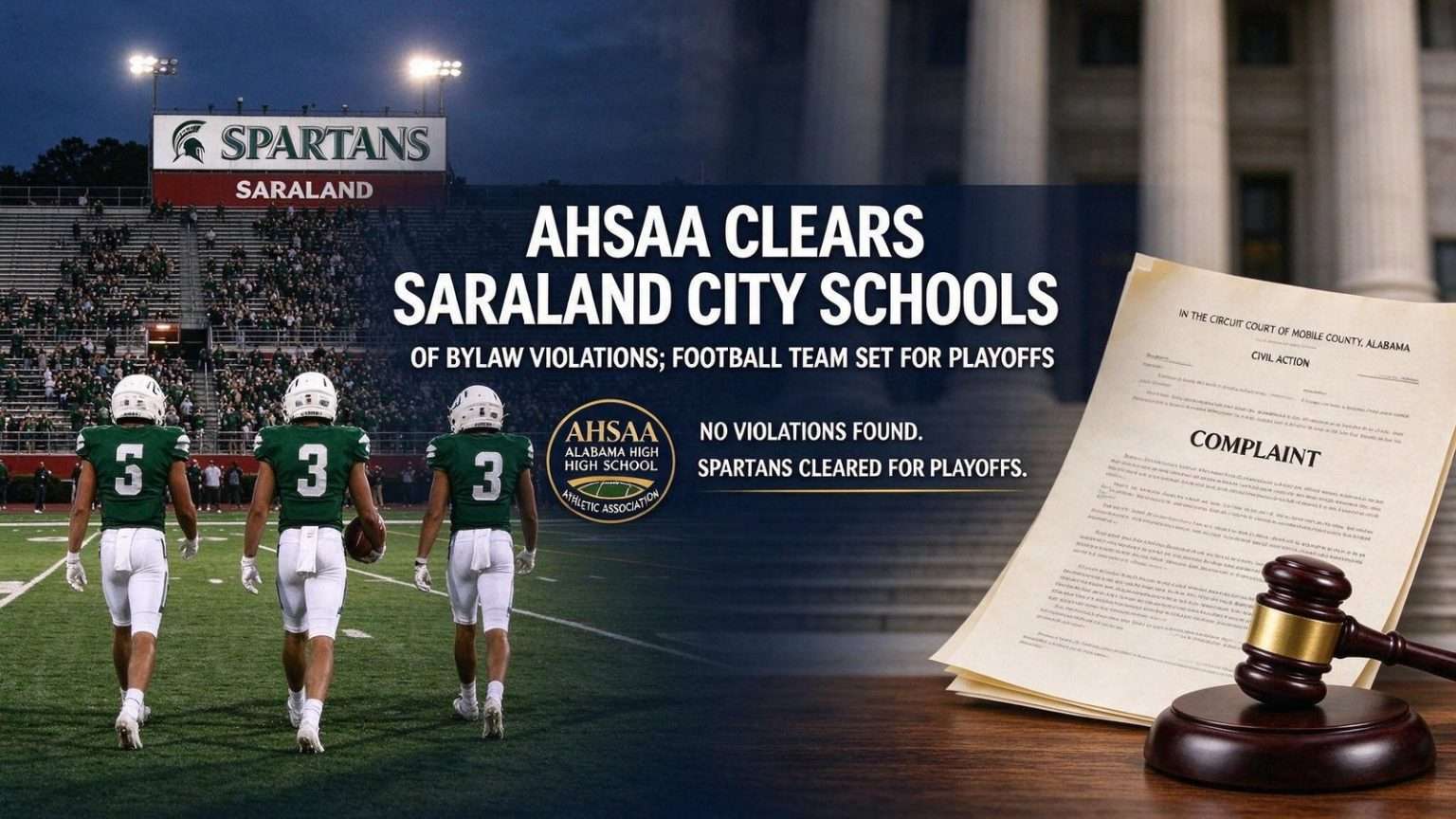
The Alabama High School Athletic Association has informed Saraland City Schools that Saraland High School is not in violation of any of its bylaws, according to the Saraland Superintendent, clearing the way for the Spartans’ football season to continue into the playoffs without interruption. The association had been investigating claims about a violation of player eligibility rules, and the finding that no rules were broken ends a dispute that had followed the program into the most important weeks of its season.
The inquiry was triggered after Spanish Fort High School received unsolicited information suggesting a Saraland player may have been ineligible, and the school’s principal requested that the association look into the matter, Baldwin County Schools confirmed. Under AHSAA procedures, any member school that receives information bearing on another school’s compliance can ask the association to investigate, and the association’s staff then gathers records, interviews, and documentation before reaching a determination.
What the AHSAA Does
The Alabama High School Athletic Association is the governing body for interscholastic athletics in the state’s public and most private high schools, overseeing everything from eligibility and transfers to classification, district alignment, and postseason play. Eligibility rules sit at the center of that responsibility. They are designed to ensure that students compete only where they genuinely reside and are enrolled, that athletic recruiting does not distort competition, and that every team on the field is playing by the same standards, regardless of how large its school or how successful its program.
Because eligibility questions can decide games, the association treats them seriously. An ineligibility finding can forfeit wins, bar a player from competition, and in extreme cases cost a program its playoff berth, which is why even the suggestion of a violation draws close attention from member schools. An official finding that no bylaws were broken, by contrast, allows a program to move forward with its standing intact — the outcome Saraland received this week.
Lawsuit Filed Against Accusers
The investigation unfolded against the backdrop of a legal fight. The Saraland City Board of Education filed a lawsuit against John Quinnelly Senior and Eric Winberg, a private investigator. According to court documents, the school board claims Quinnelly hired Winberg and directed him to stalk and harass the family of a 15-year-old child, and that Quinnelly made false and malicious statements attacking the student.
The suit further alleges that Quinnelly made allegations that Saraland City Schools violated Alabama’s competitive bid laws knowing the statements were false or intentionally misleading, and that the high school football coach and the school were in violation of player eligibility rules. Alabama’s competitive bid law generally requires public bodies to award significant contracts through an open bidding process, an obligation the board says it met and that Quinnelly’s claims wrongly suggested it did not.
In July, the Board of Education’s counsel delivered a cease and desist letter to Quinnelly regarding what the board described as defamatory and libelous statements. A cease and desist letter is a formal legal demand that a recipient stop specified conduct — in this case the publication of statements the board characterized as false — and it often precedes broader litigation if the conduct continues. The lawsuit itself seeks to hold Quinnelly and Winberg accountable in court for the allegations the board says were manufactured and spread about its operations and its people.
The path from those accusations to an AHSAA investigation shows how disputes that begin in one arena can spill into another. Once the eligibility claims reached Spanish Fort’s principal, the proper channel under association rules was a formal request for review, and that is precisely what occurred. The association then examined the player’s situation against its own bylaws and concluded that no violation existed, effectively closing the athletic chapter of the controversy even as the civil case continues in the courts.
The superintendent’s announcement of the finding marked the public end of that uncertainty. For coaches, players, and families who had spent weeks aware of the questions being raised, the confirmation that no bylaws were broken was more than a procedural note — it was a full vindication of a program that had done nothing wrong. School officials in Saraland have maintained throughout that the district’s operations, including its athletic program, follow the rules, and the association’s determination supported that position on the specific claims under review. It also spared the Spartans any postseason penalty tied to the allegations.
Eligibility questions of this kind typically focus on where a student lives, who the student lives with, whether any athletic motivation influenced an enrollment or transfer, and whether the paperwork supporting a player’s participation is in order. Until such a review is resolved there is often uncertainty about a player’s availability for the postseason. A clean finding resolves all of it: the roster stands as submitted, the season’s results stand, and the team enters the playoffs with nothing held against it.
What the Clearance Means for the Spartans
With the AHSAA’s finding that no bylaws were broken, Saraland’s football team will play Friday night in the 6A playoffs, hosting Wetumpka. The staging of a home playoff game is a meaningful advantage in Alabama high school football, where first-round matchups reward regular-season performance with a friendly crowd, familiar surroundings, and no travel burden on a short week of preparation.
Saraland is one of the newest city school systems in Mobile County, and its high school has built a reputation as a consistent contender since joining the highest levels of state classification. A playoff run brings an economic and community lift to the city as well: home games fill the stands with families, students, and local businesses benefit from the traffic, and the program’s success becomes part of the city’s identity. For a school system that has invested heavily in its campuses and programs, the assurance that its teams compete cleanly matters to more than just wins and losses.
Wetumpka, the visiting opponent, travels from Elmore County on the edge of the Montgomery metropolitan area, meaning a long trip for a postseason game against a team cleared to play at full strength. Playoff football in Alabama is a production that draws the entire community together, and the home crowd at Saraland will now be able to focus entirely on the game rather than the investigation that shadowed the week.
The Bigger Picture for Mobile County Athletics
The episode highlights the competitive intensity of high school football in south Alabama, where programs in Mobile and Baldwin counties regularly meet in games with playoff implications and where scrutiny of rosters and residency is a persistent undercurrent. Rival schools follow one another closely, and eligibility questions — fair or unfair — have become a recurring flashpoint whenever a program rises quickly through the classifications.
For school boards, the cost of defending against such claims is not only financial. Administrators and coaches spend time responding to inquiries, families caught in the middle of an investigation bear a personal toll, and the district’s reputation can take a hit from accusations that ultimately prove unfounded. That is the rationale behind the board’s decision to pursue the matter in court rather than simply weather it: a public school system that allows false statements about its bidding practices and its personnel to circulate unanswered invites more of the same.
The distinction between the two proceedings also matters for residents trying to follow the story. The AHSAA review was an administrative question — did a specific player meet the association’s eligibility bylaws? — and it has been answered. The lawsuit is a civil matter involving claims of harassment, defamation, and false statements, and it will be resolved on the court’s timetable, not the playoff schedule. A finding in one forum does not control the other, but the association’s clearance removes the competitive consequence that the eligibility allegations were meant to create.
It also illustrates how the pieces of the case fit together in the public record. The unsolicited information that reached Spanish Fort, the principal’s request for review, the AHSAA’s examination, and the finding of no violation form a chain that ends in a clean bill of health for Saraland’s roster. The separate chain — the lawsuit, the allegations about stalking and harassment directed at a child’s family, the claims about competitive bidding, and the July cease and desist letter — remains open, and it is in the courts where the board will seek answers about why the accusations were made in the first place. Residents following both threads should expect very different timelines: athletic eligibility questions move at the speed of a season, while civil litigation moves at the speed of the docket.
For now, the focus returns to the field. Saraland’s players, coaches, and fans get the outcome they wanted — a postseason that starts at home on Friday night, with the program’s eligibility fully cleared and its attention fixed on Wetumpka rather than on an investigation. Whether the broader legal battle with the men accused of instigating the claims will conclude as decisively remains to be seen in the courts.