AHSAA golf playoffs advance to sub-state tournaments
AHSAA golf playoffs move to sub-state tournaments May 3-4, with south Alabama teams chasing spots in the state championship at Magnolia Grove.
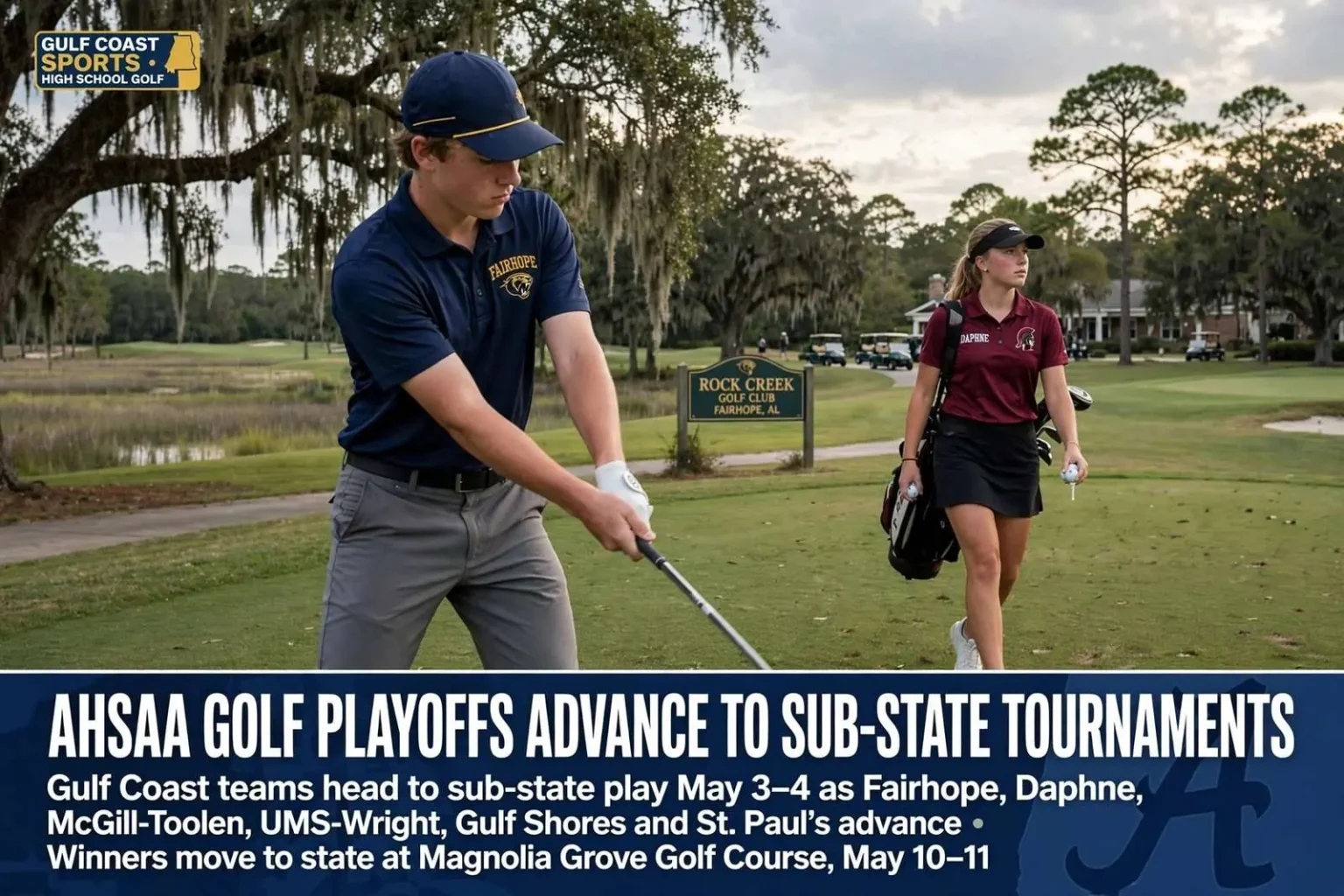
The Alabama High School Athletic Association opened postseason play in boys’ and girls’ golf with sectional tournaments and now moves to the second round, with sub-state tournaments scheduled Monday and Tuesday, May 3-4. For the qualifying teams, the calendar now compresses: eighteen holes stand between most rosters and the end of their season, while the winners who emerge carry their year forward one more week.
Several teams from the coverage area qualified for sub-state play, keeping the Gulf Coast’s strong representation in the bracket intact through the first cut of the postseason. Winners there advance to the state championships, set for May 10-11 at Magnolia Grove Golf Course, Mobile’s stop along the Robert Trent Jones Golf Trail — a home-state finale for the schools that make it, on a course many of them have played before.
Magnolia Grove gives the state tournament a stage worthy of the field. The RTJ Trail facility in west Mobile is a nationally recognized complex, its courses carved through the rolling terrain of the Mobile area with the risk-reward design the Trail is known for. Hosting the AHSAA’s championship rounds there puts high school golfers on the kind of course that hosts professional qualifying events, on ground a short drive from their own campuses.
In most classifications, the top four teams and the top four individual players not on qualifying teams earn spots in the sub-state tournaments. The dual track matters as much as the team race: golf’s individual medalist competition runs parallel to the team standings all season, and the sub-state field is built to preserve the seasons of strong players whose teammates could not keep pace — a golfer who shot well enough at sectionals advances even if his or her squad finished fifth.
State qualifiers will be the top two teams and top two individuals not on a qualifying team. The narrowing from four to two across one round of golf is the sport’s postseason math at its harshest — a single bad hole by a top scorer can flip a team’s total by four or five strokes, and at sub-state there is no next week to absorb it.
Sectional and sub-state events are 18 holes; the state tournament is 36 holes. The format shift matters for the schools that reach Mobile. Two-day tournaments reward depth and recovery — a team that shoots poorly in the opening round can still contend with a strong second day, and individual champions must sustain form across two entirely different weather windows and course conditions.
The Road Through the Section
In sectional results, Fairhope and Daphne led Class 7A, Section 1 at Lake Forest Golf Course, the two Eastern Shore rivals emerging from the sectional in the expected order of strength. Both programs carry the depth that 7A postseason golf demands, and both now take their seasons to Rock Creek with state berths one round away.
The Eastern Shore rivalry adds spice to the sub-state pairing. Fairhope and Daphne students see each other across every sport, in every season, and golf is no exception. Advancing through sectionals together means at least one more round of the rivalry, now with a trip to Magnolia Grove attached.
McGill-Toolen and UMS-Wright topped Class 6A, Section 1 at TimberCreek, sending Mobile’s two most tradition-rich private school programs on to sub-state. McGill-Toolen and UMS-Wright have stacked up championships across the AHSAA’s full sports calendar for decades, and their golf programs operate with the same year-round expectations — postseason qualification is assumed, advancement is the goal.
Gulf Shores and St. Paul’s led the Class 6A section at Azalea City, giving the south’s 6A bracket a Gulf Shores-to-Mobile axis. St. Paul’s enters sub-state with the pedigree of a program that competes for titles across classifications, while Gulf Shores carries the banner for the beach communities whose athletes drive the length of the county to practice and play.
Bayside Academy and Mobile Christian advanced in the smaller-class sections, keeping the smaller schools’ postseason hopes alive alongside the big classifications. The smaller classes often produce the postseason’s most compelling storylines — smaller rosters mean a single standout player can carry an entire program to Magnolia Grove, and the depth gap that separates 7A powers matters less when a team needs only to beat three opponents, not a full field.
The South Sub-State Map
South sub-state sites include Rock Creek Golf Club in Fairhope for Class 7A boys and girls, Mobile Country Club for Class 5A boys, and Heron Lakes and other courses across the region for the remaining classes. The geography favors the Gulf Coast’s qualifiers — while sub-state fields draw from across south Alabama, the site assignments put several of the local teams on courses within a short drive of their campuses, a logistical edge that is easy to undervalue.
Rock Creek’s placement of both 7A tournaments in Fairhope means the Eastern Shore’s qualifying teams play their biggest round of the year on home-adjacent ground. Familiarity with a course’s greens and its trouble spots — where to lay up, which pins to attack, how the wind moves across the property — is worth real strokes in an eighteen-hole qualifier decided by margins that small.
Mobile Country Club, a longtime fixture of the Mobile golf scene, gives the Class 5A boys a classic parkland test for their sub-state round. Heron Lakes and the region’s other assigned courses fill out the bracket, and the multi-site structure is how the AHSAA accommodates the full field of classifications without crowding any single course — each site hosts its own tournament simultaneously across the Monday-Tuesday window.
For coaches, the sub-state week is one of preparation and paring. Rosters set for sectionals get refined for the courses at hand — practice rounds on the host sites where schedules allow, putting work tuned to the week’s greens, and lineup decisions made with the top-two advancement standard in mind. Every coach in the field knows the arithmetic: four teams arrive, two leave with state berths, and the margin between them is usually two or three swings.
The individuals advancing without their teams carry a different kind of pressure and a different kind of freedom. A solo qualifier answers to no team scorecard; his or her round is the whole season. For those players — the top four individuals at each sectional who shot their way in — sub-state is a one-round season in itself, with the state tournament as the prize.
What Awaits at Magnolia Grove
The state championships at Magnolia Grove on May 10-11 will end the season for every classification that survives Monday and Tuesday. The 36-hole format on the RTJ Trail course will test exactly what the postseason has been building toward: depth across a scoring lineup, recovery after a bad stretch, and the kind of course management that two decades of Trail golf has taught Alabama players to expect.
For the Gulf Coast schools that qualify, the venue adds a dimension beyond competition. A state tournament in Mobile means home crowds, home beds and practice rounds on familiar ground — advantages the AHSAA’s other regions have long envied when the Trail sends championships south. Local golf has built toward this week all spring; the sectional results set the stage, and the sub-state round at Rock Creek, Mobile Country Club, Heron Lakes and the region’s other courses will decide who plays it out at Magnolia Grove.
The Postseason Structure Explained
The AHSAA’s golf postseason differs from its team-sport brackets in ways that shape how the season ends. There is no single-elimination drama, no regional final under the lights — just stroke play, one round at a time, with every stroke counted. That structure rewards programs built around consistency and course management rather than momentum, and it explains why the same Gulf Coast schools tend to surface at Magnolia Grove year after year.
The sectional round that opened the postseason did the first sorting. Section tournaments group schools geographically, and the results that sent Fairhope, Daphne, McGill-Toolen, UMS-Wright, Gulf Shores, St. Paul’s, Bayside Academy and Mobile Christian forward established the Gulf Coast’s presence across classifications. The sectional also produced the list of advancing individuals — the golfers whose personal scores earned them a sub-state berth regardless of their team’s total.
Class 7A, the AHSAA’s largest classification, presents the deepest fields and the thinnest margins. Programs of that size draw from the largest pools of junior golfers, and the difference between the state tournament’s two berths and the third team’s season-end often comes down to a single player’s back nine. The same arithmetic holds in the girls’ bracket, which runs through Rock Creek in Fairhope alongside the boys.
The sub-state week also serves as the unofficial showcase of the region’s public and private courses. Municipal and country-club layouts across south Alabama take on tournament conditions for two days — firm greens, pinned flags, tee times run with championship pacing — and the players who advance carry that experience to Magnolia Grove, where the state’s championship courses are set up the same way. Postseason golf in Alabama is, in part, a tour of the state’s best courses, and the south sub-state sites are a strong first stop.