Air Lease Corporation Takes Delivery of First U.S.-Built A321 From Mobile Plant
Air Lease Corporation has taken delivery of its first U.S.-built Airbus A321, assembled at the Mobile manufacturing facility, before the jet enters service with Frontier Airlines.
Air Lease Corporation has taken delivery of its first Airbus A321 built entirely at the manufacturer’s final assembly line in Mobile, marking another milestone for the coastal Alabama facility as it continues to expand its footprint in the U.S. commercial aviation market. The delivery places one of the industry’s most closely watched leasing firms among the customers receiving jets assembled on the Gulf Coast, and it adds another data point to Mobile’s argument that it belongs among the established centers of commercial aerospace manufacturing.
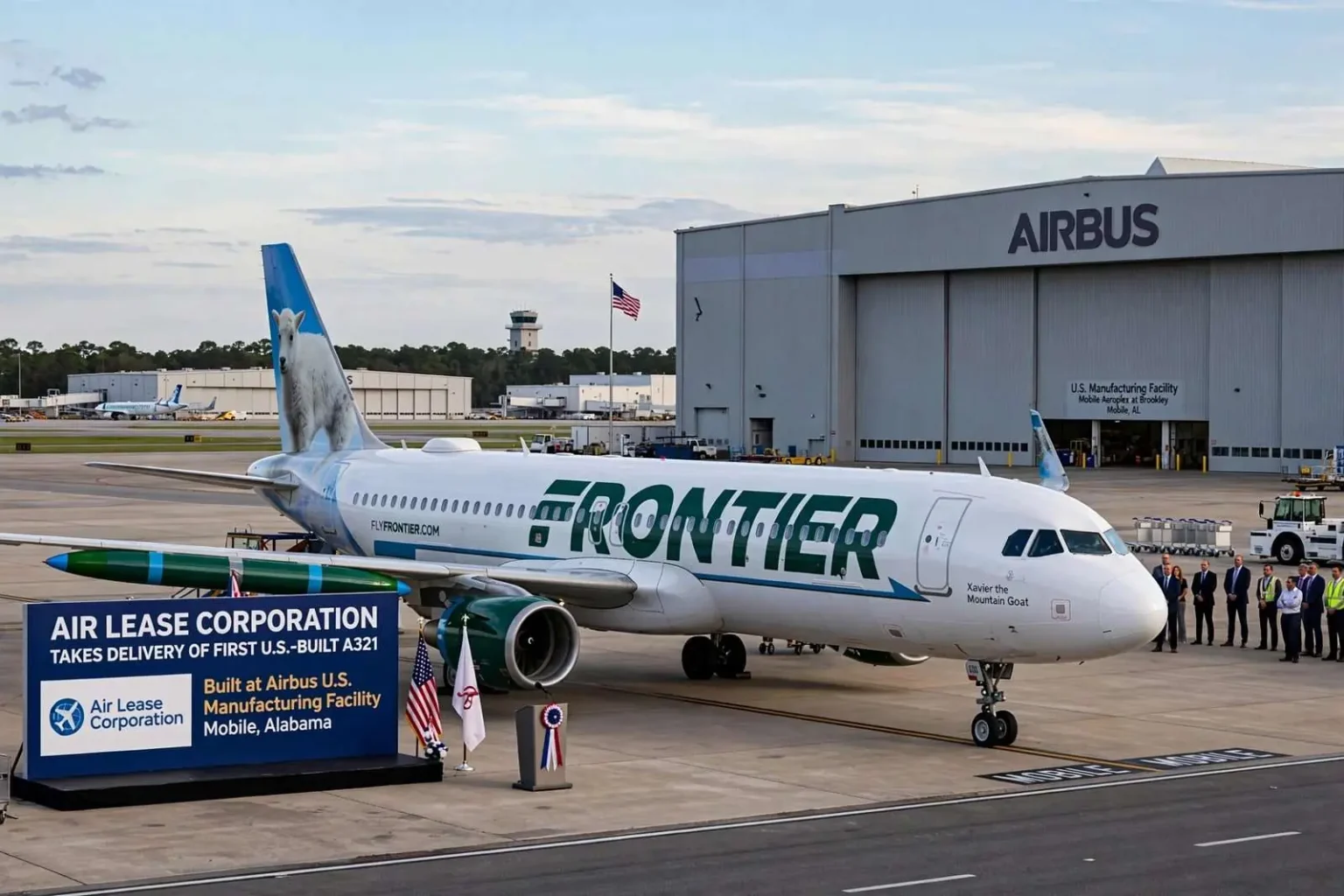
The single-aisle jet rolled off the line at the Airbus U.S. Manufacturing Facility on Mobile Aeroplex property at Brookley before heading into service with Frontier Airlines, the Denver-based low-cost carrier that will operate the plane under a lease agreement with Air Lease Corporation. The path from the Mobile assembly floor to a leased airliner flying for a major U.S. carrier captures the way the modern aviation industry actually works: manufacturers build, lessors buy, and airlines fly — often without an airline ever owning the metal beneath its passengers.
The aircraft carries Frontier’s signature branding, including an image of Xavier the Mountain Goat painted on its tail, along with fuel-saving wingtip devices known as Sharklets. The distinctive animal-tail livery is part of Frontier’s branding strategy, with each named animal tying a specific airframe to the airline’s conservation-themed marketing. The Sharklets, tall wingtip extensions that reduce drag, are a visible feature of the A320 family and translate into measurable fuel savings over an aircraft’s service life.
A First for Frontier’s U.S.-Built Fleet
For Frontier, the delivery represents the airline’s first U.S.-assembled A321ceo, adding a larger variant to a fleet that has already welcomed six A320neo aircraft built at the same Mobile facility and delivered directly to the airline by Airbus. The A321 seats more passengers than the A320, giving Frontier additional capacity as it grows routes across its network. For an ultra-low-cost carrier, extra seats on the same trip are the essence of the business model — more revenue per flight with only a marginal increase in operating cost.
The ceo variant the airline received from Mobile represents the current engine-option generation of the A320 family, complementing the neo aircraft Frontier has been taking from the same assembly line. Running both variants alongside each other gives the carrier fleet flexibility while its crews, maintenance programs and gate operations accommodate a mix of the two types — a common approach for fast-growing low-cost carriers.
Air Lease Corporation Joins the Mobile Customer List
Air Lease Corporation, a major global aircraft leasing firm that buys planes from manufacturers and leases them to airlines around the world, becomes the eighth U.S.-based customer to take delivery of an aircraft from Airbus’s Alabama assembly operation. Los Angeles-based Air Lease is one of the largest aircraft lessors in the world, and its purchase orders with both major airframers run to hundreds of aircraft. When a lessor of that scale begins accepting deliveries from a particular factory, it signals confidence that the plant’s output meets the standards demanded by airlines on every continent.
Leasing firms occupy the quiet middle of the airline business. By purchasing aircraft and placing them with carriers under multi-year leases, they take on the capital costs and residual-value risk that airlines would otherwise carry, freeing carriers to grow their networks without tying up balance sheets in aircraft ownership. A Mobile-built A321 entering Air Lease’s fleet and flying with Frontier shows the full financing chain in a single airframe.
The Mobile Plant’s Growing Role
The Mobile plant, which opened in 2015 along the Mobile River, builds A320 family aircraft, including the A319, A220 and A321 variants, for both airlines and leasing companies that supply jets to carriers worldwide. The facility was Airbus’s first final assembly line on U.S. soil, a landmark decision that followed years of courting by state and local officials and was reinforced by the presence of a large Airbus engineering center and the wide-body A330 assembly work that followed at Brookley. Rising jets assembled from sections shipped by sea to the Port of Alabama have become a familiar sight over Brookley Field, the former Air Force base that now anchors the city’s aeroplex.
The facility has steadily grown its output and workforce since production began, becoming a significant employer in the Mobile area and a symbol of the region’s push to build a diversified aerospace and manufacturing sector. Employment at the plant and among its suppliers runs to thousands of jobs, and the assembly line’s presence has helped recruit aerospace suppliers, maintenance providers and training programs to the region — including the aviation mechanics and aerospace workforce pipelines that feed the plant and its neighbors along the Gulf Coast.
Each delivery from the plant is closely watched locally as a gauge of the facility’s expanding role within Airbus’s global production network and its importance to the Gulf Coast economy. Mobile now competes with final assembly lines in Toulouse, Hamburg, Tianjin and elsewhere for the aircraft Airbus builds for the North American market, and every milestone order extends the plant’s footprint in that network.
What It Means for Mobile
Local officials and economic development leaders have pointed to the Airbus operation as a cornerstone of Mobile’s aerospace industry, which has drawn additional suppliers and support businesses to the area in the years since the assembly line opened. Continued orders and deliveries, such as this one to Air Lease Corporation, are viewed as evidence that the investment in the Mobile facility continues to pay dividends for the regional economy — in direct manufacturing wages, in the supplier firms that have followed Airbus to the area, and in the city’s growing reputation among site selectors evaluating the Gulf Coast for aerospace work.
The arrangement behind this particular aircraft also reflects how the plant has broadened its customer base. Early deliveries flowed to launch airlines such as JetBlue and American; adding lessors like Air Lease to the customer list means Mobile-built jets can end up flying for any carrier the lessor serves, spreading the “Made in Alabama” label across route networks worldwide. For Frontier, meanwhile, the leased A321ceo arrives as the airline pushes capacity growth from its Denver hub, and for Mobile it is one more jet rolling out of Brookley — each one carrying the region’s aerospace ambitions with it into the sky.
How an Airbus Jet Comes Together at Brookley
Understanding the delivery requires a look at how the Mobile operation works. The A320 family aircraft assembled at Brookley arrive as major sections — fuselage barrels and nose sections from Europe — shipped across the Atlantic to the Port of Alabama, then move a short distance to the plant for mating, systems installation, painting, cabin completion and ground and flight testing. The process takes weeks per aircraft and follows the same certification standards applied at Airbus’s European lines, which is why airlines and lessors treat a Mobile-built jet as identical to one built anywhere else in the manufacturer’s network.
Brookley’s location is central to the operation’s logic. The Mobile Aeroplex offers deepwater port access adjacent to the runway, allowing the giant section-carrying ships to dock within a few miles of the assembly hall. That logistical advantage — unique among Airbus’s assembly sites — lowers shipping costs for the North American market, where the manufacturer has been competing for share with its Boeing rivals in the workhorse single-aisle segment that airlines fly more than any other.
The A321 itself occupies the top of the A320 family’s size range, trading a longer fuselage for more seats and greater range potential. It has become the growth aircraft of its class, favored by both traditional and low-cost carriers for busy transcontinental and trunk routes. Every A321 that rolls out of Mobile adds to the line’s share of that demand.
Frontier and the Low-Cost Growth Model
Frontier’s use of the aircraft illustrates why low-cost carriers lean on the larger variant. The airline’s fares are structured around ancillary revenue — bag fees, seat selection and other charges — with the base fare kept low, so each additional passenger on a flight carries high margin. An A321 delivers that capacity without requiring new gates, crews trained on a different aircraft family, or maintenance programs beyond the A320 types Frontier already operates.
Leasing makes the growth possible on the schedule the airline wants. Purchases direct from the manufacturer carry multi-year delivery waitlists, while lessors acquire aircraft in volume and can place them with airlines at the pace those airlines’ route plans demand. Air Lease’s model — long-term leases with carriers across the Americas, Asia and Europe — means the same Mobile-built jet might eventually serve more than one airline over its life, repainted and reconfigured between operators.
For the region, each such arrangement deepens the plant’s integration into the commercial aviation mainstream. The delivery to Air Lease, flying first with Frontier under the mountain goat tail, is one airframe — but it threads together the port, the plant, a global lessor and a national airline, all anchored to a Gulf Coast city that two decades ago had no commercial aircraft assembly at all. Local leaders who count each delivery as evidence of momentum have, in this case, an unusually complete illustration of why the industry’s attention keeps returning to Mobile.