Airbus Hosts Career Fairs to Staff Its Mobile Production Lines
Airbus scheduled Southeast career fairs July 29-Aug 1, 2019 to hire engineers and technicians for A220 and A320 assembly in Mobile, Alabama.
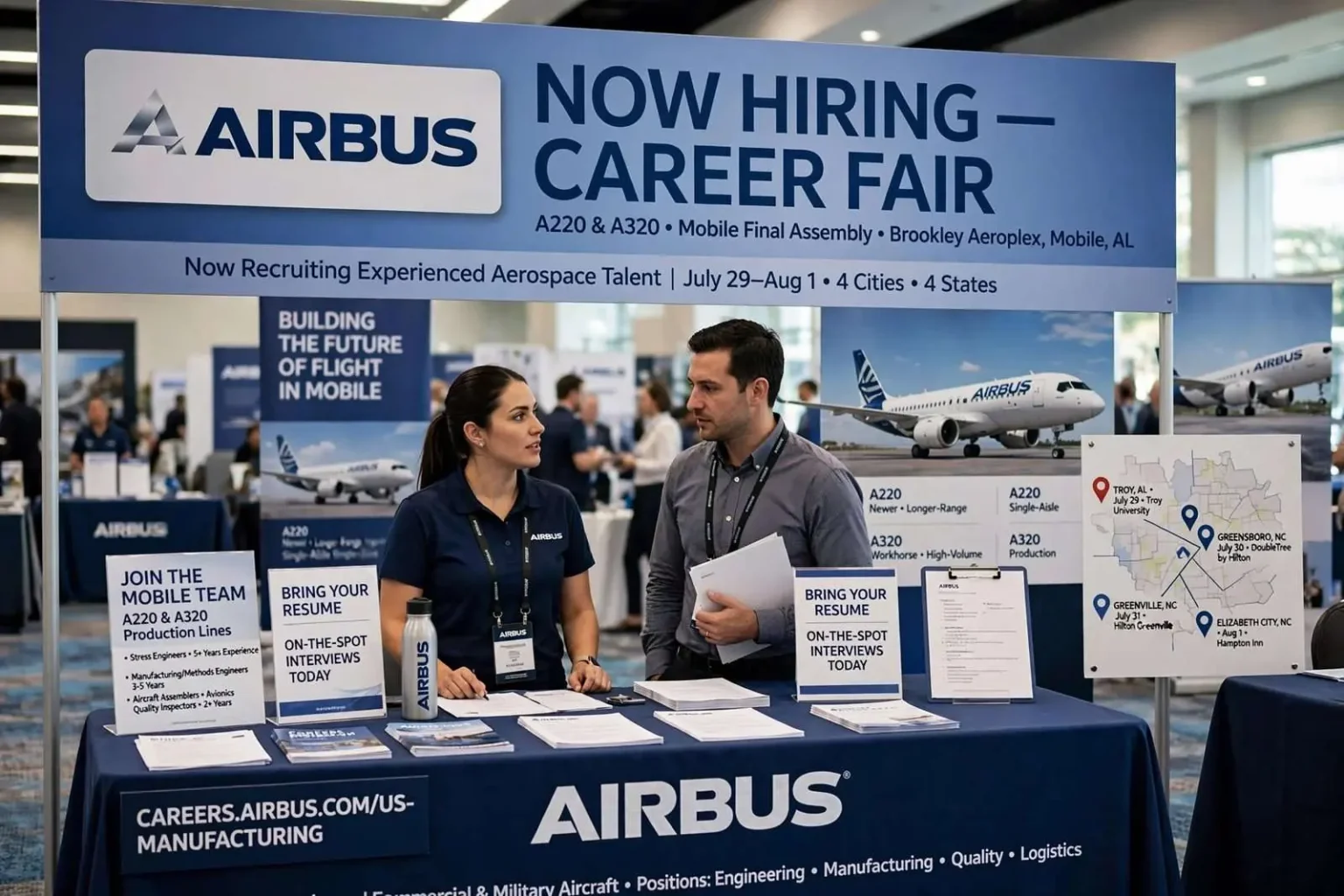
Airbus is taking its hiring roadshow on the road in search of experienced aerospace talent to build the A220 and A320 at its Mobile final assembly line. The European planemaker scheduled four career fairs across the Southeast, and job seekers were told to bring a resume ready to go — the events are working interviews in miniature, with recruiters on hand to screen candidates for positions that support two production lines running simultaneously in Mobile.
The schedule covered a week and four states’ worth of travel for the company’s recruiting team. In Troy, Ala. — July 29, the Bibb Graves Atrium at Troy University hosted the fair from 10:30 a.m. to 5:30 p.m., putting the company in front of Alabama graduates and aviation-inclined students in the state’s own backyard. The next three stops ran through North Carolina: Greensboro — July 30, DoubleTree by Hilton Greensboro, noon to 7 p.m.; Greenville — July 31, Hilton Greenville, noon to 7 p.m.; and Elizabeth City — Aug. 1, Hampton Inn Elizabeth City, noon to 7 p.m.
The North Carolina leg was no accident. Those stops placed Airbus recruiters inside a region dense with experienced aerospace workers — communities built around military aviation depots, legacy manufacturing plants and a commercial aviation workforce trained on airframes the Mobile plant assembles every day.
Who Airbus Wants
The company laid out a clear experience ladder. Stress Engineers need five or more years — the senior tier of the hiring push, reflecting how critical structural analysis is to certifying and producing commercial aircraft. Liaison Engineers, Manufacturing/Methods Engineers, Flight Operations and Quality Inspectors fall in the three-to-five-year range, the middle band that keeps production moving and conforming to Federal Aviation Administration standards.
A long list of hands-on roles — Aircraft Assemblers, Avionics Technicians, Electricians, Mechanical Technicians, Sealers, Interiors Assemblers, Ground Handlers, Jigs & Tools Operators, Logistics and Painters — require at least two years. Each of those trades corresponds to a stage of the assembly process: structures and systems going in, avionics and electrical runs, sealing and painting, the tooling and logistics that feed the line.
The common requirement across every tier is commercial or military aircraft experience. Airbus is not hiring trainees at these fairs — it is recruiting people who already know how an airframe goes together and can be productive on a new line without a long runway, the fastest way to add capacity at a plant that is ramping up two aircraft programs at once.
The A220 and the Two-Line Era in Mobile
Both aircraft named in the hiring push are central to the Mobile operation’s growth. The A320 family — the workhorse of single-aisle commercial aviation — has been assembled at the Brookley Aeroplex facility since the plant opened, the first Airbus final assembly line on United States soil. The A220, the smaller, longer-range single-aisle jet Airbus acquired through its Bombardier partnership, joined the Mobile line as the company’s second program there, making the site one of the few in the world assembling two distinct families side by side.
Running two lines changes a factory’s demands. Each program has its own structures, tooling, and supplier flows, and the workforce has to scale in both engineering and skilled-trades categories simultaneously. That is the arithmetic behind a four-city hiring tour: the Mobile plant needs experienced people faster than the Gulf Coast’s own labor pool can supply them, so recruiters are going to where aerospace workers already live.
The push reflects steady production growth at the Brookley Aeroplex site, one of the Gulf Coast’s largest advanced-manufacturing employers — a facility that has transformed Mobile’s industrial identity from shipbuilding and paper into commercial aviation.
Brookley and Mobile’s Aerospace Ascent
The Mobile final assembly line sits at the Brookley Aeroplex, the former Air Force base at the southern edge of the city that has become the anchor of the Gulf Coast’s aviation corridor. The region’s aerospace cluster includes the Mobile airport’s industrial complexes, supply-chain plants across Baldwin County and the Florida Panhandle, and the military aviation work at bases and depots across the Southeast — an ecosystem that has been building toward large-scale commercial manufacturing for two decades.
Airbus’s arrival confirmed what regional planners had argued for years: the Gulf Coast had the workforce fundamentals to support final assembly of commercial jets. The plant opened with the A320 family and has grown with the single-aisle market, each expansion adding to a labor pool that now spans the specialized trades a modern assembly line requires.
For workers, the significance is durability. Final assembly lines operate for decades once established, and a plant producing two aircraft families represents long-horizon employment — skilled trades and engineering careers with a manufacturer whose order book stretches years into the future. That is why a hiring fair in Troy or Greenville is local news in Mobile: every experienced hire strengthens an operation the region’s economy increasingly depends on.
Why Troy, Greensboro, Greenville and Elizabeth City
Each stop on the tour maps to a concentration of aerospace talent. Troy University anchors southeastern Alabama and its aviation management programs; the fair in the Bibb Graves Atrium put recruiters in front of both area residents and students considering aerospace careers. Greensboro sits in North Carolina’s Piedmont Triad, a region with a deep aviation manufacturing base. Greenville anchors eastern North Carolina’s aviation corridor, and Elizabeth City is home to the Coast Guard’s largest aviation base and depot — a community where airframe experience is a way of life.
Military-connected communities produce exactly the candidates the two-year requirement targets: people who have maintained, repaired or manufactured aircraft in uniform and are translating that experience into civilian careers. Recruiting fairs held inside those towns meet candidates where they are, rather than waiting for relocation to happen on its own.
The strategy also reflects competition. Aerospace hiring is regional, and other manufacturers along the Gulf Coast and in the Carolinas are competing for the same experienced assemblers and engineers. Showing up in person, with specific open positions and a clear experience ladder, is how a plant keeps its pipeline full when the labor market is tight.
Inside the Hiring Process
Those interested could register through the event links or apply directly through Airbus’s U.S. manufacturing careers page, and the company encouraged candidates to arrive at the fairs prepared — resume in hand, experience documented, and ready to speak to specific aircraft work they had done. Recruiters at events of this kind screen on the spot: candidates whose experience matches a listed trade move forward toward formal interviews, while others get pointed to openings that fit their backgrounds.
Preparation matters more at a career fair than in an online application. A candidate who can describe specific airframe experience — the aircraft types, the phases of assembly or maintenance, the certifications held — gives a recruiter far more than a form can, and the fairs were structured to capture exactly that conversation. For experienced aerospace workers, the two-year minimum made the events a realistic shot: the jobs are real, specific and available.
Candidates should also understand what the ladder means for pay and progression. Stress Engineers sit at the top with five-plus years; the engineering middle band follows; the trades form the entry tier at two years — but trades on an assembly line advance through skill certification and seniority, and many of the assemblers and technicians hired at the two-year mark build long careers as the plant grows.
What the A220 and A320 Mean for Workers
The two programs hiring at the fairs give workers different but complementary profiles. The A320 family is among the most-produced commercial jetliners in history, with a backlog that keeps assembly lines running at capacity worldwide — steady, high-volume production work. The A220 is the newer program, growing its rate as orders accumulate, which means early hires on that line help establish processes and have a stake in how the program matures in Mobile.
Both lines share the fundamentals: safety-critical work performed to aviation standards, quality inspection at every stage, and the discipline of a production schedule measured in aircraft delivered. Workers with military or commercial aviation backgrounds generally find the transition to a final assembly line familiar — the standards are exacting, but the work is structured, documented and team-based.
The hiring push also signals opportunity beyond the factory floor. A growing assembly line pulls suppliers, maintenance providers and training programs into its orbit, multiplying the effect of each hire across the regional economy. Every career fair that fills classes of new employees strengthens the case for the next investment in the Gulf Coast’s aviation cluster.
A Week on the Road for a Workforce
Four cities in five days is an intensive recruiting swing, and it illustrates how workforce strategy works at the scale of a final assembly line. A plant the size of Mobile’s does not simply post openings and wait; it plans hiring in waves matched to production rate increases, identifies the regions where its target skills concentrate, and sends recruiters out in force. The July 29 through Aug. 1 tour — Troy, Greensboro, Greenville, Elizabeth City — was one of those waves.
The geography also shows how wide the plant’s labor shed has become. When the Mobile facility opened, its workforce came largely from the immediate Gulf Coast; as production has grown and the region’s experienced aerospace workers have been absorbed, the net has widened to military towns and manufacturing centers hundreds of miles away, with relocation now a standard part of the pitch.
That is a familiar pattern in American manufacturing history. Major assembly plants draw talent from a national map once they scale, and the communities they recruit from lose some experienced workers and gain relocated families — a swap that trade towns like Elizabeth City have experienced across every industry cycle.
Advice for Candidates Watching the Next Round
For job seekers who missed this tour, the company’s U.S. manufacturing careers page remains the standing route to the same positions, and openings refresh as production needs evolve. The fairs demonstrated what the company screens for — documented aircraft experience, specific trade skills, and the certifications that translate between military and commercial aviation — so candidates applying online should lead with exactly those details.
Workers who fall just short of the experience minimums have regional paths to bridge the gap: community college and technical programs along the Gulf Coast have built aviation manufacturing curricula with the industry’s input, covering the assembly, avionics and quality processes the Mobile line uses. Completing one of those programs puts a candidate inside the two-year window for the skilled trades.
The career fairs will continue as the plant’s needs dictate — that is how aerospace hiring works in a growth phase. What the July and August tour made plain is the direction of travel: two aircraft families in Mobile, production rates rising, and a company willing to drive a recruiting team four states up the Eastern Seaboard to find the people to build them.