A.L. Martin Historical Museum Receives $20,000 and a 1934 Diploma at Homecoming Celebration
State Rep. Thomas Jackson presented a $20,000 check at the Aug. 22 event, which also brought school supplies, a 1934 diploma, a historic piano and a 1960s drum major uniform to the museum.
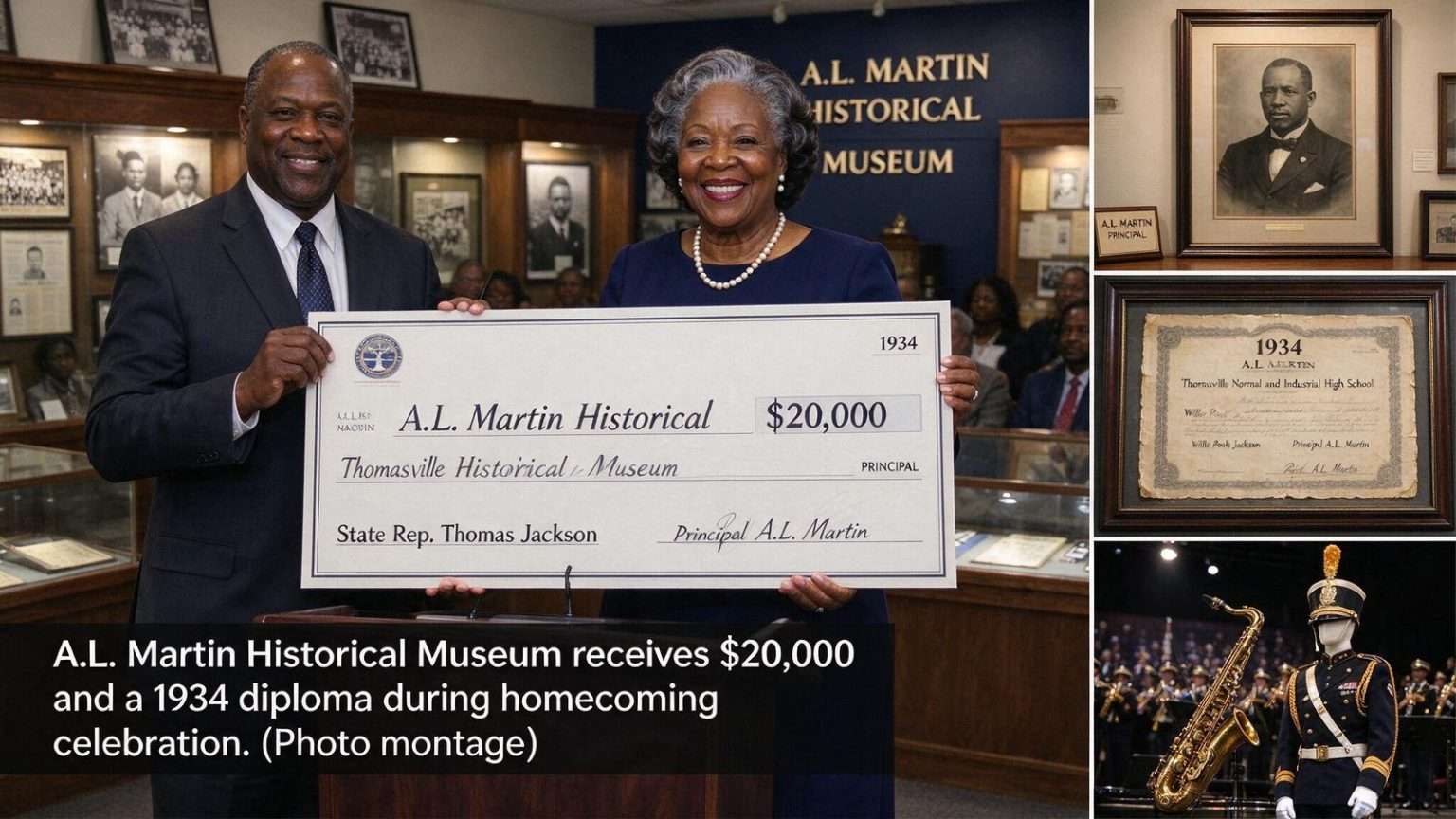
The A.L. Martin Historical Museum hosted a homecoming celebration on Aug. 22 that brought donations of school supplies and a $20,000 check from state Rep. Thomas Jackson.
The Building’s History
The A.L. Martin Museum was originally the Thomasville Normal and Industrial High School, later renamed for Principal A.L. Martin.
The school closed in 1970 due to integration. The building is now a museum filled with African-American history.
That closure date places the school within a pattern repeated across Alabama and the South. When districts consolidated under integration, Black schools were disproportionately the ones closed rather than merged, and their buildings were frequently repurposed or demolished. Communities that preserved those buildings — and the records, photographs and objects inside them — preserved institutional histories that would otherwise have no physical home.
The Celebration
“The celebration brought joy and excitement,” museum director G.B. Quinney said. “We were glad to coordinate the event and welcome all attendees. Their donations and gifts to the museum and Thomasville High School students made for a wonderful evening.”
The event honored Johnny “Boy” Williams, a longtime band director and saxophone player at A.L. Martin High.
A Diploma From 1934
Thomasville native Bernard Jackson donated the 1934 Thomasville Normal and Industrial High School diploma of his grandmother, Willie Poole Jackson, signed by Martin.
A signed 1934 diploma is a substantial acquisition for a museum of this kind. It documents a specific graduate by name, carries the principal’s signature, and establishes a concrete date in the school’s operating history — the sort of primary record that anchors an institutional narrative in verifiable fact rather than recollection.
Other Artifacts Added
The old piano from Thomasville Public High School and A.L. Martin High was dedicated to the museum, along with drum major Terry Robinson’s uniform from the 1960s.
Both objects speak to the school’s music program, which the evening’s tribute to Williams also honored. School bands occupied a central place in the life of Black high schools of that era, functioning as a source of community identity and public presence well beyond the halftime performances they are remembered for.
Support for Current Students
The donations at the event benefited both the museum and current Thomasville High School students, with school supplies collected alongside the financial contribution.
That dual purpose reflects how the museum positions itself — not solely as a repository of a closed school’s history, but as an active participant in the education of students attending the school that succeeded it.
What $20,000 Means
For a small community museum operating largely on volunteer effort, a $20,000 contribution is transformative rather than incremental. Funds at that level can address building maintenance, archival storage for fragile documents and textiles, exhibit construction, or the digitization work that makes a collection accessible to researchers who cannot travel to Thomasville.
Visiting
To schedule a tour of the museum, call 205-515-3780 or email [email protected].