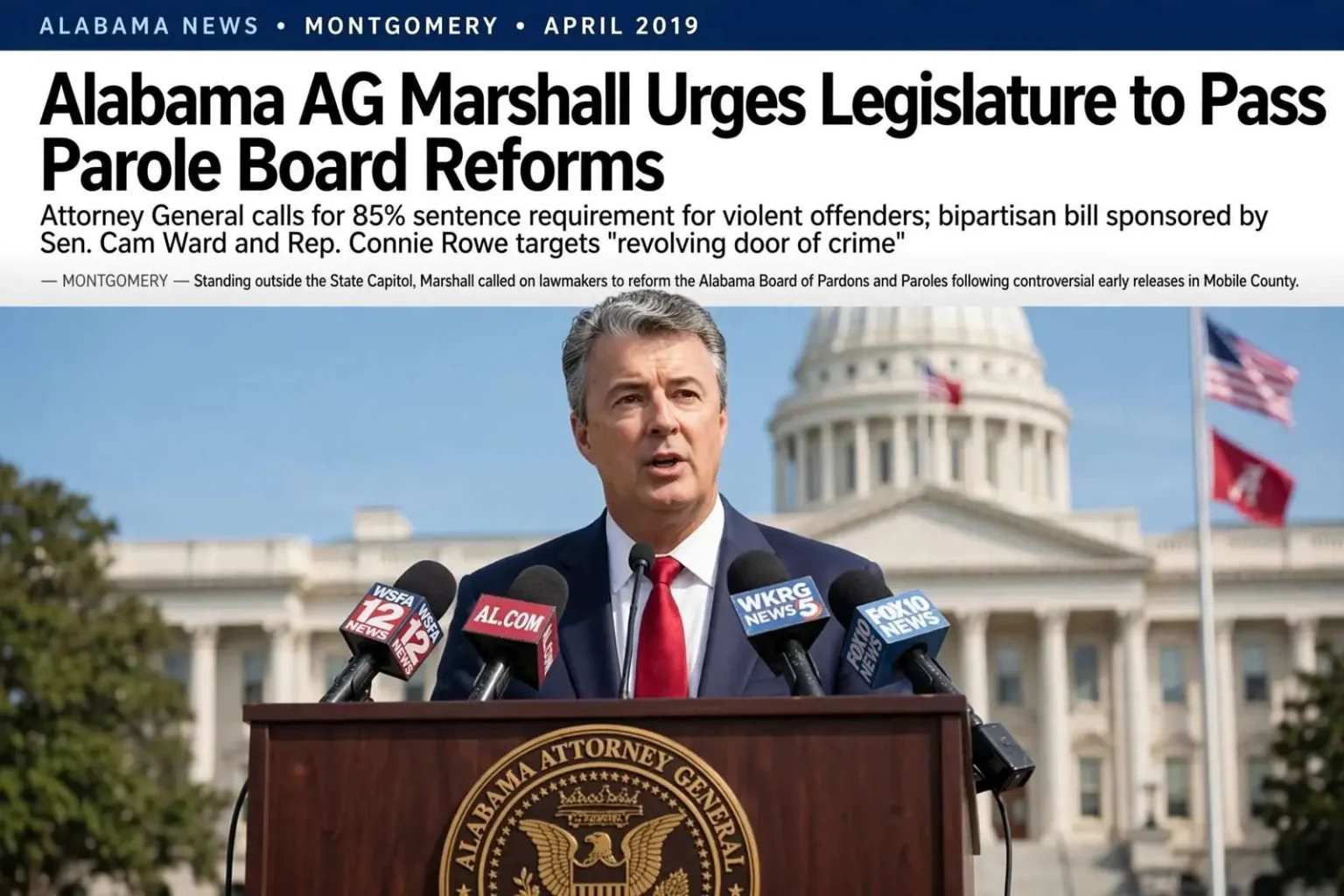
Alabama Attorney General Steve Marshall is urging state lawmakers to pass a package of reforms to the Alabama Board of Pardons and Paroles, arguing in a video message that the board has created what critics in Mobile County call a revolving door of crime. The proposal, delivered to the legislature with sponsorship from Sen. Cam Ward and Rep. Connie Rowe, would require people convicted of violent offenses to serve at least 85 percent of their sentences before becoming eligible for parole.
“We must protect the people of Alabama, we must fix the broken system of parole, we must pass this bill,” Marshall said in the video, which he shared on social media from Montgomery. The message marked an unusually public campaign by the state’s top prosecutor against the board that decides when prisoners leave prison early, and it put the Legislature on notice that the issue would not quietly go away.
The push follows high-profile early releases that have drawn scrutiny across south Alabama. Among them was the case of a Mobile County woman sentenced to 13 years for a near-fatal stabbing who was granted parole after serving about two years; the decision was later reversed after the attorney general’s office intervened. For prosecutors who had negotiated that sentence expecting it to be served, the episode became the clearest possible illustration of a system they believe has drifted away from its purpose.
Why the Parole Board Became a Flashpoint
The Alabama Board of Pardons and Paroles, headquartered in Montgomery, is a three-member panel that holds hearings on prisoners across the state and decides who may be released before completing a sentence. Its decisions touch every county, from the Shoals to the Wiregrass, but the controversy that prompted this legislative push has been loudest in the state’s largest jurisdictions, where district attorneys see hundreds of violent-crime cases a year.
Prosecutors’ complaint is straightforward. In plea negotiations and trials, sentences are often structured with the understanding that most or all of the term will be served. When a board releases a violent offender after a small fraction of that term, the bargain struck in open court is effectively rewritten behind closed doors, and victims’ families learn about it from a hearing notice rather than a phone call.
Mobile County District Attorney Ashley Rich also appeared in Marshall’s video, saying some violent offenders were serving less than a tenth of their sentences and that the board was undermining her office’s work. “This revolving door of crime is happening, and they see the defendants getting out of the penitentiary as fast as I can put them in there,” Rich said. In February, she publicly accused the Board of Pardons and Paroles of negating prosecutors’ efforts to keep violent offenders behind bars.
What the Bill Would Do
At the center of the package is the 85 percent requirement for violent offenders, a standard that would sharply limit early release for the most serious crimes. Under the proposal, a person convicted of a violent offense would have to serve at least 85 percent of the sentence imposed before even becoming eligible for a parole hearing, rather than facing the board under the looser eligibility rules that have governed Alabama practice.
Sponsorship gives the measure an unusual bipartisan pedigree of institutional weight. Sen. Cam Ward of Alabaster, who carried the bill in the Senate, had spent years chairing that chamber’s Judiciary Committee and was the Legislature’s leading voice on prison and justice reform. Rep. Connie Rowe of Jasper, sponsoring in the House, held a similar role on the House side, meaning the package arrived in both chambers endorsed by the lawmakers who knew the state’s criminal code best.
The measure had been introduced in committee and was awaiting action as of April 2019. Legislative watchers noted that parole reform had a path that some other criminal-justice bills lacked: it aligned prosecutors, the attorney general and victims’ advocates, and it asked the Legislature to do little beyond changing eligibility rules rather than appropriate new money.
The politics of the issue were complicated by the state’s broader prison situation. Alabama has operated under intense scrutiny over prison conditions and overcrowding, and reform advocates have long argued that the state incarcerates too many people for too long. The parole board’s defenders, at various points, described its release decisions as part of a necessary valve in that system. Marshall and the district attorneys rejected that framing for violent offenders specifically, drawing a line between nonviolent cases that might merit early release and crimes of violence that they argued should be served nearly in full.
That distinction shaped the bill’s design. Rather than abolishing parole or restructuring the board outright, the proposal targeted the category of crimes — assault, robbery, manslaughter and other offenses of violence — where early release had generated the loudest complaints. The approach allowed lawmakers to answer prosecutors without forcing a broader referendum on sentencing, and it gave the bill room to move through committees that include members wary of any measure that appears to grow the prison population.
The View from the Hearing Room
Parole hearings in Montgomery are brief, scheduled affairs, and families on both sides of the question describe them as disorienting. A victim’s relatives may travel hours for a hearing that lasts minutes, while the inmate appears with family, clergy or counsel. When the outcome surprises the victim’s side — as in the Mobile County stabbing case that helped ignite this debate — the backlash tends to travel fast, aided by social media and by prosecutors willing to speak on the record.
The reversal of the Mobile County parole after the attorney general’s intervention was itself an unusual event, and it highlighted how few checks exist once a board announces a release decision. Prosecutors pointed to that episode as evidence that the fix could not be left to case-by-case intervention; only a change in the eligibility rules, they argued, would prevent the next dispute rather than clean up the last one.
What It Means for South Alabama
For residents of Mobile and the surrounding counties, the practical stakes are visible in the numbers prosecutors cite: offenders who walk out after a fraction of a sentence are, by definition, back in the community years earlier than the court record suggests. Neighborhood watch groups, victims’ families and law enforcement agencies across Baldwin and Mobile counties have followed the debate for that reason, and local legislators have reported hearing about it more than almost any other criminal-justice topic.
Victims’ advocates framed the issue in terms of predictability. A family that hears a sentence of 13 years should be able to plan around 13 years, they argue, or at least around a known parole date, rather than discovering that the arithmetic of the sentence was never binding. The 85 percent rule, its supporters say, restores that basic promise without eliminating parole entirely, since even a nearly complete sentence still leaves room for the board to weigh conduct near the end of the term.
Defense attorneys and civil liberties voices cautioned that mandatory minimums served the opposite lesson: rigid eligibility rules tend to swell prison populations and transfer discretion from paroling authorities to prosecutors negotiating pleas. Alabama already spends a large share of its general fund on corrections, and any measure that keeps more prisoners longer carries a fiscal note. Supporters of the bill responded that violent offenders represent a defined subset of the population and that the state’s first obligation is public safety.
Marshall’s office made the public-safety argument the centerpiece of its video campaign, but the message also carried a political dimension. A statewide attorney general standing with the state’s largest county prosecutors creates momentum that individual legislators find hard to ignore, and the video’s distribution on social media was calculated to reach constituents directly rather than through Capitol coverage alone.
The families affected by early paroles said they were watching closely and hoped the reforms would hold. Their accounts gave the legislative debate its emotional center: parents and siblings who organized their lives around a sentence imposed in court, only to see it renegotiated in Montgomery without their input. Several made the trip to committee hearings to testify, and their presence in the gallery was noted by lawmakers weighing the bill.
The Road Ahead in the Legislature
Passing the package would still require the ordinary gauntlet of committee approval and floor votes in both chambers, and history offered reasons for caution. Criminal-justice bills in Alabama have a way of stalling as stakeholders add amendments, and any change to parole eligibility invites technical questions about which offenses count as violent, how the change applies to people already sentenced, and how the board’s remaining discretion should be exercised at the end of a long term.
Those questions were precisely the ones Ward and Rowe had handled for years as Judiciary chairs, and their sponsorship was widely read as a signal that the details would be worked rather than rushed. The bill’s committee assignment put it in front of the same members who had processed the state’s major sentencing reforms of the past decade, giving supporters reason to believe the measure would get a full hearing rather than a quiet burial.
If enacted, the 85 percent requirement would align Alabama with a sentencing philosophy already common in neighboring states, several of which adopted truth-in-sentencing standards in the 1990s. Advocates argued that the change would not require new institutions or new bureaucracy — only a different answer to the question of when a violent offender may first ask for the door. Opponents’ counter, that the state should be shrinking its prison system rather than lengthening stays, promised to keep the debate alive through the session.
Either way, the attorney general had succeeded in moving the parole board from an obscure corner of state government to the center of the Legislature’s criminal-justice agenda. The combination of a statewide office, county prosecutors and affected families proved difficult to dismiss, and the bill’s sponsors were candid that the campaign behind it was part of the strategy. A measure introduced quietly would have died quietly; this one arrived with video, news coverage and a gallery of families.
For now, the question in Montgomery was not whether Alabama’s parole system needed attention — even the board’s defenders conceded the controversies of the previous year had damaged public confidence — but whether the specific fix on the table was the right one. As of April 2019, the measure awaited committee action, and the people most affected were watching Montgomery the way they once watched a courtroom: hoping the system keeps its word.
Residents who want to follow the bill’s progress can track committee calendars through the Alabama Legislature’s website, and victims’ families seeking information about parole hearings can contact the Board of Pardons and Paroles directly. For south Alabama, where several of the cases that sparked the debate unfolded, the outcome will determine whether the sentences pronounced in local courtrooms carry the weight those courtrooms promised.