Alabama Coastal Cleanup Returns for 31st Year on Sept. 15, Organizers Seek Volunteers Along Gulf Coast
The 31st annual Alabama Coastal Cleanup returns Sept. 15, with volunteers needed at more than 30 sites across Mobile and Baldwin counties.
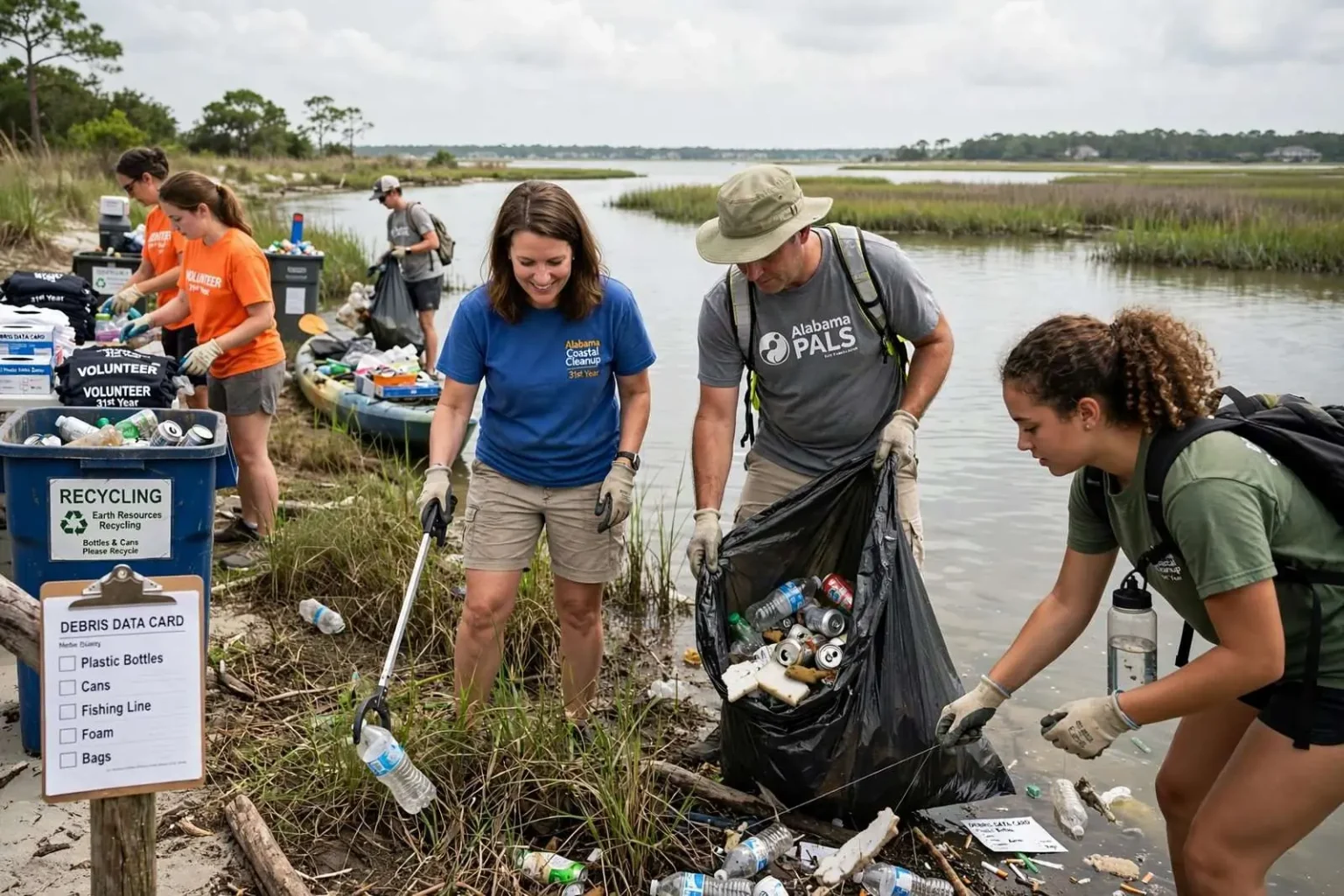
Alabama’s largest one-day volunteer event is set to return for its 31st year on Saturday, September 15, as organizers of the Alabama Coastal Cleanup call for volunteers to help clear trash and debris from more than 30 coastal sites across Mobile and Baldwin counties. The annual ritual has become as much a part of the coastal calendar as shrimp season — a single morning when thousands of residents show up to give their beaches and bayous a fresh start.
The cleanup will run from 8 a.m. to noon, rain or shine, with volunteers needed on foot, on the water and stationed at collection zones to help sort recyclable plastics and aluminum cans. The half-day format is deliberate: four hours is long enough to move serious tonnage, short enough that families, church groups, students and fishing clubs can all commit without giving up their Saturday.
Organizers say the effort typically draws more than 4,000 volunteers each year to work along South Alabama’s beaches, bayous and waterways. That scale — four thousand pairs of gloves spread across two counties in a single morning — is what separates a coastal cleanup from a beach maintenance budget: no crew could walk the miles of shoreline, bayou banks and backwater edges that volunteers cover in one tide cycle.
A Recycling Partnership Grows
This year’s cleanup marks the second year the event has partnered with Earth Resources Recycling to process bottles and cans collected from the various zones. The partnership addresses a long-standing irony of cleanup events: the bags of recyclables volunteers fill often ended up in the same landfills as everything else, simply because sorting and processing them was beyond what a one-day event could manage.
State Coordinator Angela Underwood said the partnership reflects a growing awareness of how litter affects marine life and natural resources along the coast. “Understanding the harmful effects of marine debris in the environment, and our dwindling resources, we are happy to offer recycling options to our volunteers for the second year,” Underwood said.
She added that participants are being asked to bring their own reusable water bottles to help cut down on plastic waste, though bottled water will still be available in limited quantities. The request is more than symbolic — hydration stations at the zone captains’ tables replace a small mountain of single-use bottles that would otherwise join the very debris the morning is meant to remove.
The recycling focus also fits the event’s data mission. Coastal cleanups worldwide do more than pick up trash; they catalog it, item by item, feeding the international databases that document what washes ashore and where it comes from. Beverage containers are among the most consistently counted items in those inventories, which makes recovering them for actual recycling a meaningful addition to the count.
The data cards volunteers fill out have quietly become one of the event’s most valuable products. Each bag gets tallied by category — bottles, cigarette butts, fishing line, foam pieces, bags — and those local numbers roll up into the international cleanup’s database, where they inform researchers and policymakers about which products dominate the debris stream. Alabama’s contribution comes from thousands of individual cards filled out by volunteers on their hands and knees in the sand.
Signing up ahead of time helps organizers most. Zone captains plan gloves, grabbers, bags and T-shirt sizes based on expected turnout, and the sites that draw the biggest crowds — the public beaches of Gulf Shores and Orange Beach among them — can run short if volunteers arrive uncounted. The website and phone line exist to spread the workforce across all 30-plus sites rather than piling it onto the best-known beaches.
How the Cleanup Works
Volunteers who take part will receive a T-shirt and basic cleanup supplies. Anyone interested in joining the effort, finding a zone captain, or signing up ahead of time can visit AlabamaCoastalCleanup.com or call (251) 928-9792. Updates are also shared on the Alabama Coastal Cleanup Facebook page.
The zone captain system is the engine of the event. Each of the more than 30 sites has a captain who knows the ground, distributes supplies, records the debris tallies on the data cards and handles the inevitable odd cases — a derelict crab trap, a half-buried tire — that need more than a pair of gloves. New volunteers simply show up at a site, sign in and get pointed toward a stretch of shoreline.
The work itself varies wildly by site. Gulf-front zones on the Baldwin County beaches tend to collect the visitor-borne litter of a tourist season, while sites up Mobile Bay and along the Delta’s bayous catch the debris that every rainstorm washes down creeks and rivers toward the sea. Deltas collect everything — it is the sink of the whole watershed — which is why inland volunteers matter as much as the ones on white sand.
Marine debris has become one of the most closely watched pollution problems on the Gulf, and the cleanup sits at the point where individual behavior and ocean-scale consequences meet. Plastics do not biodegrade in seawater; they fragment into smaller and smaller pieces, working their way into the food web from plankton up through the fish that define the coast’s cuisine and economy. Every bottle pulled off a Baldwin County beach before a storm tide takes it out with the current is a piece of that problem intercepted at the shore.
The International Connection
The event is coordinated locally through the Alabama Department of Conservation and Natural Resources along with Alabama People Against a Littered State, commonly known as PALS. It is part of the broader International Coastal Cleanup, a global effort to remove debris from coastal waters that Alabama first joined in 1987.
The International Coastal Cleanup is recognized as the largest single-day volunteer event dedicated to protecting the marine environment. Alabama’s 31 years of participation — joining the effort in its early years and never missing since — has made the state a fixture of the international data set, contributing a Gulf Coast profile dominated by plastics, foam and fishing gear.
The state-level structure behind the event matters to its endurance. Alabama PALS, the anti-litter organization that operates statewide year-round, provides the institutional memory and administrative spine that volunteer efforts often lack, while the conservation department supplies staff, scientific grounding and the weight of a state agency behind permits, logistics and site coordination.
The Sponsors Who Keep It Going
This year’s cleanup is made possible through the continued support of title sponsor the Poarch Band of Creek Indians, along with a long list of returning sponsors that includes NOAA, the Original Oyster House, Alabama Power Company, LuLu’s, the cities of Gulf Shores and Orange Beach, Baldwin EMC, Flora-Bama, The Home Depot and several other regional businesses and organizations.
The sponsor roster doubles as a map of the coastal economy. Restaurants, utilities, resorts and retailers whose businesses depend on clean water and clean beaches put their names — and their money — behind the cleanup each year, an admission that the region’s most valuable asset is the one the volunteers spend the morning restoring.
Federal involvement runs through NOAA, the National Oceanic and Atmospheric Administration, which has supported marine debris programs nationally for years. The agency’s interest is practical: debris that entangles wildlife, fouls propellers and damages habitats costs coastal economies real money, and data collected by volunteers informs the policies meant to stem the flow.
Safety on the Shoreline
Organizers are asking participants to keep a few safety tips in mind while working along the shoreline: drink plenty of fluids and bring a reusable water bottle, wear sunscreen, a hat and comfortable shoes, keep children supervised at all times, and use caution around sand dunes and other fragile ecosystems.
The dune warning carries more weight than it might appear. The dune systems along Alabama’s Gulf beaches are both habitat and infrastructure — the first line of defense against storm surge — and they heal slowly. Foot traffic compacts the sand, crushes the sea oats that hold a dune together and can undo years of natural rebuilding in an afternoon of careless shortcuts.
Volunteers are also asked not to attempt to move heavy or hazardous items themselves, and instead mark the location and notify their zone captain. The rule exists because the shoreline collects things that do not fit in a bag — derelict vessels, drums of unknown contents, storm-tangled construction debris — and because well-intentioned volunteers with rope and enthusiasm are how injuries happen.
September conditions add their own cautions. Late-summer heat and humidity along the Gulf Coast make hydration a real safety issue even on a half-day event, and the cleanup’s rain-or-shine policy means volunteers should watch the sky — September sits at the front edge of the peak of hurricane season, and fast-moving weather can develop over the Bay with little warning.
The event’s longevity also reflects a particular Gulf Coast trait: an economy and an ecology so tightly braided that protecting one means protecting the other. Seafood, tourism, fishing and the postcard image of white sand are all downstream of clean water, and the cleanup’s sponsors, volunteers and organizers are drawn from the same population that benefits. It is conservation with a direct financial return, which may explain why it never needed a protest or a campaign to survive — just a September Saturday and a few thousand neighbors.
Thirty-One Years of Showing Up
A cleanup that has run for 31 years has outlasted fashions in civic life, survived staffing changes and economic downturns, and taught generations of coastal children what a data card and a trash grabber are for. Many of this year’s volunteers were not born when Alabama joined the international effort in 1987 — and some of them will bring children of their own next September.
The morning’s arithmetic is simple: more than 30 sites, roughly 4,000 volunteers, four hours, two counties. The result is measured in tons of debris removed, in wildlife spared a plastic death, and in the annual, visible proof that the people who live along the Gulf consider its water worth their Saturday morning.
For more information, residents can contact Angela Underwood with the Alabama Department of Conservation and Natural Resources at (251) 928-9792, or Spencer Ryan with Alabama PALS at (334) 263-7737. Volunteers who cannot make the official date are pointed toward the year-round ethos the cleanup promotes: the coast belongs to everyone, and so does the litter.