Alabama Coastal Cleanup Returns for 35th Year With 26 Zones in Mobile and Baldwin
The Alabama Coastal Cleanup returns Sept. 17 for its 35th year, with 26 volunteer zones across Mobile and Baldwin counties from 8 a.m. to noon.
The Alabama Coastal Cleanup will bring volunteers back to the state’s shoreline on September 17 for the event’s 35th year, according to the Alabama Department of Conservation and Natural Resources. Organizers are expecting a strong turnout this time. A rainy cleanup day in 2021 kept many volunteers home, and the event is looking to rebound. The annual sweep of beaches, bayous, and waterways is the state’s largest single-day volunteer effort on the coast, and after 35 years it has become as much a part of the Gulf Coast calendar as the seasons it protects.
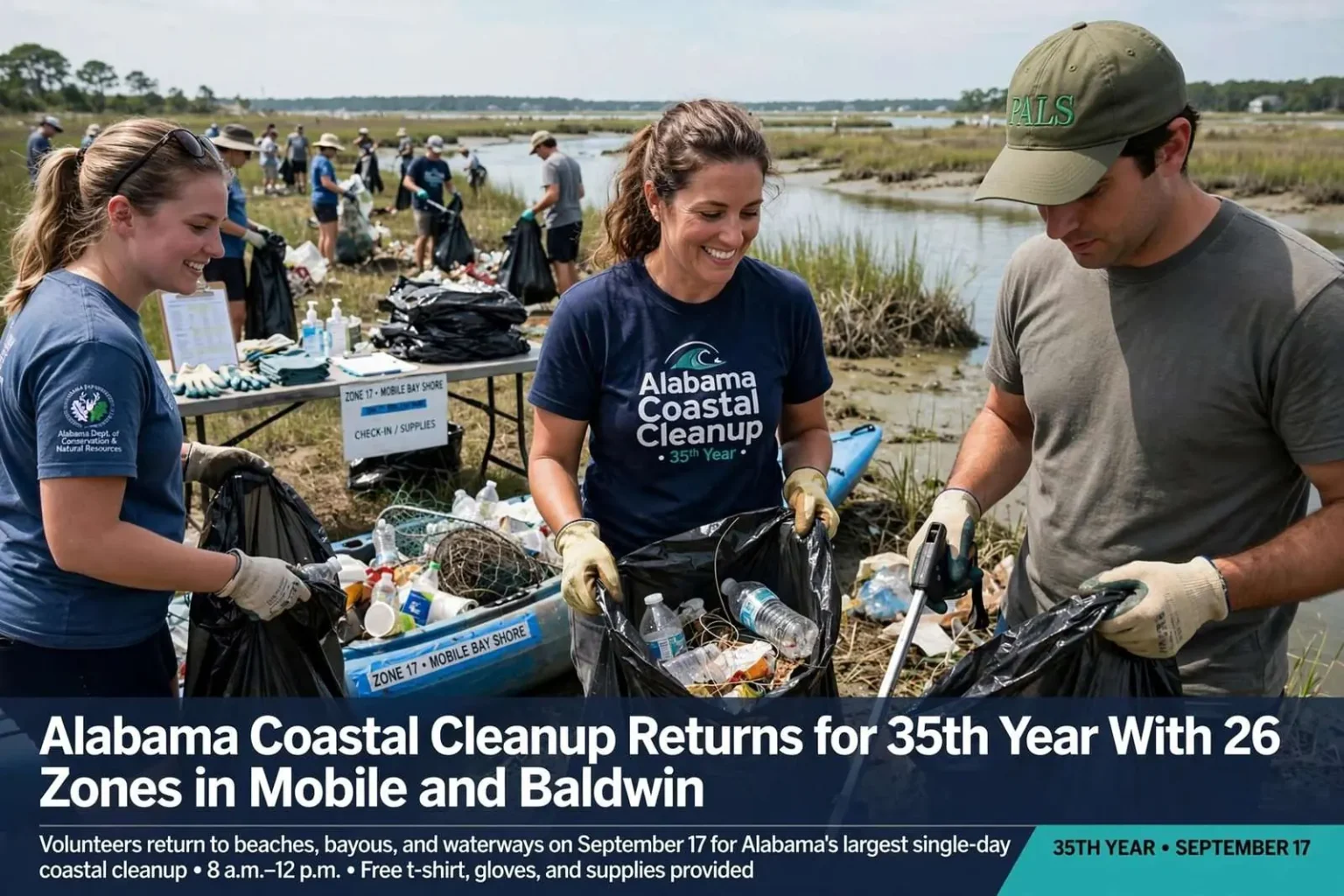
Volunteers can choose from 26 zones spread across Mobile and Baldwin counties. Work runs from 8 a.m. to noon on September 17, and participants can sign on for either land-based or in-water cleanup. Those who take part will receive a t-shirt and basic cleaning supplies when they arrive at their zone. The zone system divides the coast into manageable sections — gulf beaches, bay shorelines, tributaries, and inland waterways that drain into Mobile Bay — each with a local coordinator who logs results and directs volunteers to the stretches that need the most attention.
The land-and-water distinction matters more than it might first appear. Much of the debris that ends up on Alabama’s beaches never starts there: litter dropped miles inland travels through storm drains, creeks, and rivers into Mobile Bay and eventually the Gulf. In-water teams — kayakers, boaters, and waders — reach the coves, marsh edges, and tidal creeks that shore-based crews cannot, pulling tires, fishing line, and plastics out of the habitats where they do the most damage. Together the two approaches treat the coastline as one connected system, which is how the event has always framed its mission.
A 35-Year Tradition on the Gulf Coast
Three and a half decades of annual cleanups have produced one of the most instructive volunteer records in the country. Since the first Alabama Coastal Cleanup in the late 1980s, hundreds of thousands of volunteers have removed millions of pounds of debris from the state’s coastal zones, and the data cards filled out by zone captains each year have given researchers and policy makers a running index of what washes up on Alabama’s shores — and therefore of what needs to be prevented upstream. Cigarette butts, food wrappers, beverage containers, and plastic fragments have perennially topped the lists, findings that have fed into everything from local litter ordinances to marine debris education programs.
The event belongs to a national network as well. The Alabama Coastal Cleanup is the state’s component of the International Coastal Cleanup, the world’s largest volunteer effort for ocean health, coordinated globally by the Ocean Conservancy. That connection turns a morning of bagging trash in Bayou La Batre or Gulf Shores into data points in an international record of marine pollution — a reminder that litter is a downstream problem everywhere and that every coastline is downstream of somebody.
Spencer Ryan, executive director of Alabama People Against a Littered State, framed the cleanup as a demonstration of what sustained cooperation can accomplish. “Alabamians are blessed with an abundance of natural resources,” Ryan said. “The Alabama Coastal Cleanup demonstrates what can be accomplished long term when State Agencies, Business and Industry, Coordinators and Volunteers, come together for a common mission greater than themselves.” The quote sketches the event’s organizational anatomy: a state agency partner in the Department of Conservation and Natural Resources, corporate sponsors who fund supplies and shirts, zone coordinators who manage the ground game, and the volunteers themselves — thousands of them in a good year.
Where and How to Take Part
The mechanics of joining are deliberately simple. Volunteers choose a zone — the list is published in advance and covers Mobile and Baldwin counties from the Gulf beaches to the Mobile-Tensaw Delta’s edges — and show up between 8 a.m. and noon on September 17. At check-in, each participant receives a t-shirt, gloves, trash bags, and data cards for logging the debris collected. No experience is required, and families with children take part every year, though young volunteers should be supervised near water. Participants who want to work from a boat or kayak can sign up for in-water zones when they register.
Preparation matters for a September morning on the Gulf Coast. Volunteers are advised to dress for heat and sun — hats, sunscreen, and closed shoes suitable for sand, mud, or marsh — and to bring water for the four-hour work window. Zone captains brief teams on safety before the work begins: what to leave alone (needles, hazardous containers, heavy objects), how to record finds on the data cards, and where the collected bags will be staged for pickup. The noon finish keeps the work ahead of the September heat’s peak and gives coordinators time to weigh, tally, and report the morning’s results.
The 26 zones reflect the geography the cleanup serves. Mobile County sites include the gulf-front beaches, the west end of Dauphin Island, bay shorelines and urban creek sites in the city of Mobile itself, and access points down to the Mississippi line. Baldwin County zones reach from Fort Morgan through Gulf Shores and Orange Beach and up into the tributaries that feed Bon Secour Bay and Perdido Bay. Between them, the zones cover nearly every public access point to the water in both counties — a coverage map that has expanded over 35 years as the event has grown.
Rebounding From a Washout
The push for a strong 2022 turnout follows a 2021 event hampered by weather. Rain kept many volunteers home that year, depressing participation and leaving more debris than usual on the shoreline when the storm systems of a Gulf summer had already been active. Cleanup organizers know that weather is the one variable they cannot control — September sits in the heart of hurricane season — which makes every good-weather year’s turnout all the more valuable to the cumulative record and the shorelines themselves.
There is also accumulated work to do. Debris does not pause between cleanups: fishing gear, plastics, and storm-washed litter accumulate continuously, and a reduced volunteer corps means a reduced harvest. Organizers pointing toward a rebound are asking, in effect, for the event’s traditional base — the families, church groups, school clubs, businesses, and coastal residents who have filled the zones for decades — to return in force, and for first-timers to join them. Every additional volunteer adds coverage to a zone that would otherwise be sampled rather than cleared.
The case for showing up rests on both pride and practicality. Alabama’s beaches and bays are the engine of a coastal economy built on tourism, seafood, and recreation, and the waters that the cleanup protects are working waters — nursery grounds for the Gulf’s fish and shellfish, feeding areas for the pelicans and gulls that follow the boats in, and the backdrop for the region’s quality of life. Ryan’s formulation — state agencies, business and industry, coordinators, and volunteers united around a mission greater than themselves — describes not just one September morning but the standing arrangement by which the Gulf Coast takes care of its own edge. On September 17, from 8 a.m. to noon, that arrangement goes back to work.
The partnership structure behind the cleanup has been central to its longevity. The Alabama Department of Conservation and Natural Resources provides the state agency backbone, while People Against a Littered State — the organization better known as PALS, which has coordinated anti-litter efforts across Alabama since the 1980s — manages the campaign’s public face and its network of local partners. Corporate and civic sponsors fund the shirts, supplies, and logistics that make participation free for volunteers. Zone coordinators, many of them longtime coastal residents and leaders of local civic groups, handle the ground-level work of recruiting teams, distributing gear, and reporting results. The result is an event that runs on institutional memory as much as institutional money, year after year.
That structure also explains why the event has survived weather years, economic downturns, and shifting volunteer habits for 35 years. Each element of the partnership carries a piece of the load: the state provides legitimacy and reach, PALS provides continuity, sponsors provide materials, and the zone captains provide the local knowledge that turns a general invitation into actual coverage of 26 zones. When one element falters in a given year — as volunteer turnout did in the 2021 rain — the others hold the framework in place for the rebound.
The data collected each September has quietly become one of the event’s most valuable products. Because volunteers record what they find — by item type and count — on standardized cards, the cleanup produces a annually comparable index of coastal litter. Researchers and agencies use those records to identify problem materials and problem locations, and the findings have informed local decisions on everything from smoking restrictions on beaches to fishing-line recycling stations at boat launches. A morning of volunteer work thus doubles as environmental monitoring, giving Alabama one of the more detailed long-term pictures of marine debris available for any stretch of the Gulf.
What the Cleanup Protects
The stakes of the event are visible in the ecosystems it serves. Mobile Bay and the waters around it form one of the most productive estuarine systems on the Gulf of Mexico, fed by the Mobile-Tensaw Delta — the vast river swamp and marsh complex that drains a huge portion of Alabama into the bay. The seagrass beds, oyster reefs, and marsh edges that the cleanup protects are nursery habitat for speckled trout, redfish, shrimp, and blue crabs, and the shorelines are stopover points for migratory birds along the Gulf flyway. Debris in that system is not merely unsightly: plastics fragment into the food chain, fishing line entangles wildlife, and derelict gear keeps harvesting long after it is lost.
The human economy depends on the same waters. Baldwin County’s beach towns draw millions of visitors a year, the working waterfronts of Bayou La Batre and Coden depend on clean water for their seafood harvests, and recreational fishing and boating sustain businesses across both counties. Litter that washes onto a gulf beach in September is a nuisance; the same material in a bayou or an oyster reef is an economic cost. The cleanup’s reach across 26 zones — from the white sand of the Gulf to the upper reaches of the Delta’s tributaries — tracks the geography of that dependence.
For volunteers, the September 17 event offers a direct way to be part of that stewardship, with a low barrier to entry and an immediate, visible result. Four hours of work on a Saturday morning removes debris that would otherwise drift through a year of tides and storms, and the data cards filled in along the way feed the record that guides the next year’s prevention. Thirty-five years in, the Alabama Coastal Cleanup remains what it has always been: the Gulf Coast’s annual appointment with its own shorelines, kept by the people who live along them.