Alabama Contemporary Art Center Highlights Sculpture, Caregiving Exhibit and New Education Pavilion
Alabama Contemporary Art Center in Mobile is featuring a reclaimed-materials sculpture exhibition, a multimedia show on medical caregiving, and construction of a new open-air education pavilion.
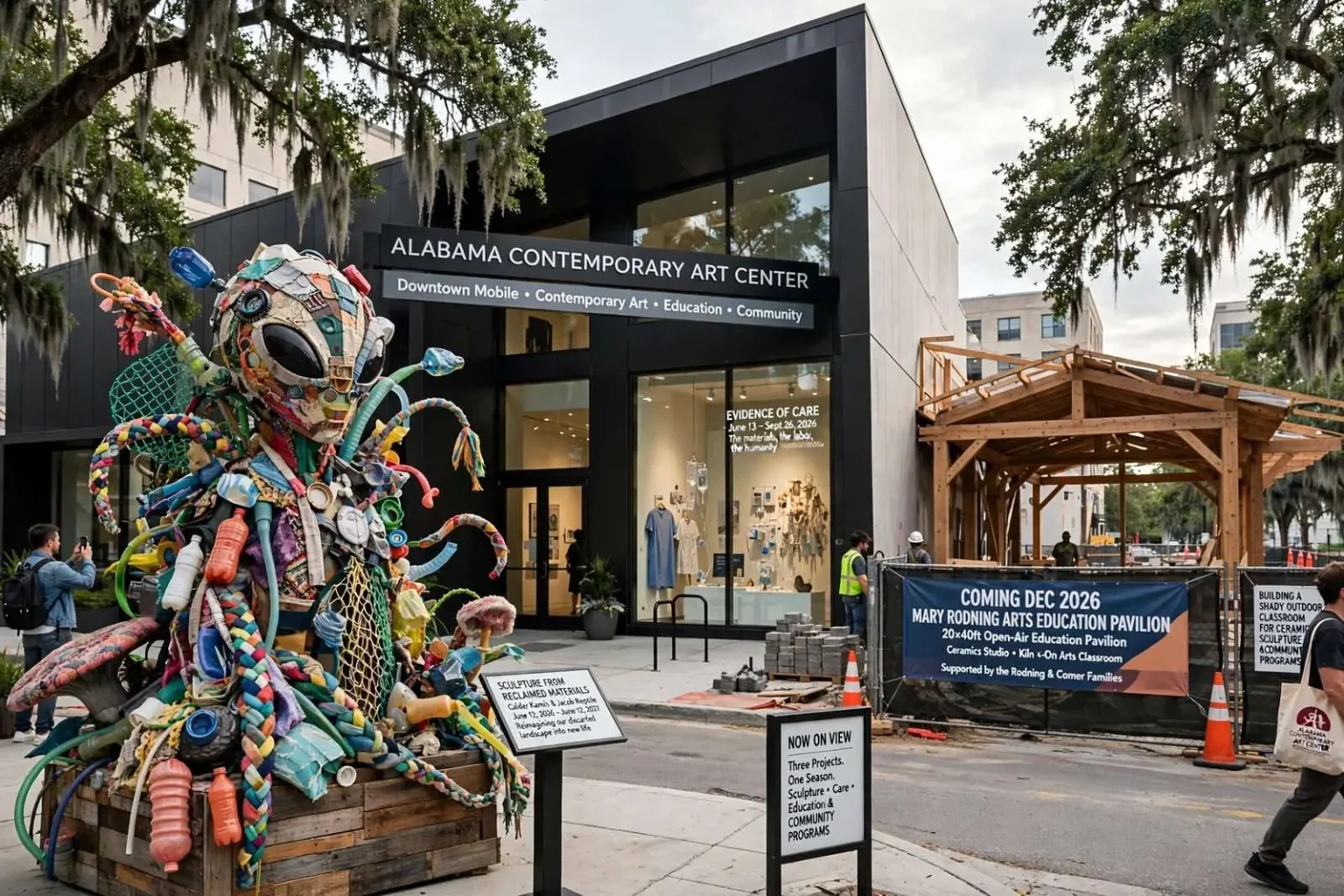
Alabama Contemporary Art Center in Mobile currently has several exhibitions and a capital project underway, ranging from sculptural work built from reclaimed materials to a multimedia exhibition centered on the tools of medical caregiving.
It is a season of simultaneous projects for the downtown institution, which has built its identity on rotating exhibitions from regional and national artists while keeping its education and community programming in near-constant motion. The three efforts now underway — a yearlong sculpture partnership, a two-show run on the theme of care, and a new open-air education pavilion — reach different audiences and different corners of the city’s cultural life at the same time.
Sculpture From Reclaimed Materials
In a partnership exhibition originated by Alabama Contemporary for the Mobile Museum of Art, artists Calder Kamin of Austin, Texas, and Jacob Reptile of New Orleans transform trash into soft, complex sculptures. Working with fabrics, plastics and second-hand materials, the two artists build what the center describes as new alien lifeforms, flora and fauna, populating an imagined landscape built entirely from reused objects. The exhibition runs from June 12, 2026, through June 12, 2027.
The collaboration with the Mobile Museum of Art extends Alabama Contemporary’s habit of working across institutions — a partnership exhibition originated by one organization and presented by another gives both audiences access to work neither could commission alone. Kamin and Reptile both work in the tradition of assemblage and found-material art, a practice with deep roots in American sculpture, but each pushes it toward the figurative: their creatures and plants read as living things rather than as piles of rescued objects.
The subject matter also speaks to a Gulf Coast audience with particular force. Coastal communities see the consequences of plastic waste and consumption more plainly than most — along beaches, bayous and waterways — and an exhibition built entirely from reused materials doubles as an argument about what a landscape made of our discards might look like. A yearlong run gives school groups and summer programming ample opportunity to use the work.
Evidence of Care
Running from June 13 through Sept. 26, 2026, is “Evidence of Care,” a multimedia art exhibition exploring the everyday medical materials that quietly support the work of medical workers. According to the center, after treatment ends and lives are changed, the physical traces of caregiving remain behind — the materials, the sweat and often the tears become evidence of the labor, urgency and humanity found within systems of care.
The exhibition’s framing is deliberately material: not a show about medicine as an idea, but about the objects through which care happens — the tubing, the gowns, the instruments, the packaging and the improvised tools that mediate every encounter between a caregiver and a patient. Multimedia presentation allows the artists involved to treat those materials as evidence in both senses: traces left behind by real labor, and proof of a system’s humanity or its strain.
Mobile’s own medical economy gives the theme local resonance. The city anchors one of the Gulf Coast’s larger healthcare networks, anchored by its major hospital systems, and a significant share of the region’s households has navigated treatment, caregiving and recovery in recent years. An exhibition that takes the physical residue of that experience seriously invites an audience well beyond the regular gallery-going public.
Overlapping with that same period is an architectural landscape intervention by artist Brian R. Jobe. Jobe’s installation offers visitors a way to slow down and find rest in a liminal space that is both a journey and a destination, continuing his broader body of work building public corridors meant for contemplation and respite.
Jobe’s practice treats built space as a medium, constructing walkable environments that ask visitors to change their pace rather than their attention. Paired with “Evidence of Care,” the intervention works as a thematic counterweight — an exhibition about urgency and exhaustion set alongside a place built deliberately for pause. Visitors can move between them in a single visit, and the pairing turns the center’s galleries into something closer to a sequence of states: labor, aftermath, rest.
New Education Pavilion Underway
Alabama Contemporary has also announced the construction of a new education space at its AC Satellite location. With support from the Rodning and Comer families, the center is building a 20-by-40-foot open-air pavilion to be named the Mary Rodning Arts Education Pavilion. Construction is expected to run from July 29 through Dec. 31, 2026.
The pavilion, open to the AC Satellite Sculpture Garden, is being designed to host some of the organization’s messiest hands-on art activities and educational programming. It will house a 25-cubic-foot gas kiln for ceramics and provide a shaded outdoor classroom space to facilitate plein-air painting, sculpture and ceramics classes, along with small-scale theater productions, movie nights and other performances.
The design logic is practical. Ceramics, plein-air painting and sculpture are the classes that most strain an indoor gallery’s floor, drains and air handling — clay dust, spilled media and open flames are exactly what a museum building is built to avoid. Moving those activities into a dedicated open-air structure, equipped with its own kiln, lets the center expand its studio offerings without compromising the exhibition spaces, and the shaded classroom extends programming through the long Gulf Coast summer.
The pavilion’s name honors Mary Rodning, an artist and longtime advocate for the arts in the Mobile area whom the organization describes as a beacon of generosity who shared her skills and talent widely and helped build cultural assets that continue to serve the community. Alabama Contemporary Executive Director elizabet elliott said putting Rodning’s name on the structure is a deep honor. “She is a north star when it comes to art supporters and advocates,” elliott said. “I am unlikely to ever meet anyone like her again. The Mary Rodning Arts Education Pavilion is an open air classroom that will act as a lodestone for our entire creative community, it will support so many artists and educate new generations. It is our great privilege to do this work, and to carry Mary Rodning’s legacy forward in this community.”
Naming a working classroom rather than a gallery after an artist-advocate is a deliberate fit. Rodning’s reputation in Mobile rests on making things and teaching others to make them — the daily, messy labor of a working artist — and a kiln-equipped outdoor studio used by children and adults learning ceramics is a more literal continuation of that legacy than a quiet exhibition hall would be.
The Rodning and Comer families’ support reflects the pattern by which Mobile’s cultural institutions have historically been built: private family giving attached to a particular project and a particular name. In a city whose museums, performance venues and gardens trace back generations of philanthropic families, the pavilion continues a civic tradition as much as it adds a facility.
Funding the build-out
Alabama Contemporary said continued support for the project will go toward completing the build-out, equipping the outdoor classroom with new tools and equipment, and creating new paid opportunities for artists. The organization held an Art Yard Party and Open House on Aug. 7 from 4 to 8 p.m. at the AC Satellite location as one opportunity for the community to contribute in person. The gathering, held after the original Art Yard Party was rained out in June, was billed as a casual end-of-summer event and featured a food truck, a bouncy house, games and art activities offered by donation, whimsical creatures, prizes and live music. Entry and participation were free and open to all ages, with donations encouraged at the door and at each activity to help fund the pavilion project along with a planned sculpture garden, a community kiln and additional arts education equipment and supplies. Donations can also be made in Mary Rodning’s honor directly to Alabama Contemporary.
The party’s makeup said as much about the organization’s methods as its fundraising goal. Alabama Contemporary has long treated its public events as programming in their own right — family-oriented, participatory and priced so that anyone can come through the door — and the rained-out June gathering turned into a second chance in August rather than a cancellation. The laundry list of planned uses for the donations — a sculpture garden, a community kiln, tools and supplies, and paid artist opportunities — lays out the center’s near-term roadmap in public view.
The commitment to paid artist opportunities deserves note. In regional arts organizations, the line item most often cut is the one that pays the artists; making it an explicit purpose of the pavilion campaign ties the capital project to the working livelihoods of the creative community the pavilion is meant to gather.
What it means for downtown Mobile
Alabama Contemporary Art Center is located in downtown Mobile and regularly rotates exhibitions from regional and national artists alongside community and education programming.
Downtown Mobile’s cultural district has grown over the past two decades into a walkable corridor of museums, galleries, performance spaces and historic attractions, and Alabama Contemporary sits near the center of it. Institutions there measure success not only in attendance but in how they stitch together the city’s wider civic life — school partnerships, neighborhood events, artist studios and the visitors who come downtown for an evening and stay for dinner.
A pavilion that hosts movie nights, small theater, ceramics classes and plein-air sessions is aimed at exactly that stitching. It gives the center a second kind of public space — informal, outdoor and open late — to complement its galleries, and it gives the surrounding neighborhood a reason to treat the block as a destination rather than a pass-through.
Between now and the pavilion’s expected completion at the end of 2026, the center’s calendar remains full: the reclaimed-materials sculpture exhibition runs a full year, “Evidence of Care” and Jobe’s landscape intervention share the summer and early fall, and the education team has promised the AC Satellite grounds will host programming throughout the construction window. For Mobile’s creative community, the season offers both a full slate of work to see and a visible bet on where the organization intends to grow next.