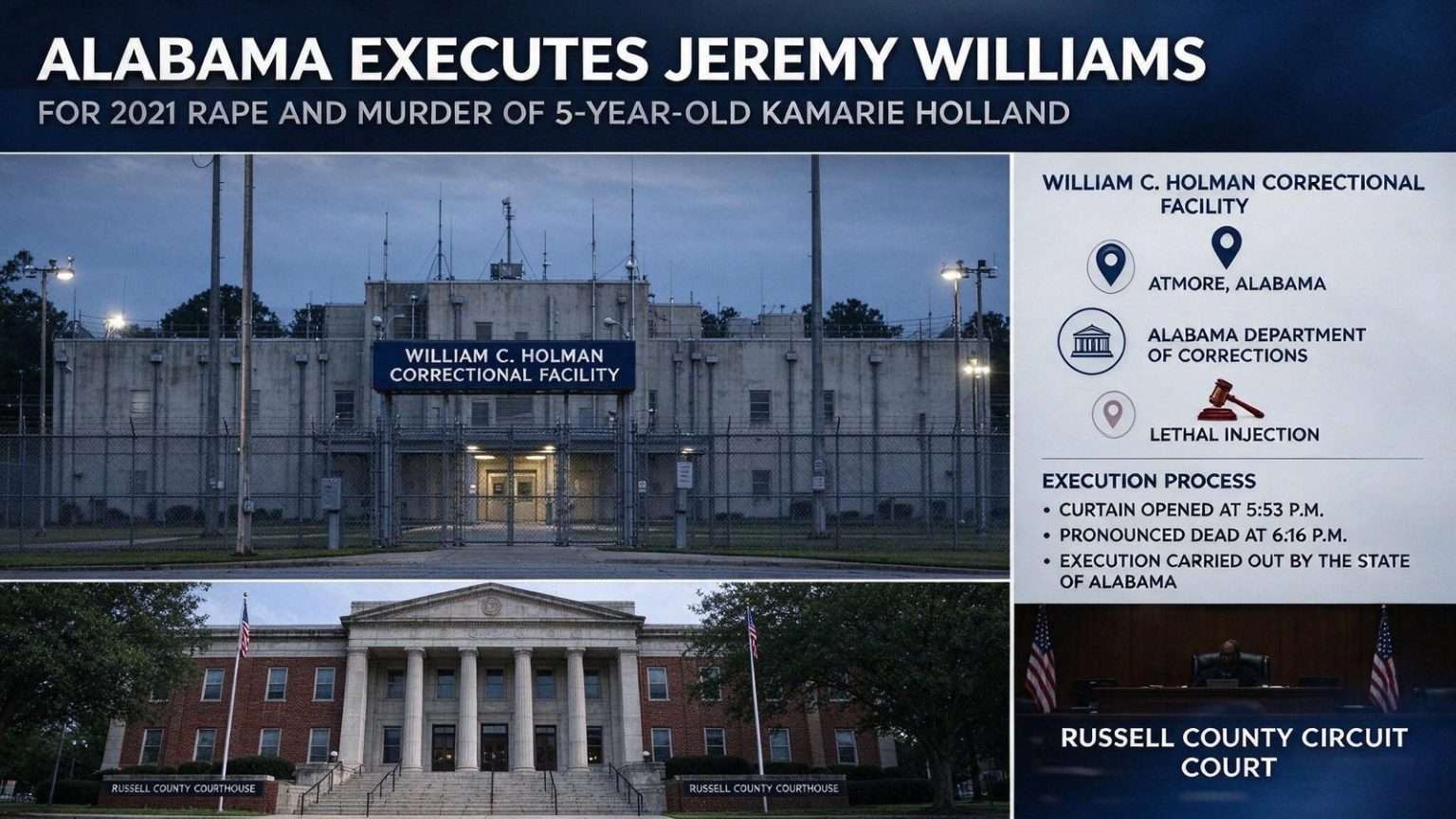
Alabama executed Jeremy Tremaine Williams by lethal injection Thursday evening for the 2021 rape and murder of 5-year-old Kamarie Holland, a crime he recorded on his cellphone. Williams, 42, was pronounced dead at 6:16 p.m. at the William C. Holman Correctional Facility in Atmore after Gov. Kay Ivey declined to grant clemency. The execution is a matter of public record, carried out by the State of Alabama following a completed legal process.
Thursday evening, Ivey informed Corrections Commissioner Greg Lovelace that she would not exercise her clemency powers and directed him to proceed with Williams’s lawfully imposed death sentence. Attorney General Steve Marshall’s office cleared the execution to begin at 5:53 p.m. “There are few words to adequately describe the depth and depravity of Jeremy Williams’ evil act,” Ivey said in a statement. “The unspeakable nature of this crime is exactly why we have the death penalty statute in the state of Alabama. Kamarie Holland is an innocent girl who is no longer with us, but she finally received justice tonight.”
In a statement issued after the execution, Marshall said “justice has been served.” “In addition to molesting and murdering five-year-old Kamarie Holland in 2021, Williams confessed to a series of violent crimes against children,” Marshall said. “He killed his infant daughter in Alaska, raped at least two other small children, and sexually abused his young cousin. At his own request, his execution was set and carried out. This is one of the most atrocious crimes we have seen against an innocent child.” Marshall also said Kamarie’s short life was marked by failures from those who should have protected her, noting the trial court had written that Williams’s actions “were so shockingly evil in everything that you did that there’s nothing that I can order to give you what you truly deserve.”
The Crime and the Investigation
According to court records and prosecutors, Williams convinced Kamarie’s mother, Kristy Siple, to let him take her 5-year-old daughter from their Columbus, Georgia, home in December 2021 in exchange for $2,500, an amount later negotiated down to $1,300 that Williams never paid. He took Kamarie to an abandoned house in Phenix City, Alabama, where he assaulted and strangled her, recording the acts on his cellphone both before and after her death, before hiding her body and returning to Columbus. He was arrested in a Phenix City hotel room, and investigators found Kamarie’s body while he was in custody. In a five-hour recorded statement on Christmas Day 2021, Williams admitted to taking, sodomizing, raping and strangling Kamarie, and to forcing her to smoke methamphetamine. He also confessed to raping at least two other children under the age of six, sexually abusing a young cousin, and killing his one-month-old daughter in Alaska in 2005 — a confession that led Alaska authorities to charge him with second-degree murder in 2022. In 2009, an Alabama jury had acquitted Williams of burning a 3-year-old child in his care with scalding water.
The Legal Path to Execution
Williams pleaded guilty in Russell County Circuit Court in March 2024 to four counts of capital murder, along with production of obscene material involving Kamarie, abuse of her corpse, human trafficking and conspiracy to commit human trafficking, and sodomy and sexual abuse involving his cousin. Because Alabama law still required the state to prove the capital charges to a jury even after a guilty plea, a jury heard the case and found him guilty on all four capital counts; he was sentenced to death. Williams then wrote a series of letters asking to drop his appeals and be executed immediately. The Alabama Court of Criminal Appeals affirmed his convictions and sentence on March 27, 2026, the Alabama Supreme Court authorized the execution on June 16, and Ivey set the execution date two days later. Siple separately pleaded guilty to sex trafficking and was sentenced to 20 years in prison; a murder charge against her was dismissed as part of her plea agreement.
The Final Hours
Prison officials said Williams requested a cheese pizza for his last meal and was visited in his final 24 hours by his wife, mother, stepmother, brother and father, and spoke by phone with his grandmother and aunt. Asked for any last words before the injection began, Williams said, “I want to thank God for forgiving me for my sins so I can meet him in peace. Goodnight.” The curtain to the execution chamber opened at 5:53 p.m., and Williams was pronounced dead at 6:16 p.m.
After the execution, Russell County District Attorney Rick Chancey, trial attorney Malory Hatfield and Russell County Sheriff Heath Taylor held a news conference, saying they attended in support of Kamarie’s family. “Kamarie is why we’re here. He killed that baby, and that’s why we’re here,” Chancey said. Taylor, who investigated the case, called it the worst of his 39-year law enforcement career. Corey Holland, Kamarie’s father, described his daughter as an exuberant child who loved princesses, dress-up and Halloween costumes. Holland was barred from witnessing the execution because of a 2022 charge accusing him of violating a custody order by allowing Kamarie to go with her mother, who did not have custody at the time.
Alabama’s Execution Calendar
Williams’s execution was Alabama’s first of 2026. A separate execution using nitrogen gas was halted in June after a federal court ruled the method was “likely unconstitutional”; that inmate is now scheduled for lethal injection in September. Williams’s execution also fell on the same day Tennessee and Oklahoma each carried out lethal injections, marking the first time three executions were conducted in the United States on the same day since January 2010.
About Alabama’s Courts
Alabama’s judicial system includes trial courts, the Court of Civil Appeals and Court of Criminal Appeals, the state Supreme Court, and a network of district and circuit courts that handle matters ranging from traffic offenses to serious felonies. Judges in Alabama are elected in partisan races, and the state’s high courts have frequently been involved in election-law disputes, including those arising from redistricting. Cases originating in state trial courts can be appealed through the appellate hierarchy and, where federal questions are presented, may ultimately reach federal courts.
The William C. Holman Correctional Facility
Holman Correctional Facility, located in Atmore in Escambia County, is the only site in Alabama where the state carries out executions by lethal injection. The facility houses death row inmates and is operated by the Alabama Department of Corrections. The Thursday evening execution followed the procedure used in previous lethal injections at the site, with the curtain to the execution chamber opening at 5:53 p.m. and the inmate pronounced dead shortly thereafter.
What the Case Revealed About Child Protection Failures
The Williams case has drawn attention not only to the crimes themselves but to the layers of adults whose decisions put Kamarie Holland in harm’s way. Corey Holland, Kamarie’s father, was barred from witnessing the execution because of a 2022 charge that he had violated a custody order by allowing Kamarie to go with her mother. Kristy Siple, Kamarie’s mother, ultimately pleaded guilty to sex trafficking and received a 20-year prison sentence, with a murder charge against her dismissed as part of her plea agreement. The trial court itself wrote that Williams’s actions “were so shockingly evil in everything that you did that there’s nothing that I can order to give you what you truly deserve,” a line the Attorney General highlighted in his post-execution statement.
For child welfare advocates, the case has become a touchstone for arguments about how children in unsafe family circumstances can fall through the cracks of custody arrangements, addiction services and law enforcement. Alabama’s Department of Human Resources has not commented publicly on the specific family circumstances, but the legal record in the Williams case has been used by advocates in other states to argue for stronger oversight of custody transfers involving young children, particularly when one parent has a history that should have raised red flags.
The Broader Context of the Death Penalty in Alabama
Alabama is one of a relatively small number of states that continues to carry out executions, and the state’s lethal injection protocol has been the subject of legal challenges in recent years. The nitrogen hypoxia method that Alabama authorized as an alternative — and that a federal court halted in June — was meant to provide a backup option for inmates who objected to lethal injection on grounds that it could cause severe pain. The ruling against nitrogen gas has put Alabama in a position where lethal injection remains the only viable execution method in the state, at least until the legal questions around the alternatives are resolved.
The Williams execution also took place against the backdrop of a national conversation about how the death penalty is administered, including questions about intellectual disability, mental illness and the role of clemency. Gov. Ivey’s decision not to grant clemency, made after a review of Williams’s file and his letters asking to drop his appeals, reflects the legal posture of the case: a defendant who pleaded guilty, was convicted by a jury on every capital count, and asked the courts and the governor to let the sentence proceed.
Russell County and the Path of the Case
The case moved through Russell County, an east Alabama county that sits on the Georgia border and includes Phenix City, where the crime took place. The trial was held in the Russell County Courthouse, and the prosecution team that secured the guilty plea and the jury’s death verdict was led by District Attorney Rick Chancey and trial attorney Malory Hatfield. Sheriff Heath Taylor, who investigated the case, called it the worst he had seen in 39 years in law enforcement.
The county’s role in the case is also a reminder of how capital prosecutions move through Alabama’s circuit court system. Capital cases can be tried in any of Alabama’s 41 judicial circuits, and the venue is determined by where the crime occurred. The Williams trial thus unfolded in a circuit accustomed to handling serious felony cases but one that had not recently prosecuted a capital murder of this scale, making the prosecution team’s work and the jury’s verdict all the more notable within the local legal community.