Alabama Extension Opens Registration for a Two-Day Homeowner Gardening Conference in Mobile
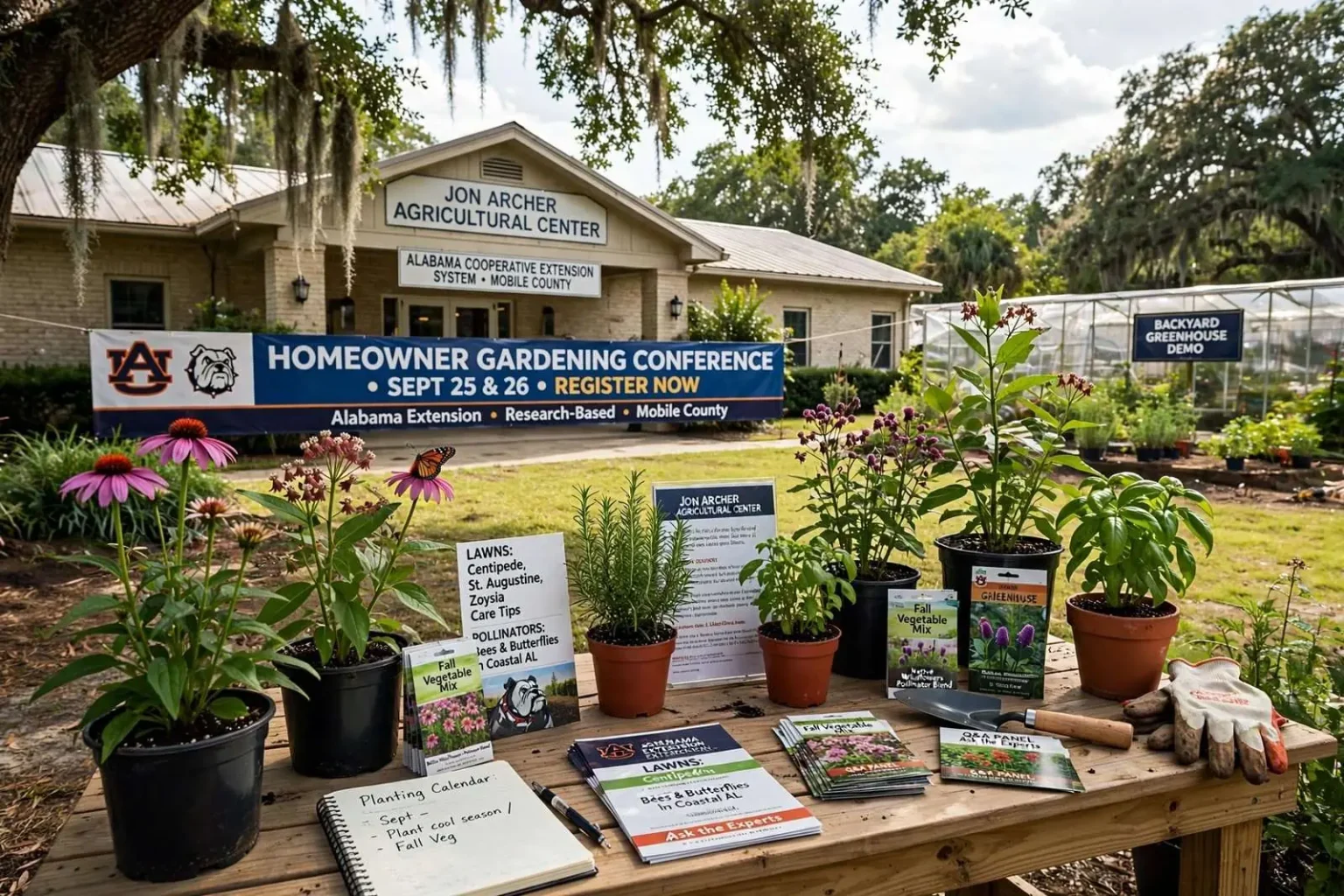
Alabama Extension will host a two-day Homeowner Gardening Conference Sept. 25-26 at the Jon Archer Agricultural Center in Mobile, covering greenhouses, pollinators, lawns and new landscape plants for $25.
Gardening knowledge tends to arrive slowly. A homeowner learns which corner of the yard drains badly after a decade of watching it flood, figures out the right planting window by missing it twice, and discovers what actually survives a Gulf Coast August by killing several things that did not.
The Homeowner Gardening Conference in Mobile County is built on the premise that this does not have to take ten years. The two-day event, hosted by Alabama Extension, is scheduled for Sept. 25 and 26 at the Jon Archer Agricultural Center in Mobile, and it packs research-based instruction and direct access to specialists into a single weekend.
The Case for Compressing the Learning Curve
Jack LeCroy, home horticulture agent at Alabama Extension with Auburn University, said the conference exists precisely because the alternative is so slow.
For many hardworking homeowners, LeCroy noted, it can take a long time to accumulate a working command of horticulture information. The conference is designed to shorten that: participants discover the research-based resources available to them and learn from other gardeners, all at one time.
“Whether you are a beginning gardener or an experienced homeowner looking to expand your knowledge, this conference will provide useful information, fresh ideas and opportunities to connect with gardening professionals and fellow plant enthusiasts,” LeCroy said.
That framing — useful to beginners and to experienced gardeners alike — is deliberate. Extension programming generally aims to serve both ends of a room, on the reasoning that a first-year gardener and a thirty-year gardener often have the same question about a new pest and simply arrive at it from different directions.
The Schedule
The conference opens Friday, Sept. 25, at 5:30 p.m. with dinner and a keynote speaker. Saturday, Sept. 26, carries the bulk of the program: four educational sessions, lunch and a closing speaker panel.
The Friday-evening-into-Saturday format is a practical concession to the audience. Homeowners who work weekdays can attend the opening after hours and give one weekend day rather than taking leave.
What Gets Covered
The program is organized around the questions homeowners actually ask, rather than around an academic outline. Topics include:
- Backyard greenhouses — structures, siting and what a home-scale greenhouse can and cannot realistically do
- Pollinators — supporting bees, butterflies and other pollinating species in a residential landscape
- Lawns — perennially the single most common source of homeowner horticulture questions
- New and interesting plants for the landscape — expanding beyond the standard palette found at most garden centers
The closing ask-the-panel session inverts the usual conference structure. Instead of experts deciding what the audience needs to hear, the audience sets the agenda and gardening specialists field as many questions as time allows.
“You are going to have experts right there with you to answer whatever questions that you may have,” LeCroy said. “If we don’t know the answer, we can and will find the answer for you.”
That second sentence is a fair description of how the Extension system is supposed to work. An agent who does not know an answer has a land-grant university research apparatus behind them and a professional obligation to go find it.
Why Gulf Coast Gardening Is Its Own Discipline
Generic gardening advice fails in coastal Alabama with some regularity, which is a large part of the value of regionally specific instruction.
Mobile County sits in a humid subtropical climate with long, hot, wet summers and mild winters. That combination produces a growing environment that behaves nothing like the one assumed by most nationally published gardening guidance. Fungal disease pressure is high. Insect populations are not knocked back by a hard freeze. Heavy rainfall events move nutrients out of the root zone. Sandy soils in parts of the region drain fast and hold little; heavier soils elsewhere hold too much. Planting calendars are shifted, and in many cases the productive seasons are spring and fall with a difficult stretch in between rather than a single continuous summer season.
Lawn management follows the same pattern. The warm-season turfgrasses that dominate the region — centipede, St. Augustine, zoysia, bermuda — each have distinct fertility, mowing height and disease profiles, and advice appropriate for one can actively damage another. The commonest homeowner lawn problems in the region trace back to a mismatch between the grass in the yard and the care regimen being applied to it.
Pollinator programming has its own regional dimension. Coastal Alabama sits on migration corridors and hosts a distinctive mix of native plants, and residential landscapes collectively represent a substantial share of the habitat available in developed areas.
About Alabama Extension
The Alabama Cooperative Extension System is the outreach arm of the state’s land-grant universities, delivering research-based information from Auburn University and Alabama A&M University to residents across all 67 counties. Its home horticulture programming exists specifically to put university research in front of ordinary homeowners rather than only commercial growers.
The practical consequence for attendees is that recommendations at the conference are traceable to research rather than to product marketing or to advice passed along until nobody remembers where it came from.
Registration and Details
What: Homeowner Gardening Conference
When: Friday, Sept. 25 (dinner and keynote, 5:30 p.m.) and Saturday, Sept. 26 (sessions, lunch, closing panel)
Where: Jon Archer Agricultural Center, Mobile
Cost: $25 registration fee, which covers meals throughout the conference
Register: www.aces.edu/go/6407
Questions: Jack LeCroy at (251) 574-8445
The $25 fee covers meals across both days, which puts the actual cost of instruction at effectively nothing — a deliberate feature of Extension programming rather than an oversight.
Late September is a well-chosen moment for this material on the Gulf Coast. It falls at the front end of the fall planting window, when cooler soil and reduced heat stress give new plantings a far better establishment period than a summer installation would, and when homeowners are making decisions about overseeding, fall vegetables and next spring’s landscape. Information delivered that weekend can be applied within days.