Alabama Food Banks Seek Delay on SNAP Fees Tied to State’s Error Rate
Alabama food bank leaders asked the state's congressional delegation to delay SNAP fees, saying more time would help lower a 9.52 percent error rate.
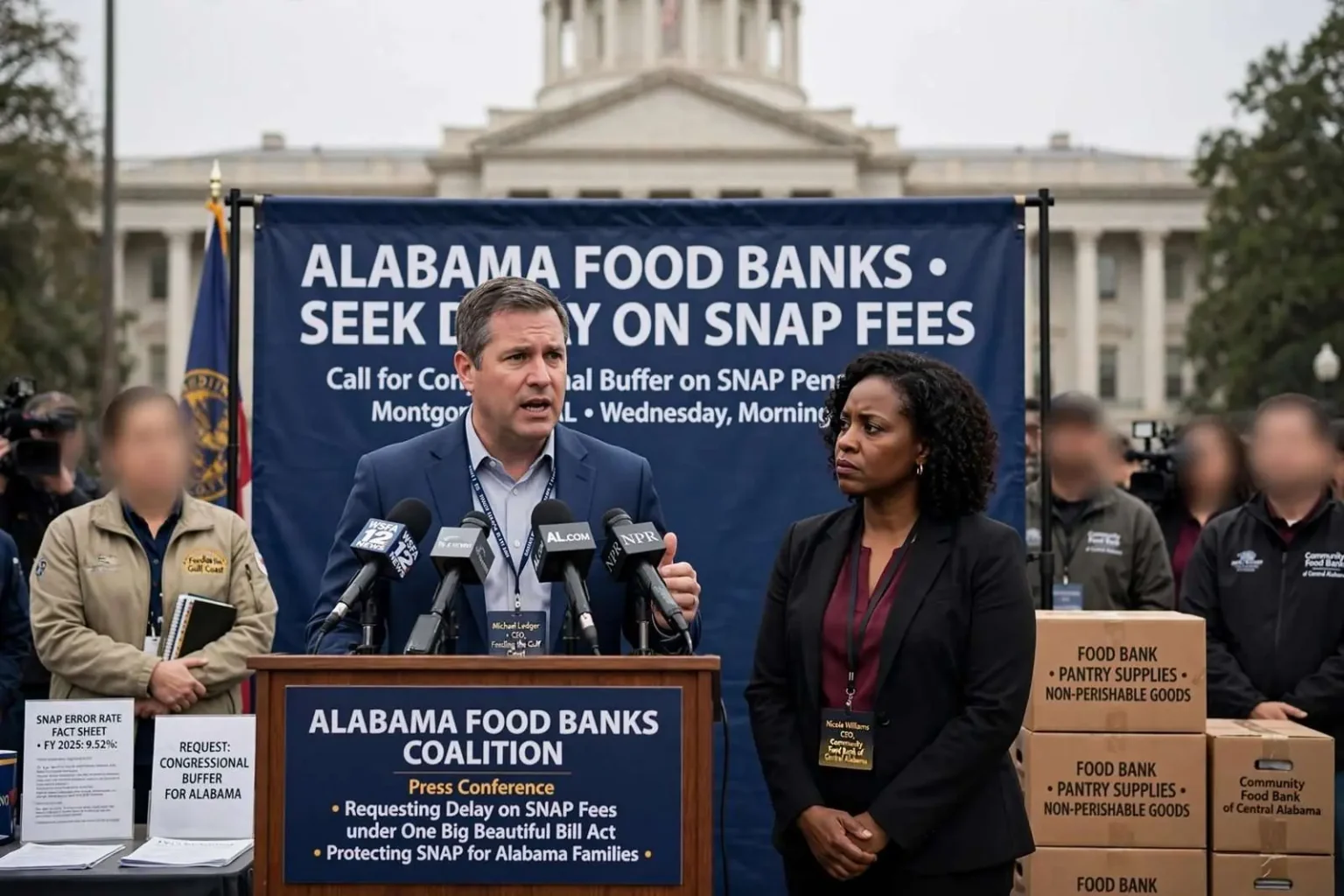
MONTGOMERY, Ala. — Alabama food bank leaders held a press conference Wednesday morning to ask the state’s congressional delegation to help secure a delay on SNAP-related fees under the One Big Beautiful Bill Act. Under the law, states that incorrectly distribute funds from the Supplemental Nutrition Assistance Program (SNAP) will have to pay a greater share of costs starting in fiscal year 2028. Food bank leaders say more time would give the state a greater opportunity to lower its error rate and avoid the fees. The gathering brought together the heads of food banks that serve communities from the Gulf Coast to the Tennessee line, all of whom are bracing for what the new cost-sharing rules could mean for state budgets and the charitable networks that backstop them.
“I know SNAP has become a four-letter word in much of the country but in reality, our neighbors across the state rely on this program every day,” said Michael Ledger, CEO and president of Feeding the Gulf Coast. His organization, headquartered in Theodore, distributes food through a network of pantries across south Alabama and the central Gulf Coast, and it operates on the front line whenever federal nutrition benefits are reduced or delayed. For pantries already stretched by demand, even a modest dip in SNAP purchasing power translates into longer lines at distribution sites.
How the error rate works
SNAP error rates are a combined percentage of overpayment and underpayment of SNAP benefits. Under the One Big Beautiful Bill Act, states with an error rate of 6 percent or more must pay a greater share of SNAP costs. However, the bill gives a buffer period to states with error rates greater than 13.3 percent. Specifically, it says states qualify for a buffer if “the payment error rate of a State multiplied by 1.5 is equal to or above 20 percent.”
That means a state with an error rate of 13.4 percent or greater in fiscal year 2025 will have its fees delayed until fiscal year 2029. The same applies to fiscal year 2026; any state with an error rate of 13.4 percent or greater will have its fees delayed until fiscal year 2030. The structure was designed to give the most error-prone states time to fix administrative problems before the financial penalties land, while holding mid-range states to the earlier deadline.
In fiscal year 2025, Alabama’s error rate was 9.52 percent. That is high enough for the state to be penalized, but not high enough to receive a buffer period under the act. In other words, Alabama finds itself in the worst position the formula allows: close enough to the national norm to expect improvement, yet far enough from the buffer threshold to face the earliest round of cost-sharing without relief.
Alaska, Delaware, Georgia, Illinois, New Mexico, Oregon, and Washington, D.C., have fiscal year 2025 error rates that make them eligible for the buffer period. The list includes states of very different sizes and administrative structures, underscoring the food banks’ argument that payment errors are a systemic challenge that states cannot simply will away on a fixed timetable. Error rates typically reflect complicated eligibility calculations, household income verification and case processing volumes rather than fraud alone.
“We are a critical safety net, but we were never built to replace the federal nutrition support that lets families buy groceries consistently and with dignity,” said Nicole Williams, CEO of the Community Food Bank of Central Alabama. Her Birmingham-based organization serves a multi-county region in the middle of the state, where it supplies hundreds of partner agencies. Food bank leaders have made the same point in varying forms for years: charity can cushion a crisis, but it cannot substitute for a monthly benefit that arrives on schedule and spends like any other grocery money.
Appeal to Alabama’s senators
At the press conference, food bank leaders asked U.S. Senators Katie Britt, R-Alabama, and Tommy Tuberville, R-Alabama, to add a buffer period for Alabama into the 2026 Farm Bill. The farm bill, the sprawling piece of legislation that reauthorizes SNAP and agricultural programs roughly every five years, is the most direct vehicle Congress has for adjusting the timeline the new law imposes. A buffer written into the bill would give Alabama the same grace period the statute already grants to states with higher error rates.
Sen. Britt’s office provided the following statement: “Senator Britt and her team are in constant communication with local leaders across the state to ensure that those eligible for SNAP benefits receive them without disruption and that the state’s payment error rate is properly addressed. Senator Britt does not sit on the Senate Agriculture Committee and therefore will have no opportunity to offer amendments to the farm bill until it advances to the Senate floor.”
Sen. Tuberville’s office did not respond to a request for comment. The silence left advocates without a public read on the state’s junior senator, whose committee assignments put him closer to federal spending questions. For the food banks, the practical path forward runs through whichever senators can attach the buffer language when the bill reaches the floor — which is why the delegation’s engagement, both senators’ offices included, was the central ask of the morning.
The following states and territories had payment error rates of less than 6 percent for fiscal year 2025: Idaho, Iowa, Kentucky, Nebraska, South Dakota, Utah, Vermont, the U.S. Virgin Islands, Wisconsin, and Wyoming. Those states sit below the penalty threshold entirely, illustrating the spread the advocates say is the problem: a formula that treats a 9.52 percent rate and a 13.4 percent rate so differently can push a state like Alabama into penalties for missing a standard that its neighbors in the Southeast — Georgia among them — avoided only by qualifying for the buffer.
What the fees would mean
The stakes for Alabama are fiscal as much as nutritional. SNAP is an entitlement funded by the federal government, with states shouldering administrative costs; the new law shifts a larger share of benefit costs onto states that distribute funds inaccurately. Any state payment toward benefits would have to come from the general fund, competing with education, corrections and health appropriations — or would force reductions elsewhere in the nutrition budget.
For the regional food banks, the calculation is simpler and harder at once. Feeding the Gulf Coast and its counterparts measure demand in pounds of food and in the number of households served each month, and they know from experience that the demand curve bends upward whenever benefits shrink. The leaders who stood at the Montgomery podium asked for a delay not as a reprieve from responsibility, but as time for the state agencies that administer SNAP to modernize case processing and bring the error rate down before the meter starts running.
The county-level view
The consequences of any benefit disruption would not fall evenly across the state. South Alabama’s coastal counties carry some of the highest food insecurity rates in the state, driven by pockets of deep poverty that sit alongside the tourism economy, and Feeding the Gulf Coast’s distribution territory reaches households from Mobile Bay to the Florida line. Rural counties in the Black Belt and elsewhere depend heavily on small pantries that operate with volunteer staff and no margin for a surge in demand.
SNAP itself remains the largest nutrition program in the country, and in Alabama it serves hundreds of thousands of residents in a typical month, most of them children, seniors, or working adults whose wages fall short of grocery costs. Benefits are loaded onto EBT cards and redeemed at grocers, meaning the dollars also flow back into the state’s food retail economy. That is the quiet argument the food bank leaders emphasized: the program is not an abstraction in Washington but a stream of grocery purchases that supports checkout lines and small-town stores across Alabama.
The road ahead for the request
The food banks’ ask now moves to Washington, where the farm bill’s path will determine whether Alabama ever gets its buffer. The bill must first clear the Senate Agriculture Committee, where Alabama has no seat, before amendments can be offered on the floor — the procedural reality Britt’s office pointed to. Advocates said they would continue pressing both senators to carry the message to colleagues who do sit on the committee, and to keep the state’s 9.52 percent error rate in view as the timeline creeps toward fiscal year 2028.
Between now and then, state administrators have a window to move the number below 6 percent and out of penalty territory entirely. The food bank leaders said they want the state to succeed in that effort — their objection is not to accountability, but to a deadline that punishes a state for errors while denying it the same grace period the law extends to states with worse records. Whether Congress agrees will decide who pays when the fiscal year turns, and how much food is left on the shelves of the pantries standing behind them.