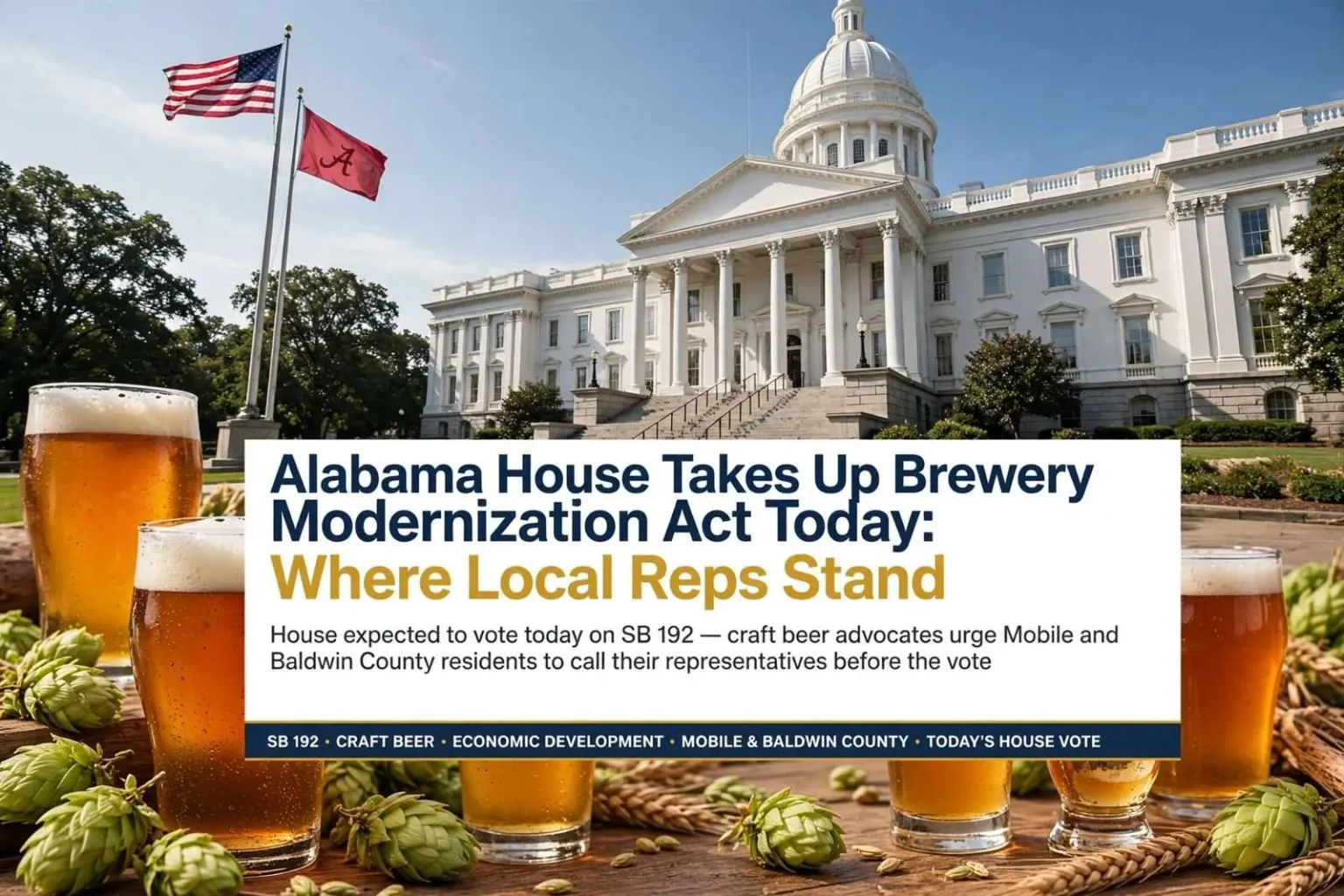
The Alabama House of Representatives is expected to vote today on SB 192, the Brewery Modernization Act — and craft beer advocates are urging Mobile and Baldwin County residents to call their representatives before the gavel falls. The bill, which passed the Senate earlier in the session, represents the most significant proposed change to the state’s production brewery laws in a generation, and its fate in the House is expected to be close enough that a handful of calls from constituents could make the difference.
Free the Hops, the grassroots group behind Alabama’s earlier gourmet beer law, says the measure would modernize state alcohol rules for production breweries and brewpubs alike — changes supporters describe as essential to ever seeing a brewery operate on Dauphin Street again. The organization has spent years building the case that Alabama’s brewing statutes, written decades before the craft beer boom, effectively lock production breweries out of the state’s cities and push new brewing investment across the state line.
Under current Alabama law, breweries face restrictions that have kept most craft production out of the state’s cities. The specifics matter to anyone who has watched Asheville, Denver or Tampa turn small breweries into neighborhood anchors and tourist draws: Alabama’s rules separate the places where beer is made from the places it can be sold and tasted in ways that make a downtown brewery nearly impossible to operate economically.
What the Bill Would Change
The Brewery Modernization Act takes aim at that framework. For production breweries, it would loosen the rules that currently force brewing operations to the outskirts — allowing breweries to sell their product for on-premises consumption, the tasting-room model that has powered the craft beer industry’s growth nationwide. For brewpubs, it would ease the restrictions that limit where and how they can operate, giving restaurant-breweries room to fit into downtown commercial districts.
Supporters frame the bill in economic terms. Breweries are manufacturing businesses that pay taxes, hire locally, and attract visitors; every state around Alabama has updated its laws to capture that activity, and the state’s restrictive code amounts to a self-imposed penalty on a growing industry. Mobile’s historic Dauphin Street corridor, with its vacant storefronts and established nightlife foot traffic, is the example advocates keep returning to — a district built for exactly the kind of small-scale production and hospitality a modernized law would allow.
Opponents have raised familiar concerns about alcohol regulation, and the bill’s path through the Legislature has been rocky. But Free the Hops argues that the measure is narrowly tailored: it does not change distribution rules, does not touch hours of sale, and simply brings brewery definitions in line with what most states already allow.
Where Local Representatives Stand
Free the Hops flags four area lawmakers as likely opponents and is publishing their contact information so constituents can weigh in before the vote. In Baldwin County, Joe Faust, District 94 (Fairhope), can be reached at his State House office, (334) 242-7699, or his district office, (251) 990-4615. Randy Davis, District 96 (Daphne), lists a State House office at (334) 242-7724 and a work line at (251) 442-2552.
In Mobile County, Victor Gaston, District 100 (Mobile), can be reached at his State House office, (334) 242-7664. Chad Fincher, District 102 (Semmes), lists a State House office at (334) 242-7778 and a district office at (251) 649-2372.
Advocates emphasize that calls from voters in a representative’s own district carry the most weight, and that the period before a floor vote is when offices actually tally constituent sentiment. A short call stating support for SB 192 — no speech required — is the entire request.
Free the Hops and the Long Game in Montgomery
The Brewery Modernization Act is the second act of a story Free the Hops has been writing since the middle of the last decade. The organization made its name with the campaign to raise Alabama’s cap on alcohol by volume in beer, a limit that had barred most of the celebrated craft styles brewed elsewhere in the country — imperial stouts, Belgian ales, double IPAs — from store shelves in the state.
That effort succeeded against long odds, and it taught the group’s volunteers how the Alabama Legislature works: which committees control alcohol bills, how lobbying pressure is counted, and how much a few hundred phone calls can move a legislator who has never heard from craft beer voters before. The gourmet beer campaign also built something the modernization bill now draws on — a statewide network of enthusiasts organized by district, ready to mobilize when a vote approaches.
The current push aims at a different layer of the code. Where the first campaign was about what beer Alabamians could buy, this one is about what businesses Alabamians can build. The distinction matters to legislators, because it converts an argument about consumer preference into one about economic development — manufacturing jobs, downtown revitalization, and tax revenue that currently accrues to neighboring states.
How Other States Handle It
The contrast advocates draw is straightforward. Across the Southeast and the nation, states have amended their alcohol codes to let production breweries operate tasting rooms on the premises where the beer is made, and brewpubs to hold both brewing and retail licenses. The result has been an explosion of small breweries — hundreds per state in places like North Carolina, Colorado and California — most of them employing a handful of people and anchoring a commercial block.
Those breweries cluster in cities on purpose. Brewing needs industrial space, but selling beer needs foot traffic, and the tasting-room model fuses the two: the brewhouse itself becomes the attraction, tours become marketing, and the neighborhood gets a destination. States that got their codes right early watched that pattern replicate in former warehouse districts from Asheville to Birmingham’s own emerging scene just across the line.
Alabama’s statute, written for a different era of the industry, treats the brewery’s production and the public’s access as things to be kept apart. The Modernization Act’s central promise is to close that gap — to put Alabama breweries on the same legal footing their competitors in Tennessee, Georgia, Mississippi and Florida already operate under.
Dauphin Street as the Test Case
Mobile’s stake in the bill is embodied in Dauphin Street. The corridor that runs through the Lower Dauphin entertainment district has spent a decade rebuilding its nightlife identity around bars, music venues and the monthly LoDa ArtWalk, and it has the architecture, parking and evening foot traffic that a small brewery needs. What it has not had is a brewery, because the state’s rules have made one untenable.
Advocates describe the scenario the bill would unlock: a working brewhouse within walking distance of the restaurants and venues already drawing crowds, with a tasting room that turns every ArtWalk night into brewery hours and every convention weekend into a tour day. Similar transformations have played out in comparable districts across the region, and each one traces back to a change in state law that made the business model legal.
The broader Gulf Coast angle matters too. Baldwin County’s communities — Fairhope, Daphne, Foley — have grown into some of the state’s most active markets for dining and craft beverage culture, and a modernized code would let entrepreneurs there build breweries close to their customers rather than watching such businesses open across state lines.
The Vote and What Comes After
A floor vote in the House is the bill’s next gate, but not necessarily its last. If the chamber passes the bill in the same form the Senate approved, it advances toward final enactment; if the House amends it, the differences must be resolved before the session’s end. Either way, today’s vote determines whether the measure continues to move or stalls for the year.
Supporters can follow the vote through Free the Hops’ forum, blog and Twitter updates, which the organization uses to report floor action in real time during a session day. Live audio streamed from the Alabama State House also lets listeners hear debate as it happens — a resource that has become standard for citizens tracking alcohol and gambling bills in Montgomery.
The organization’s guidance to supporters is consistent: make the call, keep it brief and courteous, and report responses back through the group’s channels so the tally of lawmaker positions stays current. In a Legislature where alcohol bills live or die by margins of a few votes, that feedback loop is not decoration — it is the campaign.
Why Craft Beer Advocacy Organizes Around Districts
The contact list Free the Hops publishes tells you how the group fights. Rather than mounting a general media campaign, it maps supporters to House districts and asks them to call the representative who actually answers to them. A legislator hearing from twenty brewers’ fans in Fairhope reads that as twenty votes in District 94; a generic petition carries no such weight.
The four lawmakers flagged as likely opponents hold districts that span both sides of the Bay — Fairhope, Daphne, west Mobile and Semmes — which is precisely why the organization is concentrating its outreach in Mobile and Baldwin counties. Advocates have not accused anyone of bad faith; they have simply identified where the votes are in doubt and directed their volunteers there.
It is a strategy that has worked before. The gourmet beer law passed after years of district-by-district persuasion, and the volunteers who made those calls remain the backbone of the modernization push — older now, better organized, and backed by a craft beer market that has only grown since.
The Industry Waiting on the Other Side of the Vote
What’s at stake is not theoretical. Entrepreneurs in Mobile and across the state have drafted brewery business plans that depend on the changes SB 192 would make, and investors have watched the Legislature year after year while opening their breweries elsewhere. A favorable vote would not create a brewery overnight — licensing, equipment and construction take time — but it would finally make the projects legal to build.
The pattern in other states suggests what follows: a first brewery proves the model, a second proves the market, and within a few years a city has a brewing district that appears in travel guides and draws weekend visitors on its own. Neighboring Southern states have watched that sequence unfold after updating their own codes, one after another.
Alabama’s craft beer community argues its state is the last holdout of its size, and that the Brewery Modernization Act is the bill that ends the wait. Today’s House vote — with Mobile and Baldwin County representatives holding four of the uncertain votes — will go a long way toward deciding whether that is the year the argument finally carries.