Alabama Immigration Law Squeezes Owners of Mobile Homes
Under a provision of Alabama's new immigration law, owners of mobile homes who could not verify legal presence would be unable to renew their registrations, raising the prospect of moving or selling their homes.
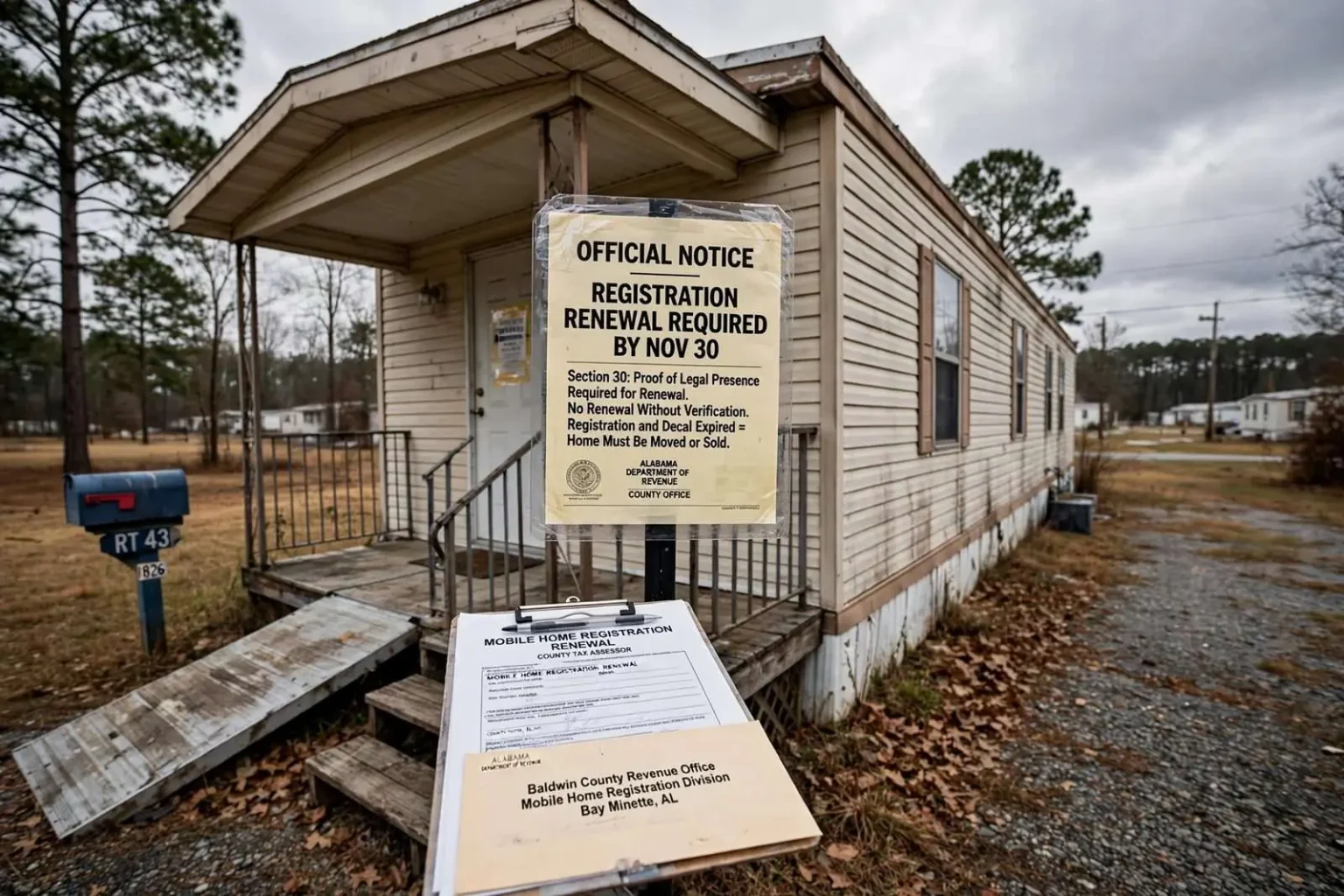
A provision of Alabama’s sweeping new immigration law reached into an unexpected corner of daily life, threatening owners of mobile homes who could not verify their legal presence with the loss of their ability to renew registrations. Under the measure, such owners would be unable to renew their registrations, leaving them to move their homes out of state, sell them, or risk being caught without the required decals. The practical consequences of an abstract legal debate suddenly landed on a specific and vulnerable population.
The law in question — pushed through the Legislature as the toughest immigration measure in the country — was written to reach far beyond border enforcement. Its drafters designed it to touch ordinary interactions between residents and their government: enrolling children in school, signing contracts, hiring workers and, in this case, keeping a home registered. For most Alabamians those interactions pass unnoticed. For owners of mobile homes who could not verify legal presence, each one became a potential point of loss.
Mobile homes are a significant part of housing across Alabama, particularly in rural counties and working-class communities where a factory-built home on a leased or owned lot is the most affordable path to homeownership. That made the provision more than a legal curiosity. Registration is what makes a mobile home a lawful, recognized dwelling, and the decals that follow registration are what property tax officials rely on to keep records straight. A rule that blocks registration strikes at the foundation of ownership itself.
Deadlines on the calendar
The timing gave the issue urgency. Registrations were due for renewal by Nov. 30, and property tax decals by the end of the year. Those deadlines meant that affected owners faced a narrow window in which to sort out their status or make other arrangements for their homes.
Deadlines of this kind leave little room for hesitation. An owner who waited to see how the courts ruled risked passing the renewal date without action; an owner who acted early committed to selling or moving a home that might ultimately have been registrable. Either way, the calendar — not the litigation schedule — was what governed the decision, and the two ran on different clocks.
The requirement flowed from a specific section of the law. Under Section 30, neither the state nor any of its political subdivisions could engage in a business transaction with anyone whose legal presence had not been verified. Registering a mobile home, the law made clear, counted as such a transaction. In other words, the everyday act of walking into a county office and renewing a registration was reclassified as a transaction the state could not lawfully complete for an unverified owner.
A provision left standing
The immigration statute had drawn immediate legal challenges, and federal courts had blocked the implementation of parts of it. Section 30, however, remained in effect, which meant its consequences for mobile home owners were not merely theoretical. That distinction, between provisions enjoined by the courts and those still operative, shaped the real-world impact of the law in its early months.
That patchwork quality was one of the law’s defining features. Some sections went into force, some were suspended, and the list changed as judges ruled. For residents trying to comply, the effect was confusing: the law they read about in the news was not the same law they faced at the counter of a county office. While litigation proceeded over the broader statute, the registration requirement continued to apply, creating immediate pressure on those unable to meet it.
Everyday consequences
The mobile home provision illustrated how a law framed in terms of immigration enforcement extended into routine transactions with government. A person needed to renew a registration and affix a decal simply to keep a home legally in place, and the new verification requirement inserted the immigration question into that ordinary process.
For owners caught by the rule, the choices were stark. Moving a mobile home out of state, selling it, or risking penalties for noncompliance each carried significant burdens, and the compressed deadlines left little time to weigh them. Moving a manufactured home is not like moving a car; it requires hauling equipment, permits and a destination that will accept the home, and it can cost thousands of dollars. Selling under deadline pressure rarely brings a fair price. Staying put without a valid registration invites penalties on top of the original problem.
The burden also fell unevenly across households. Owners who had lived in their homes for years, raising families and paying property taxes, faced the same rule as recent arrivals, and many had no practical way to verify legal presence on the timeline the renewal season imposed. County officials who administer the registrations were left to carry out a policy that put them in the position of turning away residents they had served for decades.
A law’s reach
The episode underscored the breadth of Alabama’s immigration measure, which ranked among the strictest in the nation and touched areas of life well beyond employment or law enforcement. By conditioning routine government transactions on proof of legal presence, the law reached into housing, taxation and the everyday functioning of local government.
Housing is where that reach is felt most directly. A registration requirement does not merely affect a piece of paper; it affects where a family can lawfully live. When the government transaction at stake is the one that keeps a home in place, the line between immigration enforcement and housing policy effectively disappears. Housing advocates and county officials alike noted that the provision turned a records office into an enforcement checkpoint.
As the year-end deadlines approached, the mobile home registration requirement offered a concrete example of how the statute operated on the ground, and of the difficult decisions it forced on those unable to satisfy its terms. The courts would continue to sort out which parts of the law survived, but for the moment, Section 30 remained a live and consequential provision — one whose effects were measured not in legal briefs but in homes that could or could not be lawfully kept where they stood.
How mobile home registration works
Understanding the provision requires understanding how mobile homes are treated differently from site-built houses. In Alabama, a manufactured home is typically registered much like a vehicle, with a renewal cycle and a decal that must be displayed. Property tax is assessed on the home, and the decal is the visible proof that the taxes and registration are current. Because many manufactured homes sit on leased lots in parks or on family land, the registration — not a deed — is often the clearest evidence of an owner’s rights in the home itself.
That system depends on routine renewal. Owners are accustomed to an annual or periodic trip to the county office, a payment, a decal and a year of certainty. Section 30 converted that routine errand into a verification checkpoint, and the change caught owners at exactly the moment of the year when they were most likely to encounter it — renewal season, with its fixed dates and no grace for hesitation.
The stakes for county government
Counties had practical reasons to pay attention as well. Registration and decal fees, along with the property taxes tied to mobile homes, fund services in the very counties where the rule applied, many of them rural and fiscally tight. Every owner who moved a home out of state, abandoned it, or let a registration lapse represented revenue that counties could no longer count on, alongside the administrative burden of tracking homes that had fallen out of the system entirely.
There was also a records problem. Manufactured homes that remain unregistered drift into a gray zone: they are occupied, but they are invisible to the tax rolls and to emergency planning. County officials across Alabama had spent years trying to bring such homes back onto the books, and a rule that discouraged renewal threatened to undo that progress, pushing more homes out of the official record rather than fewer.
What owners were told to do
For affected owners, the guidance that emerged in the law’s early months came down to three options, each with a cost. Selling meant finding a buyer for a home that could not be legally re-registered in place, which narrowed the market sharply. Moving meant paying to transport the home across state lines, where registration rules — and legal presence requirements — might differ. Staying meant operating without a current registration and decal, and accepting whatever penalties and uncertainty followed.
None of those options accounted for the realities of manufactured home ownership: homes that are paid off, lots that are leased, families settled in school districts and jobs. The provision treated a home as movable property in the legal sense, but for the people living in one, it was simply where they lived. That gap between the law’s categories and residents’ lives was the recurring tension of the statute’s first year, and the mobile home registration requirement put it in unusually sharp relief.