Alabama lawmaker’s abortion bill comments draw national backlash
State Rep. John Rogers' remarks during debate over an Alabama abortion ban drew criticism from both parties and U.S. Sen. Doug Jones.
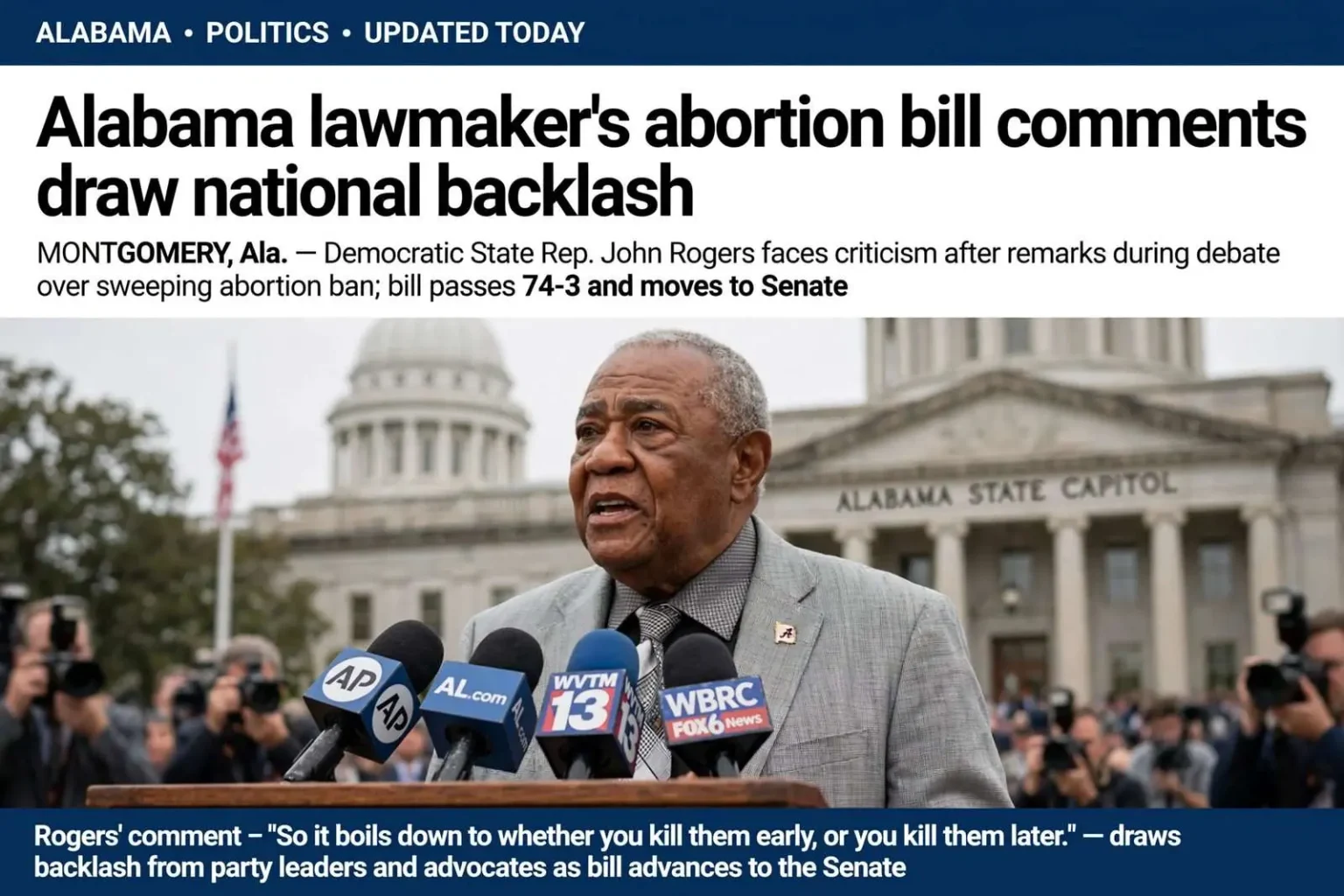
MONTGOMERY, Ala. — A Democratic state lawmaker’s remarks during debate over a sweeping abortion ban drew national attention and criticism this week, adding a fresh flashpoint to one of the most consequential legislative fights to reach the Alabama Statehouse in years. State Rep. John Rogers, a Democrat from Birmingham, drew pushback from both sides of the aisle after the House advanced a bill that would make it a criminal act to perform an abortion in the state.
The measure passed the chamber on a 74-3 vote, a lopsided margin that underscored how firmly the ban’s supporters control the legislative arithmetic in Montgomery. Rogers was among the small number of members willing to speak against it on the floor, but the way he did so quickly became the story in its own right. During the debate, according to reports, Rogers said: “So it boils down to whether you kill them early, or you kill them later.”
The comment spread rapidly through national media and social media, and it prompted criticism not only from abortion-rights advocates but from members of Rogers’ own party, who saw the remark as a rhetorical gift to the bill’s supporters. The bill now moves to the Senate, where a similar fight over its provisions and its ultimate fate awaits.
The Bill and the Vote
The legislation at the center of the storm is one of the most restrictive abortion measures to advance in any state in recent memory. By making it a criminal act to perform an abortion, the bill would place Alabama at the far edge of a multi-state push to pass laws designed to provoke a direct legal challenge to the constitutional precedents that have protected abortion access nationwide for decades. Supporters have been explicit that the goal is to force the courts to revisit those precedents, and the House’s 74-3 vote shows how little opposition the strategy faces within the chamber.
Under the measure, the legal exposure would fall on physicians rather than patients, criminalizing the performance of the procedure in nearly all circumstances. Opponents warned during floor debate that such a law, if enacted and upheld, would effectively end legal abortion in Alabama and push the state’s existing network of clinics out of operation. Supporters countered that the bill reflects the values of the state’s voters and that the courts, not the Legislature, will ultimately decide the question.
For Rogers, the vote put him in an awkward position familiar to Democrats in deep-red states: opposing a bill whose passage is assured, with his party holding only a handful of seats in the 105-member House. His floor remarks were intended, by his own framing in the debate, to argue that the ban would not actually reduce abortion but would push the procedure underground or move it to states where it remains legal. But the phrasing that carried that argument out of the chamber was received very differently than it was delivered.
Doug Jones Responds
Rogers’ comments drew a swift response from U.S. Sen. Doug Jones, Alabama’s junior senator and the state’s most prominent Democratic officeholder. Jones, who won his seat in the 2017 special election and has worked to position himself as a moderate bridge between the state’s parties, said he was “absolutely appalled” by the remarks and called on the representative to apologize to the people of the state and to his fellow legislators.
Jones’ intervention was notable for its directness. In a state where the Democratic Party is small and often fractured, public criticism from its only statewide officeholder toward one of its longest-serving legislators signaled how far outside acceptable bounds the comment had landed, even among those who share Rogers’ opposition to the underlying bill. Jones’ own position on abortion has been more supportive of legal access than most Alabama politicians, and his rebuke of Rogers emphasized tone and decency as much as policy, arguing that debate over such a serious subject demands more care than the floor remark displayed.
The episode also illustrated the scrutiny that any Alabama legislator now faces on the national stage. With abortion legislation in Alabama and neighboring states drawing sustained national coverage, floor debate that might once have remained a Montgomery story now travels within hours to cable news and national political outlets, where a single sentence can define a lawmaker’s public image far beyond his district.
Planned Parenthood’s Criticism
Planned Parenthood Southeast Advocates, the advocacy arm affiliated with the organization’s Southeast region, also criticized the remarks. In its response, the group pointed to what it described as Alabama’s shortages of OB-GYNs, high infant and maternal mortality rates, and deaths from cervical cancer, framing the legislator’s comment as especially galling against the backdrop of the state’s documented struggles with reproductive and women’s health outcomes.
The organization paired its criticism of the remark with its opposition to the broader abortion ban, arguing that the Legislature’s energy would be better directed toward the health-care gaps the group outlined. Those claims put specific health system problems at the center of the political fight: Alabama has long struggled to recruit and retain obstetric and gynecological specialists, particularly in its rural counties, where hospital obstetric units have closed over the years and expectant mothers frequently drive long distances for prenatal care and delivery.
Advocates on the other side of the dispute reject the framing that abortion access is the remedy for those outcomes, and the exchange illustrates how the same set of statistics becomes ammunition for both camps. What is not in dispute is that the state’s maternal and infant health indicators rank among the worst in the country, a fact that surfaces in nearly every serious debate over reproductive policy in Montgomery.
Rogers and His Record
Rogers is one of the most colorful and long-tenured members of the Alabama Legislature, a Birmingham Democrat whose candid, often unfiltered style has made him both a quotable fixture of Statehouse coverage and, at moments like this one, a source of trouble for his party. He has spent years in the minority as Republicans have consolidated control of the House and Senate, and he has frequently been one of the few Democrats willing to engage in extended floor debate on controversial bills.
Those who have covered Rogers over the years note that his debate style blends humor, provocation, and blunt argument, and supporters suggested the latest remark was meant in that tradition, a rhetorical jab at what he sees as the hypocrisy of anti-abortion politics rather than a literal statement. But the reaction made clear that the traditional benefit of the doubt does not extend to comments about abortion on a national stage, and that even a veteran legislator can misjudge how a floor remark will be heard once it leaves the chamber.
As of this week, Rogers had not indicated whether he would accept the apology demanded by Jones, and the national attention shows no sign of fading as the bill advances.
What Comes Next in the Senate
The bill’s movement to the Senate sets up the next phase of the fight. The upper chamber, where Republicans hold a commanding majority, has in recent years passed some of the most restrictive abortion legislation in the country, and the measure’s House passage makes its prospects there appear strong. What remains uncertain is the exact form the Senate will send to the governor’s desk, whether amendments will alter its scope, and how quickly leaders choose to move it once it reaches the floor.
Whatever the Senate does, the expectation on both sides is that the ultimate decision will not be made in Montgomery. The bill’s design and its stated purpose point toward the federal courts, where any enacted ban would face immediate challenge, and where years of litigation would follow before its provisions could ever take effect. Supporters have been candid that the litigation itself is the point, and opponents have been equally candid that they intend to fight the measure in courtrooms as vigorously as they fought it in the Statehouse.
The National Spotlight on Alabama
The controversy comes at a moment when Alabama’s abortion politics are already under a national microscope. States across the South and Midwest have advanced similarly sweeping bans, and Alabama’s legislation is consistently mentioned among the most aggressive of the batch. National advocacy organizations on both sides have treated the state’s legislative session as a bellwether, and the presence of television cameras and national reporters in the Statehouse gallery during the House debate reflected that attention.
For Alabama’s political figures, the spotlight is double-edged. Legislators who support the ban see their votes amplified to a national audience sympathetic in some quarters and hostile in others. Democrats like Rogers and Jones, meanwhile, must navigate a party nationally committed to abortion rights while representing a state where a 74-3 vote shows how unpopular that position is at home. The clash between the two men this week was, in a sense, a dispute over how to manage that impossible position, with Jones insisting that opposition to the ban cannot excuse rhetoric that degrades the debate.
Planned Parenthood Southeast Advocates and allied groups have promised continued pressure as the bill moves forward, while ban supporters have organized their own mobilization in support of the Senate’s taking it up. Both sides expect crowds, testimony, and national coverage when the measure reaches the Senate chamber.
The Stakes for Alabamians
Beyond the politics, the debate carries practical stakes for the people of the state. Alabama’s existing abortion landscape is already among the most restricted in the nation, with years of cumulative regulation narrowing access, and the clinics that remain operate under constant legal and political pressure. A criminal ban would remove legal access entirely if upheld, and opponents warn that the burden would fall hardest on low-income Alabamians who lack the resources to travel out of state for care.
Supporters of the measure view the stakes differently, arguing that the bill finally aligns state law with the convictions of a majority of Alabamians and that the moral question outweighs the logistical concerns raised by opponents. That disagreement is the durable core of the fight, and this week’s uproar over a single sentence did not change it. It did, however, demonstrate how explosive the question has become, and how much attention the nation is paying as Alabama’s Legislature moves the ban forward.
As the bill reaches the Senate, the episode serves as a reminder that in a Statehouse where one party’s victories are near-automatic, the fights that capture the public imagination are often the ones inside the minority itself, played out before an audience that now extends far beyond the Statehouse steps.