Alabama Lawmakers Consider Letting Beer and Wine Ship Straight to Your Door
Senate Bill 271 would let licensed Alabama breweries and wineries ship beer and wine directly to homes, ending one of the state's oldest alcohol.
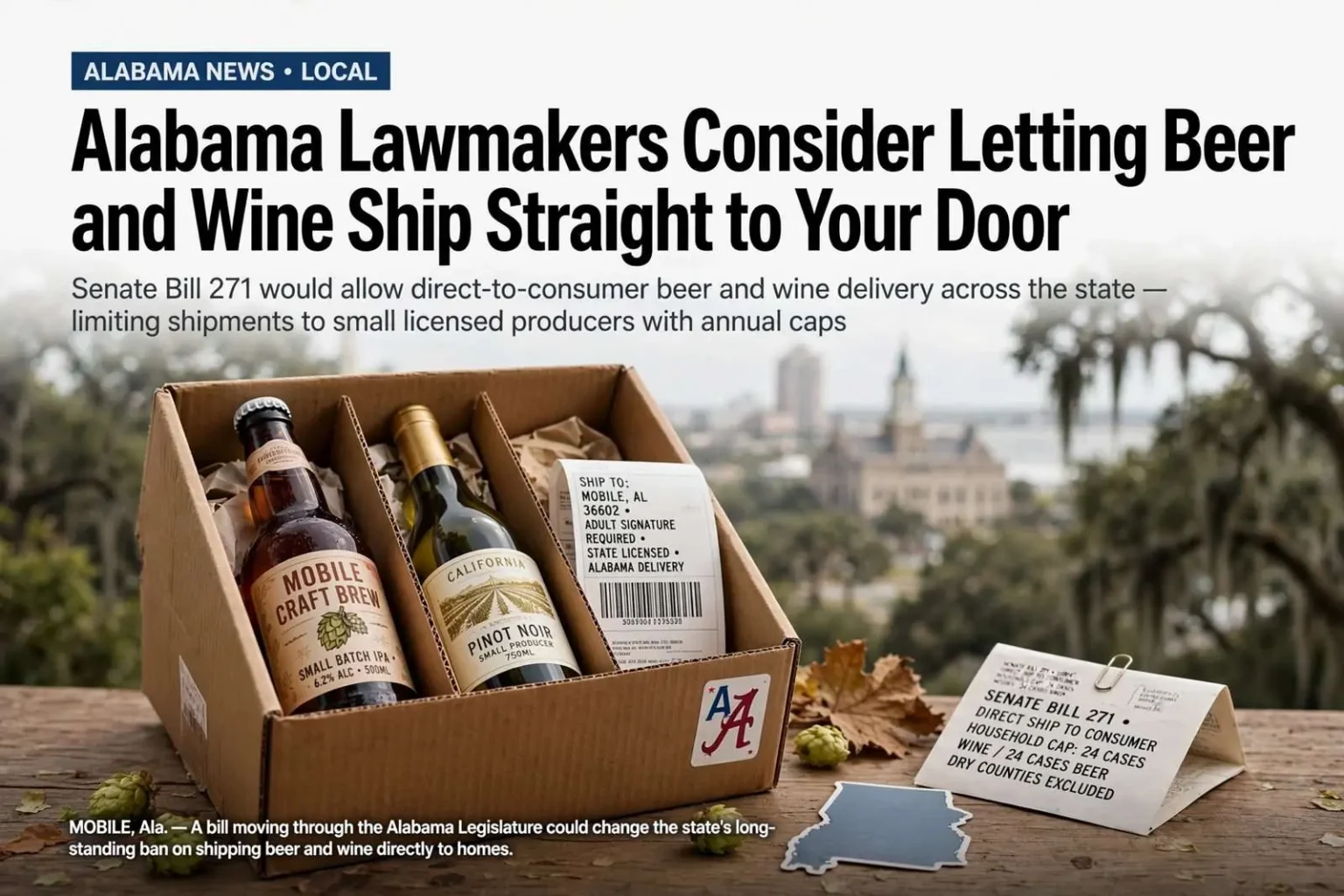
MOBILE, Ala. — Alabamians who have tried to order a favorite craft brew or a bottle of California wine online know the frustration: the shipment simply can’t be sent here. A bill moving through the Alabama Legislature could change that, opening the door to direct-to-consumer beer and wine delivery across the state.
Alabama sits among a small handful of states that still prohibit wineries and breweries from shipping directly to consumers’ homes — a holdover from the state’s long post-Prohibition tradition of tightly controlling how alcohol reaches the public. For residents of Mobile and elsewhere, that means limited-edition releases, out-of-state wine clubs and specialty craft brews stay out of reach no matter how legal the purchase would be in neighboring states.
What Senate Bill 271 would do
Senate Bill 271 would allow Alabama residents to order wine and craft beer directly to their doorstep — something only a small handful of states still prohibit. The bill comes with limits designed to keep the program narrow, a drafting approach its supporters say is meant to answer the concerns that have killed similar proposals in past sessions.
Participating breweries must hold an Alabama license and produce fewer than 1,500 barrels of beer per year, a cap aimed squarely at small craft producers rather than national brands. Eligible wineries must be state-licensed and turn out less than 24,000 gallons of table wine annually. The production ceilings mean the program would connect Alabama drinkers with genuinely small producers — the kind whose bottles rarely appear on store shelves here — rather than opening the floodgates to mass-market shipments.
There are rules on the buying side as well. Each household would be capped at 24 cases of beer and 24 cases of wine per year, a limit designed to prevent the direct-shipping channel from becoming a volume business and to keep purchases in the range of personal consumption. And deliveries to dry counties or dry municipalities would remain off-limits, preserving Alabama’s patchwork of local alcohol prohibitions that dates back more than a century.
Those local-option boundaries matter in a state where alcohol laws can change from one city limit to the next. Under the bill, a delivery address inside a dry jurisdiction stays off-limits even if the buyer lives just across the line from a wet area, meaning carriers and licensees would have to navigate the same local-option map that governs every other alcohol sale in the state.
Local drinkers weigh in
Mobile residents contacted about the proposal were largely receptive. One local wine enthusiast said she loved the idea of having wine shipped straight to her house, reflecting a view shared by many consumers who follow out-of-state wineries and know exactly which bottles they would order first.
Another described learning about the ban the hard way — after touring a California winery and discovering his purchases couldn’t be mailed home to Alabama. His experience is a common one for Alabama travelers: the wine club signup that stops at the shipping-address screen, the souvenir bottles that have to be packed into luggage or left behind entirely. For residents of nearly every other state, the same transaction takes seconds.
Beyond convenience, supporters argue that direct shipping could mean better prices and access to products that never make it onto Alabama store shelves. The state’s three-tier system — producer, wholesaler, retailer — works well for mainstream products, but small-batch releases and allocation wines often never reach Alabama distributors at all, leaving local drinkers with a narrower selection than their counterparts across the region.
The state’s craft brewing industry, which has grown steadily in Mobile and across the state over the past decade, could also gain a new sales channel under the bill. Breweries that qualify under the 1,500-barrel cap could ship limited releases directly to fans, supplementing taproom sales and distribution deals that currently make up their entire in-state business.
Alabama’s long restrictive history
Alabama’s alcohol laws are among the most restrictive in the nation, a legacy of the state’s early and enthusiastic adoption of Prohibition — which took effect in Alabama years before the national ban — and of the local-option system that followed repeal. Even today, the state maintains a patchwork of dry and wet jurisdictions, controls the wholesale and in many cases the retail sale of spirits through the Alabama Alcoholic Beverage Control Board, and imposes advertising and display restrictions that surprise visitors from other states.
Against that backdrop, direct shipping has been a nonstarter in Montgomery for years. Opponents have raised familiar concerns: tax collection, enforcement against underage delivery, and the impact on Alabama’s licensed wholesalers and retailers, who operate within the three-tier system that the state’s alcohol economy is built on. Versions of direct-shipping legislation have surfaced in previous sessions without reaching the governor’s desk, making this year’s bill the furthest any such proposal has traveled in recent memory.
Supporters counter that the bill’s structure answers the classic objections. Age verification at delivery is standard practice in the dozens of states that already allow wine shipping, household caps keep volumes modest, and the Alabama license requirement puts in-state regulators in charge of who participates. The production caps, meanwhile, mean the program adds a niche channel rather than rewriting the state’s retail market.
What it would mean for consumers
For Alabama consumers, the practical change would show up in selection and access. Wine drinkers could join out-of-state wine clubs and order regional specialties — small-producer wines from the West Coast, the East Coast and emerging Southern wine regions — that Alabama distributors have never carried. Craft beer fans could order from small breweries nationwide, including styles and limited releases that the state’s distribution system, built around larger-volume products, rarely brings across state lines.
Prices could move as well. Without direct access, Alabama drinkers who want rare bottles often pay secondary-market markups or travel out of state to buy them. A legal direct channel would let consumers buy at the producer’s price, paying only shipping — a meaningful difference for collectors and enthusiasts, though the annual case caps would keep even the most dedicated buyer’s volume modest.
The bill’s passage would also bring Alabama in line with the overwhelming majority of the country. Direct-to-consumer wine shipping is legal in most states, and the states that still ban it form a small and shrinking group. For a state that has gradually liberalized other alcohol rules in recent years — from tasting-room allowances to Sunday sales — direct shipping represents the next step in a slow, steady loosening.
Looking ahead
The bill’s path through the Legislature remains the open question. Alcohol legislation in Alabama attracts intense lobbying from all sides of the industry, and any bill touching the three-tier system faces a gauntlet of committee hearings and floor votes. But the combination of consumer enthusiasm, industry support from small producers and the bill’s carefully capped design gives its backers reason for optimism.
If it becomes law, the change will reach Alabama drinkers through a simple mechanism: a legal shipment, verified at the door, with taxes paid and records kept. For the Mobile wine lover who learned in a California tasting room that her home state was the exception, and for the craft beer fans who have watched other states’ breweries ship freely for decades, that would close a gap that has defined Alabama’s alcohol laws for generations.
The craft beer boom behind the bill
The timing of the proposal is no accident. Alabama’s craft brewing industry has expanded dramatically over the past decade, growing from a handful of pioneer breweries into a statewide scene with production facilities, taprooms and breweries-in-planning across the map. Mobile’s own brewing scene has grown alongside the city’s downtown revitalization, and festivals, taproom events and release-day lines have made craft beer a visible part of the local culture.
Small breweries face structural limits in a three-tier state. Distribution deals typically favor higher-volume brands, taproom sales depend on foot traffic, and specialty releases often sell out in hours to a local audience. A legal shipping channel would let a qualifying brewery turn a one-day release into ongoing revenue from fans across the state — and let Alabama drinkers support in-state producers they otherwise rarely see on shelves.
The same logic applies to Alabama’s small but developing wine industry and to the state’s retailers of specialty products. A capped, licensed shipping program creates a paper trail that regulators can audit, which is precisely why the bill ties participation to Alabama licensing rather than leaving the channel unregulated.
How enforcement would work
The dry-jurisdiction prohibition will demand the most operational care. Carriers and licensees would need address-level screening to keep deliveries out of dry counties and dry municipalities, since a single delivery to a wet-looking address in a dry jurisdiction could jeopardize a permit. Consumers, for their part, would need to understand that the ban follows the delivery address, not the buyer’s residence — a nuance that matters in a state where local option lines can split a single ZIP code.
Age verification at the door is the other enforcement pillar. Shipping programs elsewhere rely on adult-signature requirements built into standard carrier practice, and the same model would apply in Alabama. Underage delivery is the objection most often raised against these bills, but the experience of the dozens of states with existing programs has shown it to be rare — and rarer still where signature checks are strictly enforced.
Tax treatment rounds out the framework. Shipments into Alabama would be subject to state excise and sales taxes just like retail purchases, with licensing requirements ensuring the state can collect them. That revenue argument has quietly won over some legislators who otherwise steer clear of alcohol bills: a regulated channel produces tax receipts, while the informal workarounds Alabamians use today produce nothing.
The bottom line for Mobile
For Mobile residents, the bill’s appeal is simple and personal. The Gulf Coast’s food and hospitality culture has always leaned on access — fresh seafood, regional specialties, a growing craft scene — and wine and beer are part of that table. Allowing direct shipments would put Alabama consumers on equal footing with their neighbors in Mississippi, Florida, Louisiana and Georgia, where at least some form of direct shipping is already legal.
The reaction on the streets of Mobile suggests the demand side of the equation is already there. What remains is the legislative side: committees, votes and the long-standing caution of a state that has regulated alcohol more tightly than almost any other. Senate Bill 271’s careful caps and license requirements were written for exactly that caution — and if they carry the bill across the finish line, Alabama drinkers will finally be able to order what residents of most of America already can.