Alabama Lighthouse Association says oil spill cost $96,500 in restoration work
Alabama Lighthouse Association says the 2010 oil spill cost about $96,500 in restoration work on the Middle Bay and Sand Island lighthouses in Mobile Bay.
The Alabama Lighthouse Association says it lost roughly $96,500 in volunteer labor, vessels, equipment and funding after the 2010 Deepwater Horizon oil spill shut down restoration work on two historic Gulf Coast lighthouses for about 14 months, a loss the small nonprofit is still trying to recover more than a decade after oil first touched the state’s coastline.
Finance chair Capt. Hal Pierce said the group’s two coastal lights — Middle Bay Lighthouse and Sand Island Lighthouse — were among the first places in the state touched by the spill. The disaster, which began with the April 2010 explosion of the Deepwater Horizon drilling rig and became the largest marine oil spill in U.S. history, sent crude drifting toward the Alabama coast throughout the spring and summer of that year, closing waters and beaches and halting marine work of every kind.
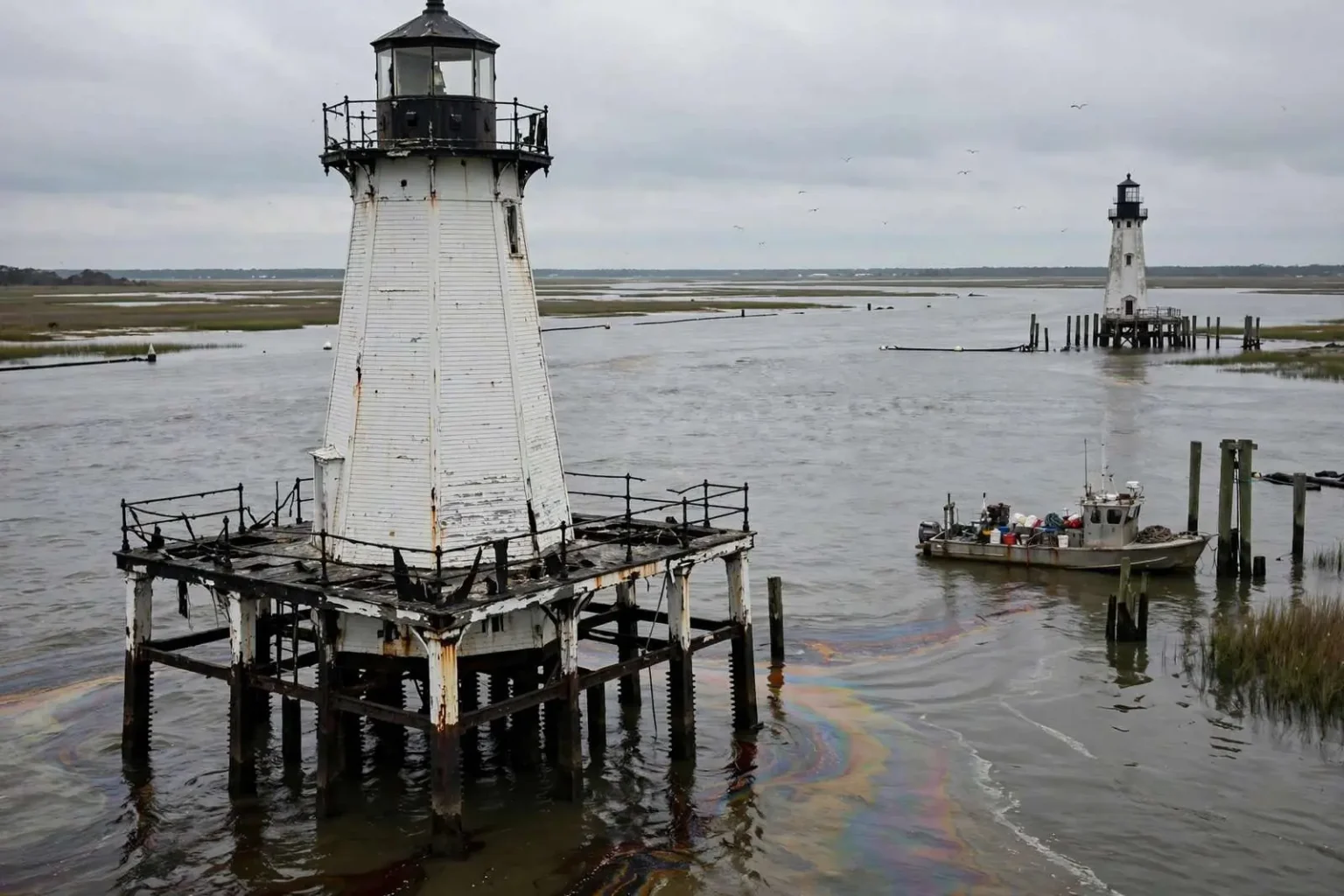
“The first thing hit by the oil was the Sand Island Lighthouse,” he said. “When that happened, our ongoing repair and maintenance operations died for a year.” The lighthouse stands near the entrance to Mobile Bay, directly in the path of the spreading slick, and its exposed position made work there impossible once oil reached the area.
The association normally ferried about 25 volunteers by boat to work on the structures, a steady rotation of skilled and unskilled hands that kept painting, carpentry and stabilization projects moving at both sites. During the closure, many were diverted to paid mitigation work, and the group’s own boat was pressed into service for the spill response, pulling both the labor and the vessel out of the nonprofit’s restoration program at the same time.
Adding Up What Was Lost
Pierce estimated the lost volunteer hours alone at as high as 3,000, valued at $31,200, on top of $26,500 in vessels, $32,500 in equipment and $6,400 in funding. The figures, tallied by the association from its own records, attempt to put a dollar value on fourteen months of interrupted work — a stretch during which weather, salt spray and time continued to degrade the two lights even as the volunteers who cared for them stood idle.
For a small preservation group, losses of that scale are not abstract. Volunteer time is the currency that keeps a lighthouse restoration moving, and equipment committed to the spill response was equipment unavailable for the association’s own projects. The funding loss compounded everything else, as donors and grant makers directed their 2010 giving toward spill relief rather than preservation.
Association president Dan Dealy said the group’s status as a 501(c)(3) nonprofit made its claim more difficult, a structural problem that has frustrated small organizations across the Gulf since the spill. Claims processes built around lost revenue and damaged property did not map neatly onto an all-volunteer organization whose losses were measured in donated hours and interrupted projects.
“Our claim was denied,” he said.
Turning to RESTORE Act Money
The association is now considering a proposal to the Alabama Gulf Coast Recovery Council, which distributes the state’s $599 million in RESTORE Act money with a focus on Mobile and Baldwin counties. The council was created under the federal RESTORE Act, the 2012 law that directed the Clean Water Act penalties from the spill back to the Gulf states, and it has spent years reviewing applications for conservation, restoration and community projects across Alabama’s two coastal counties.
About $160,000 in railing repairs at Middle Bay Lighthouse could be submitted for funding, an amount that would address one of the most visible safety and preservation needs at the structure. Whether a lighthouse proposal can compete in a process crowded with habitat restoration, seafood industry and tourism projects is one of the questions the association’s board is weighing — and exactly the concern Pierce has voiced about where small organizations stand in the queue.
Pierce worries smaller groups like his will be overlooked as municipalities and large organizations submit high-dollar proposals, a dynamic that has played out across every RESTORE-funded process on the Gulf Coast. Big institutional applicants arrive with grant writers and engineering studies; volunteer groups arrive with a structure they love and a spreadsheet. The council’s process, like its counterparts in the other Gulf states, has historically rewarded applicants who can document both need and capacity to manage federal money.
“Here we are with lighthouses in a serious state,” Pierce has said of the group’s predicament, summarizing the fear that two of Alabama’s most recognizable maritime landmarks could deteriorate past the point of affordable rescue while larger claims consume the available funding.
New Ways to Raise Money
The group has also found new ways to raise money. The Alabama Historical Commission approved a wedding at Middle Bay Lighthouse, and Dealy said events such as Boy Scout gatherings, memorial services and weddings could help make up for the lost income. Renting the state’s historic sites for private events has become a common preservation strategy, converting public landmarks into modest but recurring revenue streams without altering their historic character.
Two Landmarks With Deep Roots
Middle Bay, a hexagonal “screw-pile” lighthouse first lit in 1885, and Sand Island Lighthouse, built in 1837 near the entrance to Mobile Bay, remain beloved landmarks, and each carries a history that preservationists say justifies the effort. Screw-pile lighthouses — structures raised on iron piles screwed into the bay bottom — were an engineering answer to the soft mud and shallow waters of the Gulf Coast, and Middle Bay is among the few survivors of the type anywhere on the northern Gulf, standing sentinel over the waters off the Fairhope area where it has guided bay traffic for well over a century.
Sand Island’s story is older and harsher. Built near the mouth of Mobile Bay in 1837, the light has been rebuilt and battered across its long life, standing through hurricanes and the slow erosion of the island that gave it its name. Its position at the bay’s entrance made it the first Alabama structure to meet the 2010 oil as it drifted in from offshore — a grim milestone Pierce has never forgotten.
The two lights are more than scenery. Middle Bay sits in the middle of one of the busiest boating and fishing bays in the Southeast, and both structures anchor the maritime identity of a coast whose economy runs on the water. Preservation groups across the Gulf have used the same argument in seeking spill-related funding: the lighthouses draw visitors, define the shoreline, and connect modern residents to the maritime history that built Mobile.
A Long Road From Denial to Renewal
The arc from a denied claim to a possible RESTORE Act proposal has taken the association more than a decade, and members describe it as a lesson in how spill recovery money actually moves. The immediate claims process after Deepwater Horizon addressed direct losses — closed businesses, damaged property, canceled charters. The longer-term processes, from the RESTORE Act councils to the National Fish and Wildlife Foundation’s Gulf projects, were designed for restoration rather than reimbursement, forcing groups like the lighthouse association to reframe their needs as eligible projects.
That reframing is what the possible $160,000 railing proposal represents: not a claim for what was lost in 2010, but a forward-looking project that fits the restoration framework. The association’s officers have spent years learning the application process, attending council meetings and documenting needs at both lights in the format the funding agencies expect.
Meanwhile, the event-based fundraising — weddings, Scout campouts and memorial services at Middle Bay — keeps money trickling in and keeps the public engaged with the structures. Members say every booking introduces a new circle of people to the lighthouses, and every dollar raised is a dollar that does not have to be chased from a grant program.
Whether the Alabama Gulf Coast Recovery Council agrees to fund the Middle Bay railing work will say a great deal about how the state’s spill legacy reaches its smallest stewards. For now, the Alabama Lighthouse Association keeps doing what it did before the oil arrived: organizing volunteers, scheduling boat trips and caring for two lights that have outlasted storms, erosion and, so far, the longest recovery process in Gulf Coast history.
Why Volunteer Groups Carry These Burdens
The lighthouse association’s experience illustrates a pattern documented across the Gulf Coast after Deepwater Horizon. When the spill closed waters in April 2010, organizations that depended on boats, volunteers and access to the water lost their operating capacity almost overnight — not because anyone damaged their property, but because the response effort and the closures made their normal work impossible. Charter captains could file claims for lost trips. Volunteer nonprofits, whose losses lived in canceled workdays and idle equipment, had no equivalent claim category, and the association’s 501(c)(3) application ran headlong into that gap.
The 3,000 volunteer hours Pierce values at $31,200 represent the kind of labor no invoice ever captures. Federal formulas assign dollar values to volunteer time precisely because it is real economic input, but claims adjudicators in 2010 and 2011 had little practice applying those values to a denied-access scenario on someone else’s schedule.
The equipment and vessel figures tell a similar story. The association’s boat, pressed into spill-related service, earned its keep somewhere in the response — but the maintenance hours, fuel and wear that came with that service came out of the organization’s modest budget. Fourteen months later, the boat came back to a restoration program that had lost an entire season and half of another.
What Comes Next for the Two Lights
Association members remain upbeat about the path forward despite the setbacks. The possible RESTORE Act application for Middle Bay’s railings is the highest-stakes item on the agenda, and the group continues gathering the documentation a federal grant process demands: engineering assessments, cost estimates, and the historical significance argument that distinguishes the lights from ordinary waterfront structures.
The wedding approved by the Alabama Historical Commission has already opened a door the group did not have before 2010. If bookings grow, the association gains something it lacked when the spill hit — a modest independent revenue stream that is not hostage to the next grant cycle or claims process. Dealy has pointed to the variety of possible events, from Boy Scout gatherings to memorial services, as evidence that the lighthouse can serve its community in more ways than one.
And the volunteers, the association’s real engine, never left. Members who spent 2010 working the spill response returned to the restoration roster when the water reopened, and the boat trips to both lights resumed on the same pattern as before — 25 or so volunteers at a time, carrying paint, lumber and the conviction that Alabama’s two coastal lighthouses are worth the trouble.