
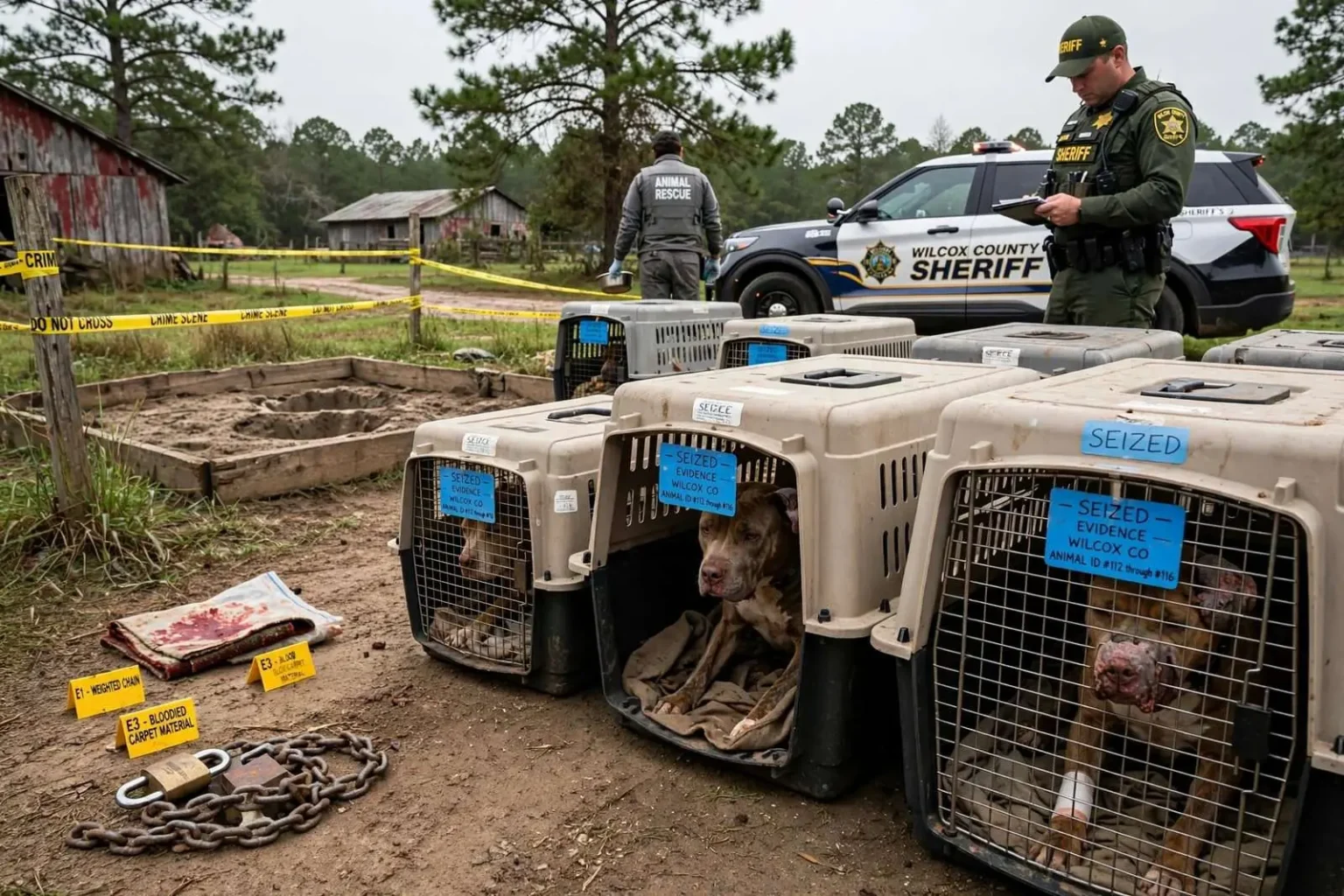
MOBILE, Ala. — An Alabama man known as “Bear” pleaded guilty Wednesday to federal gun and dogfighting charges, admitting in court to two crimes that carry serious penalties under federal law. Antonia Rico Rodgers admitted to being a felon in possession of a firearm and to knowingly possessing dogs for use in animal fighting, closing out a case that began when law enforcement searched his property in Wilcox County and uncovered one of the more disturbing dogfighting operations documented in the state in recent years.
The evidence seized during the search painted a detailed picture of what investigators found. Officers seized 47 dogs bearing injuries consistent with dogfighting, along with the equipment that gave away the operation’s purpose: weighted chains used to build the animals’ strength, a dog pit built for fights, and bloodied carpet. Those items — the chains, the pit, the scarring patterns on the animals themselves — are the markers trained investigators look for when distinguishing an active fighting operation from a household that simply keeps multiple dogs.
Rodgers’ guilty plea resolved both charges at once. The firearm count stems from his status as a convicted felon, under federal law that prohibits anyone with a felony record from possessing guns or ammunition. The animal fighting charge falls under federal statutes that make it a crime to possess, train, sell, or transport animals for fighting ventures — laws Congress has strengthened repeatedly over the past two decades as dogfighting has moved from a tolerated underground practice in some areas to a federal felony pursued aggressively across the country.
The terms of the plea agreement
As part of his plea, Rodgers has agreed to surrender the dogs seized from the property and to pay more than $100,000 in restitution to cover their care. That figure reflects the reality of rescuing dozens of fighting dogs at once: each animal requires veterinary evaluation, treatment of injuries, food, shelter, and behavioral assessment, often for months, before any disposition can be made. Restitution provisions in animal fighting cases exist precisely so that the cost of that care falls on the person who created the situation rather than on the shelters and rescue organizations that would otherwise shoulder it.
The surrender of the dogs is likewise a standard and significant component. Fighting dogs seized in raids cannot simply be returned to the defendant, and the agreement to surrender them clears the way for the animals to be evaluated and, where possible, placed with rescue groups experienced in rehabilitating dogs recovered from fighting operations. Contrary to old assumptions that fighting dogs must automatically be destroyed, many dogs seized in such cases are found to be adoptable after evaluation, and placement efforts can stretch across a network of rescues for a seizure of this size.
The case also demonstrates why federal prosecutors take these charges even though Alabama has its own animal cruelty and fighting statutes. Federal jurisdiction brings sentencing exposure, supervised release, and investigative resources that a county case cannot match, and the combination of a gun count and an animal fighting count — both federal felonies — gives prosecutors leverage that typically produces exactly the kind of plea entered Wednesday in Mobile.
Dogfighting enforcement in Alabama and the United States
Dogfighting is illegal in every state, and Alabama made the practice a felony in its own right years ago, but the underground activity has proved stubborn, particularly in rural areas where operations can be hidden on isolated property. Investigations typically begin with tips, and the search of a Wilcox County property like Rodgers’ is the culmination of a process that involves gathering evidence, obtaining a warrant, and coordinating among deputies, federal agents, and veterinarians who document each animal’s condition.
The physical evidence matters enormously in these prosecutions. Weighted chains are used to condition fighting dogs, building neck and jaw strength; a pit — whether a formal ring or a improvised enclosure — is where the fights themselves occur; and the injuries and scarring on the dogs tell investigators a history that no witness statement can match. Bloodied carpet and similar materials complete the picture. Taken together, the items seized from the property gave prosecutors a documentary record of the operation that made the guilty plea all but inevitable.
Federal interest in dogfighting cases has grown steadily since Congress upgraded the animal fighting provisions of federal law. The reasoning is not only animal welfare, though that alone would justify the effort: dogfighting operations are repeatedly associated with other crimes, including illegal gambling, drugs, and — as this case illustrates — illegal firearms. A defendant who keeps a fighting operation on his property and a gun in his possession despite a felony record represents precisely the overlap of offenses that federal multi-count prosecutions are built for.
What happens after the plea
With the guilty plea entered, the case moves toward sentencing, where Rodgers faces punishment under federal sentencing guidelines that weigh the nature of the offenses, his criminal history, and the scale of the fighting operation. The restitution obligation — more than $100,000 for the dogs’ care — will remain part of the judgment, and failure to pay it can carry consequences of its own. The dogs, meanwhile, move into the rescue and evaluation process that the surrender agreement set in motion.
For the animals, the weeks and months ahead will be spent in the care of organizations equipped to handle dogs rescued from fighting operations. Each of the 47 dogs will be examined, treated, and assessed individually, since fighting operations typically keep dogs in isolation and condition them for violence, and recovery varies widely from animal to animal. Some will prove suitable for adoption into homes; others may require longer-term placement with experienced rescuers. The seizure of nearly five dozen dogs — 47 in this case — is a logistical undertaking that has become more organized over the years as national and regional rescue networks have built experience responding to large seizures.
For Wilcox County and for the region, the case is a reminder that dogfighting persists in pockets of rural Alabama, and that the response to it now runs through the federal courthouse in Mobile as well as the local courthouse. The guilty plea by the man known as “Bear” closes the investigation phase of one such case — and leaves 47 dogs with a chance at a very different life than the one they were seized from.
Why these cases cost so much — and who pays
The six-figure restitution figure in this case is worth understanding, because it reflects costs that are easy to underestimate. When dozens of dogs are seized, they cannot be released to the community or held in a typical animal control kennel; many jurisdictions lack the facilities to house that many animals for the months a prosecution can take. Rescue organizations step in, incurring veterinary bills, boarding costs, and staffing expenses that accumulate daily. Courts have increasingly required defendants in animal fighting cases to cover those costs upfront through restitution orders, both to relieve the rescues and to make the financial consequences of the crime explicit.
The firearm charge that accompanied the dogfighting count is likewise a reminder of how federal law reaches conduct that crosses state lines of criminal activity. A felon found with a gun commits a federal offense regardless of whether the weapon was used in another crime, and prosecutors routinely pair the gun count with whatever conduct brought the defendant to law enforcement’s attention. In a case like this one, the two charges tell a single story about the property, the operation, and the man running it — and the plea agreement resolves them together.
The guilty plea entered Wednesday in Mobile brings the case one step from its conclusion, with sentencing to follow and the terms of the agreement — the surrender of the dogs, the restitution payment — to be carried out under the court’s supervision. What the plea does not erase is the record of what investigators found on that Wilcox County property: 47 injured dogs, weighted chains, a fighting pit, and the evidence of an operation that existed only because someone built it. The dogs now move toward the care the law was designed to give them.
Large-scale seizures like this one also illustrate the coordination required among agencies when a dogfighting operation is uncovered. Local deputies execute the search and secure the property, federal investigators build the case, and animal welfare organizations mobilize to transport and house dozens of dogs on short notice. The seizure of 47 animals is not a one-day event but the start of a months-long effort to document evidence, treat injuries, and account for every animal, and the pleas that follow are built on that groundwork.
For prosecutors in the Southern District of Alabama, animal fighting cases have become a recurring part of the docket as enforcement has intensified statewide. Each conviction adds to the public record that the practice is treated as serious organized crime rather than a rural tradition, and each restitution order shifts the burden of the aftermath onto the person responsible. The outcome in this case — a plea on both counts, the dogs surrendered, and care costs assigned — follows the pattern that investigators and rescuers have worked to establish across the state.


