Alabama Players Line Up at Perdido Key for a Shot at Two Massive Jackpots
Alabama residents lined up for 12 hours at the Flora-Bama Liquor and Lotto at Perdido Key chasing Mega Millions and Powerball jackpots worth hundreds of.
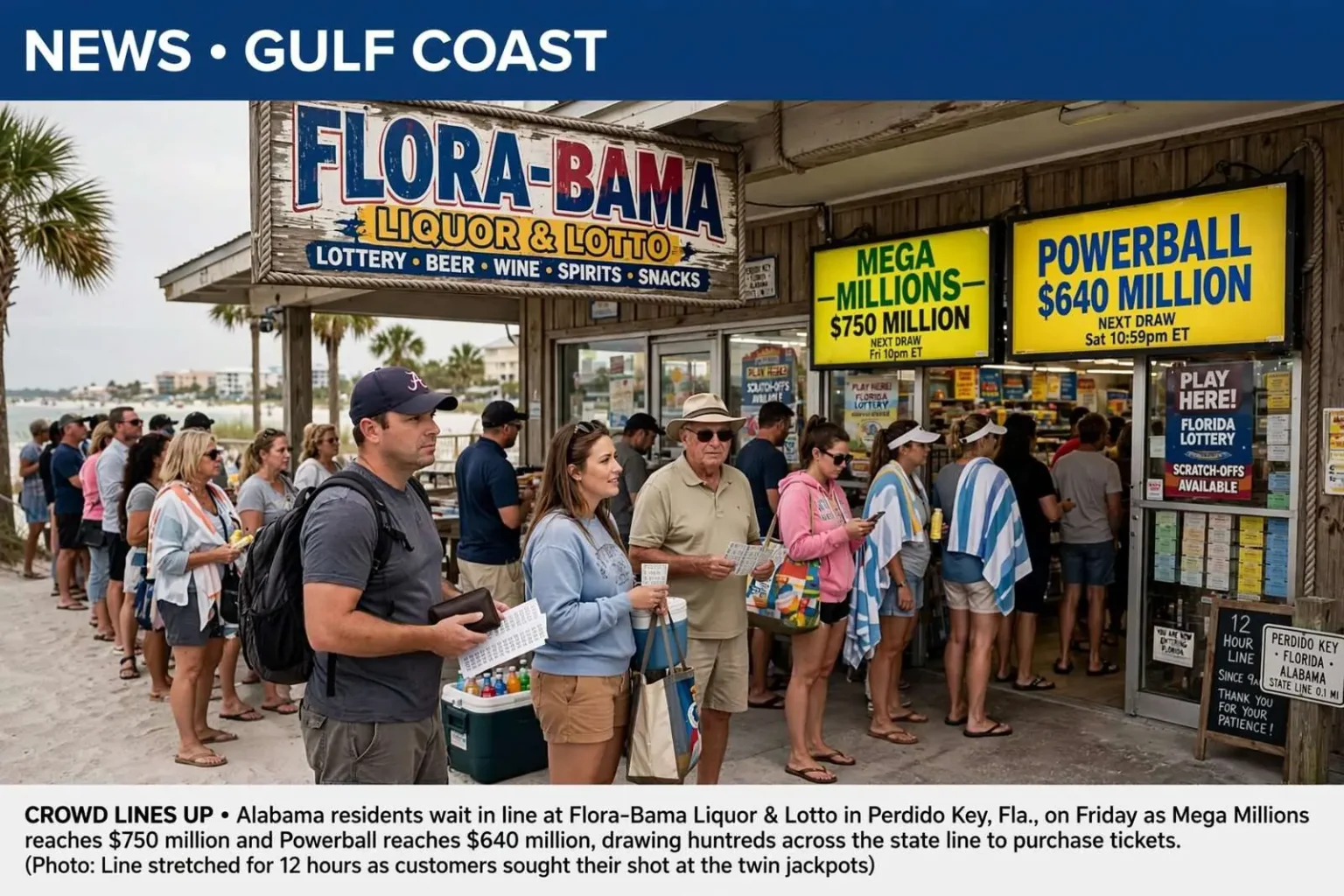
With Mega Millions climbing toward $750 million and Powerball sitting near $640 million, Alabama residents spent Friday crossing the state line into Florida to buy tickets, and the Flora-Bama Liquor and Lotto at Perdido Key felt it all day. Employees said the store had a line inside for most of the 12 hours between 9 a.m. and 9 p.m. as customers waited their turn at the lottery machine. The twin jackpots — among the largest the multistate games have offered — turned an ordinary Friday at the landmark beachside package store into something closer to a festival, with a line that stretched through the aisles from open to close.
The Flora-Bama complex, straddling the Alabama-Florida line on Perdido Key, has long occupied a unique position in Gulf Coast culture: a beach bar, music venue and roadside landmark that has outlasted hurricanes and changing times. Its liquor and lotto store, which sits on the Florida side of the state line, becomes a destination in its own right whenever the big jackpots swell, drawing crowds from across south Alabama who cannot buy a ticket at home.
Why the traffic heads south
Alabama does not run a state lottery, so players who want a ticket have to drive to a neighboring state. For much of south Alabama, the shortest trip is to the Florida line, which puts stores near Perdido Key and the Alabama-Florida border in a good position whenever jackpots swell. The geography is unforgiving for would-be players: from Mobile or Baldwin County, a ticket purchase is a deliberate trip, not an impulse stop at the corner store, and that dynamic concentrates the business at a handful of border outlets whenever drawing day approaches.
The border economy around the lottery is a familiar Alabama story. Proposals to establish a state lottery have surfaced repeatedly in Montgomery over the years, surfacing in legislative sessions and governor’s races, but Alabama remains one of the few states without one. Neighboring Florida, Mississippi, Tennessee and Georgia all run lotteries, and each captures a share of the spending that Alabama residents direct at big-jackpot drawings. On nights like Friday, the distance between a Baldwin County doorstep and a Florida lottery terminal becomes the most consequential few miles in the state.
The crowd Friday included both newcomers and regulars. Big jackpots have a way of pulling in people who otherwise never think about the lottery — office pools organizing their first group purchase, families visiting the beach who decide a ticket is part of the occasion — while the regulars treat a record drawing as appointment business. The Flora-Bama store saw both, in line, all day.
Dreams at the counter
A woman visiting from Montgomery said she already knew what she would do with a win: “I’m gonna buy a house on the beach.” The answer, simple as it sounds, captures the particular flavor of Gulf Coast lottery dreaming — the prize imagined not as an abstraction but as a specific place, a house with the water in view, purchased with money from a ticket bought a few hundred yards from the sand.
Jason Slay, who said he is from north Alabama, had similar plans. “I’m from north Alabama so I definitely wouldn’t live in north Alabama anymore,” he said. “I’d be living somewhere down here.” For a certain kind of Alabamian, the Gulf Coast is the destination of dreams, and a jackpot ticket is the imagined vehicle. The store’s location makes that fantasy literal: winners would move to the very shoreline where they bought the ticket.
A regular keeps score
Joe Phillips of Orange Beach plays year-round and tracks his winnings, which have added up to hundreds of dollars rather than millions. His accounting is cheerfully one-sided. “I keep a running total of what I do,” Phillips said. “I think total last year in lottery, all the different forms of lottery, I won like 260 bucks, but I have no idea how much I spent. I don’t keep a running total of that. I’m afraid to look.”
Phillips is the honest face of lottery play — the regular who knows the odds, keeps playing anyway, and tracks the wins while declining to audit the losses. His $260 year of winnings, gathered from scratch-offs and drawings across every form of the games available to an Alabama resident willing to drive, will not be mistaken for the jackpot, but the routine of playing, checking and winning a little is its own reward. Every lottery counter has its Phillipses: the customers the clerks know by name, who buy the same games on the same schedule and measure their luck in modest, satisfying increments.
The odds and the ritual
The odds of winning either grand prize are, of course, astronomically long — the kind of odds that make a ticket less an investment than a two-dollar permission slip to dream for a few days. That has always been the Lottery’s strange economics: the worse the odds and the bigger the jackpot, the bigger the crowds. A $40 million drawing barely registers; a three-quarters-of-a-billion-dollar one sends lines down the aisles at border stores across the region. The jackpot grows precisely because so few people win, rolling over drawing after drawing until someone matches all the numbers, and each rollover multiplies both the prize and the traffic.
The multistate games work the same way everywhere, but the Alabama twist is distance. In Florida, Georgia or Tennessee, the jackpot chase happens at the gas station on the way home. In Alabama it happens after a drive — across the Perdido Key bridge for Pensacola-area residents, up the beach highway for those in Gulf Shores and Orange Beach, down I-10 for Mobile. The trip becomes part of the ritual, and stores that sit conveniently near the line, like the Flora-Bama’s, absorb the crowds.
What happens to the money
Wherever the ticket is bought, the money flows to the state that sold it. Lottery proceeds in Florida support education programs through the state’s educational enhancement trust fund, which is part of how lotteries sell themselves politically — the entertainment of the games underwritten by a public-purpose argument. Every ticket an Alabamian buys at Perdido Key contributes to Florida’s fund, a fact that surfaces in Montgomery every few years when lottery legislation returns to the Statehouse and supporters point to the revenue crossing the border.
For the players on Friday, none of that arithmetic was the point. The point was the ticket in hand, the numbers chosen — birthdays, ages, lucky digits — and the days between purchase and drawing when anything seems possible. The line inside the Flora-Bama Liquor and Lotto ran most of the day because thousands of people wanted a piece of the same long shot, and the store at the state line was the nearest place to stand in it. When the balls drop, a handful of tickets nationwide will match something, one might match everything, and the rest of the players will file the dream away until the next time the jackpot swells big enough to cross a state line for.
Friday at the Flora-Bama
Inside the store, the rhythm of the day rarely broke. Employees described a queue that formed early and never fully dissolved, snaking from the lottery machine back through the aisles as tourists in beachwear stood behind locals making their weekly play. The clerks worked the machine steadily, one ticket and one customer at a time, while the crowd — a mix of sunscreen, flip-flops and hopeful speculation — passed the wait the way lines at the Flora-Bama always pass: with conversation.
The store’s dual identity helped move the line along. Shoppers who came for beer, wine or spirits left with tickets; ticket buyers picked up party supplies on the way out. The lotto machine, usually a quick stop on an ordinary Friday, became the store’s busiest station by far, and employees said the pace barely slackened through the afternoon hours when a line like that might normally thin to nothing.
Big-jackpot days at a border lottery store have a carnival quality that ordinary errands lack. Strangers compare number strategies, office pools send a designated buyer with a list and a fistful of cash, and everyone in line shares, for a few minutes, the same pleasant fiction. The Flora-Bama’s status as a landmark only amplifies it; buying a ticket there is already a small event for visitors, and a record jackpot makes it a pilgrimage.
By the time the store closed at 9 p.m., the day’s sales had joined the jackpot total, and the tickets were in thousands of pockets from Mobile Bay to Pensacola Beach. Whatever the drawing brought, Friday belonged to the line — the 12 hours when Perdido Key was, for a stretch of Gulf Coast Alabama, the center of the dreaming world.