
Alabama Power, City of Mobile Team Up to Recycle Tree Limbs Into Mulch
The city of Mobile and Alabama Power will recycle tree limbs and woody debris into mulch, saving both entities money on tipping fees and materials.
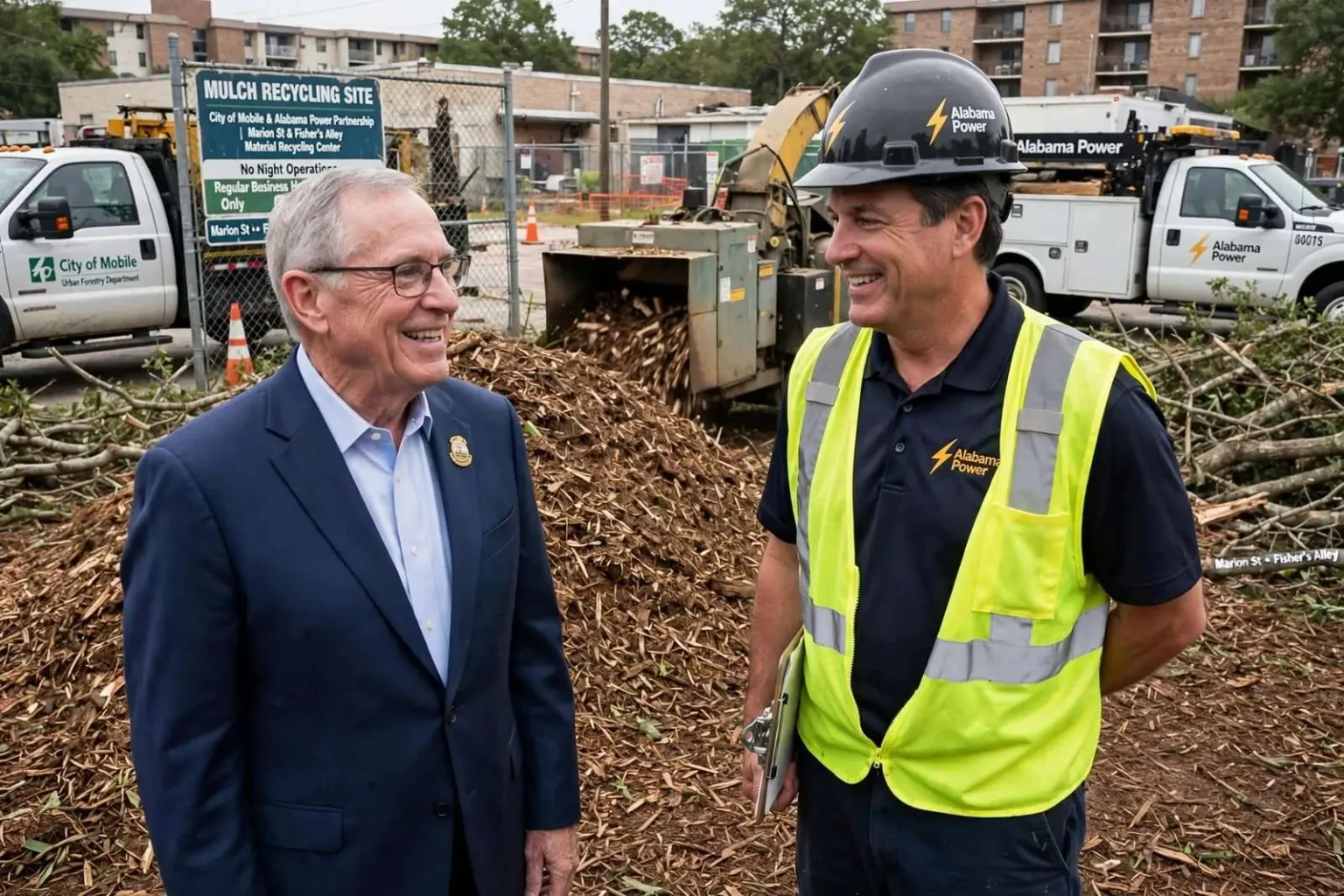
Mayor Sandy Stimpson’s administration and Alabama Power have agreed to recycle the tree limbs and other woody material each collects, rather than sending it to a landfill. Previously, limbs collected by Alabama Power and the city’s Urban Forestry Department were taken to the Dirt, Inc. landfill in West Mobile. Now those materials will be turned into mulch at an outdoor facility at the corner of Marion Street and Fisher’s Alley, near the Renaissance public housing community downtown.
The arrangement turns two separate waste streams into one shared resource. Alabama Power trims and removes limbs across its Mobile division service territory to keep lines clear, a year-round job that generates mountains of woody debris. The city’s Urban Forestry Department does the same work on public rights-of way, parks and city property, especially during storm season when damaged limbs pile up quickly across the city’s neighborhoods.
Under the old system, every truckload from both operations ended up at Dirt, Inc., where tipping fees accrued by the ton. Under the new one, that material becomes mulch the city can actually use, closing a loop that saves money on both ends: less paid disposal, less purchased landscaping material.
What the City Gets Out of It
“One of the great things about this is not only is it a collaboration, but it will save both entities money in the long run,” Stimpson said. The mulch will be used on public landscaping projects, something the city previously had no budget for, according to Parks and Recreation Director Matt Capps. The city expects to save at least $50,000 in tipping fees and materials.
The savings compound in ways that go beyond the ledger. Mulched beds hold moisture longer, suppress weeds and moderate soil temperature, which means less watering, less herbicide and less replanting for parks, medians and public buildings. For a parks department stretching a budget across hundreds of sites, free mulch that would otherwise have cost tens of thousands of dollars changes what is possible in a given year.
The $50,000 figure covers tipping fees the city no longer pays on its own woody debris plus the materials it would otherwise purchase. And because Alabama Power shares the facility and the process, the company captures parallel savings on its disposal costs, which is what makes the arrangement durable rather than a one-time favor.
The Downtown Site
The mulching operation sits at the corner of Marion Street and Fisher’s Alley, near the Renaissance public housing community in downtown Mobile, a location chosen for its working character and central access. That proximity to a residential neighborhood is exactly what city officials moved to address at the announcement.
Stimpson said the mulching would be periodic and brief, and Capps stressed it would not occur at night or outside regular business hours, addressing potential concerns from neighbors near the downtown site. The commitment matters: residents near the Renaissance community were the people most likely to notice trucks, machinery and piles of limbs, and the administration put operating hours on the record before complaints could accumulate.
Mike Saxon, Alabama Power’s Mobile division vice president, said the company was “delighted to be involved.” For the utility, the partnership is a natural extension of the vegetation management work it already performs, and it aligns with the company’s broader recycling and environmental stewardship practices across its service territory.
Why Cities Recycle Woody Debris
Municipal wood recycling has become standard practice in cities across the country as landfill space tightens and disposal costs climb. Tree limbs, trunks and brush are bulky, heavy material that consumes landfill capacity fast, and tipping fees charge by weight and volume. Grinding that material into mulch reduces its volume dramatically and converts a disposal liability into a usable product in a single step.
The practice also carries environmental benefits that city governments increasingly count. Organic material buried in a landfill decomposes without oxygen and produces methane, a potent greenhouse gas, while the same material ground into mulch returns to the soil. Keeping limbs out of the waste stream also reduces the truck traffic between city operations and distant disposal sites, saving fuel and wear on streets.
For Mobile, the partnership is a modest operation with outsized symbolism: two of the largest property managers in the city, the utility and city hall, coordinating instead of duplicating. Storm response makes the coordination especially valuable, since a single hurricane or severe thunderstorm can generate more debris in days than routine trimming produces in months.
How the Flow Works
The division of labor under the new arrangement is specific. Limbs collected by Alabama Power crews and by the city’s Urban Forestry Department route to the Marion Street and Fisher’s Alley site for grinding. Yard debris that the city picks up from residents, the loose piles and bagged material collected curbside in neighborhoods across Mobile, will continue to be sent to Dirt, Inc., a city spokeswoman said.
That distinction matters for residents trying to understand where their yard waste goes. The curbside collection program operates at a scale and consistency that the downtown mulching site is not designed to absorb, and the existing contract with Dirt, Inc. continues to handle it. The partnership covers the material the two institutional operations generate, not the household stream.
Grinding operations of this kind typically process limbs into coarse mulch that then seasons in windrows before use. The city’s parks crews and other departments can draw from the supply for landscaping projects across the city, from downtown planters to neighborhood parks, replacing purchased material with product made from the city’s own tree work.
Collaboration as a Model
Stimpson’s administration has made inter-agency efficiency a recurring theme, and this agreement is the kind of low-profile collaboration that produces savings without fanfare. No new taxes, no capital construction, no lengthy procurement: a shared site, agreed operating hours and two organizations routing material that was already being collected.
The model is portable, too. Other public and private landholders in the region, from the county to school systems to the port, generate woody debris of their own, and the economics that make this partnership work apply broadly. Cities that establish mulching operations frequently expand them as nearby institutions ask to participate.
For now, the measure of success is straightforward: at least $50,000 a year kept in the city’s budget, landscaping beds mulched without a line item for material, and a quiet corner downtown where the city’s tree limbs get a second life instead of a landfill grave.
The Urban Forestry Context
Mobile’s tree canopy is one of its defining features, a legacy of live oaks and mature hardwoods that shade the city’s historic districts and line its avenues. That canopy is also a responsibility. The Urban Forestry Department maintains public trees, responds to storm damage and clears limbs that threaten streets, sidewalks and power lines, and every one of those operations generates debris that has to go somewhere.
Alabama Power faces the same equation across a much wider footprint. Vegetation management is one of the utility’s largest ongoing field operations, because a single limb contacting a distribution line can knock out power to an entire neighborhood. Crews trim and remove continuously across the division, and the debris that follows them has traditionally been a pure disposal cost.
Putting both operations through one mulching site means the material is handled once, close to where much of it is generated, instead of hauled to a landfill across the city. The distances saved translate directly into fuel, crew hours and truck maintenance, savings that stack on top of the tipping fees and material purchases the partnership eliminates.
What Neighbors Can Expect
City officials were explicit about the operating pattern because the site’s nearest neighbors were the first stakeholders. The mulching will be periodic and brief, in Stimpson’s description, tied to the rhythm of collections rather than a constant industrial presence. Capps added the assurance that work will not occur at night or outside regular business hours, an unusually specific commitment for a municipal operations announcement and one aimed directly at quality-of-life concerns.
The Renaissance community adjacent to the site is a revitalized public housing development, and its residents have a legitimate stake in what happens on the surrounding blocks. Putting the operating limits on the record at the press conference, rather than after the first noise complaint, signals that the administration understood the location’s sensitivity from the start.
Periodic grinding operations of this scale are comparable in impact to routine yard work amplified: the sound of a tub grinder or chipper for a bounded stretch of daytime hours, trucks arriving and departing during the same window, then quiet until the next cycle. Cities that run similar operations report that the communication of clear hours is what determines whether neighbors view the facility as a nuisance or a neighbor.
The Bottom Line
The arithmetic of the deal is easy to state. Two large collections of woody debris that once cost money to bury will now cost less to process and will yield a product the city previously had to go without. At least $50,000 in combined savings is expected, a figure that will compound annually as long as trees keep growing and lines keep needing clearance.
The partnership also demonstrates the kind of cooperation that costs nothing to propose and pays from the first month. Alabama Power gets an efficient outlet for its vegetation debris; the city gets mulch and avoided fees; the landfill gets its capacity back; and residents get better-maintained public landscapes. It is a small deal with the shape of a good one, announced on a downtown corner where the first piles of limbs will speak louder than the press conference did.


