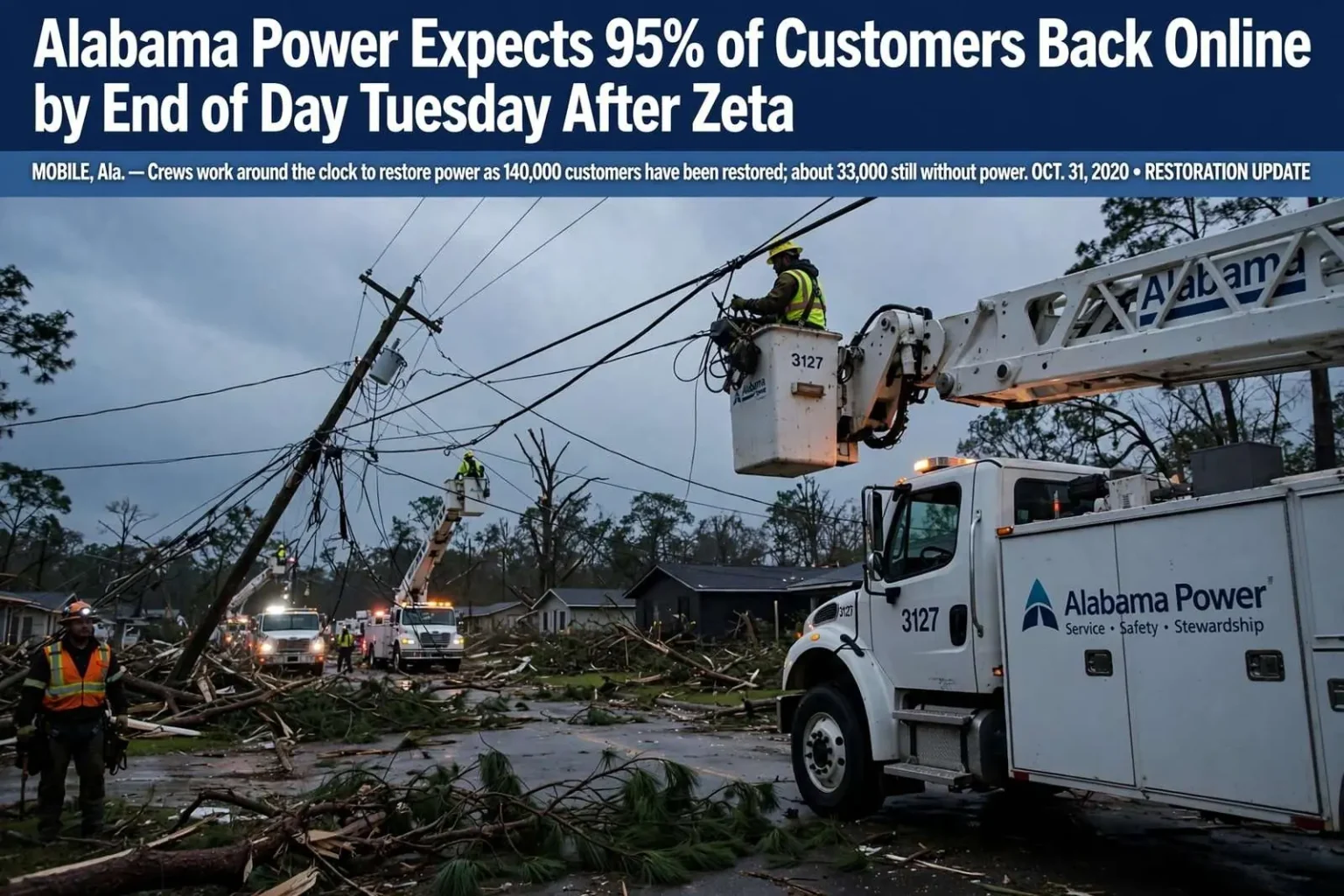
MOBILE, Ala. — Alabama Power said Saturday it expected to have electricity restored to about 95 percent of the customers knocked offline by Hurricane Zeta by the end of the day Tuesday, putting a finish line in sight for the most widespread outage the coast had seen from a single storm that season. According to figures released by the company, roughly 140,000 customers had already been restored, leaving about 33,000 still without power as restoration work continued across the region.
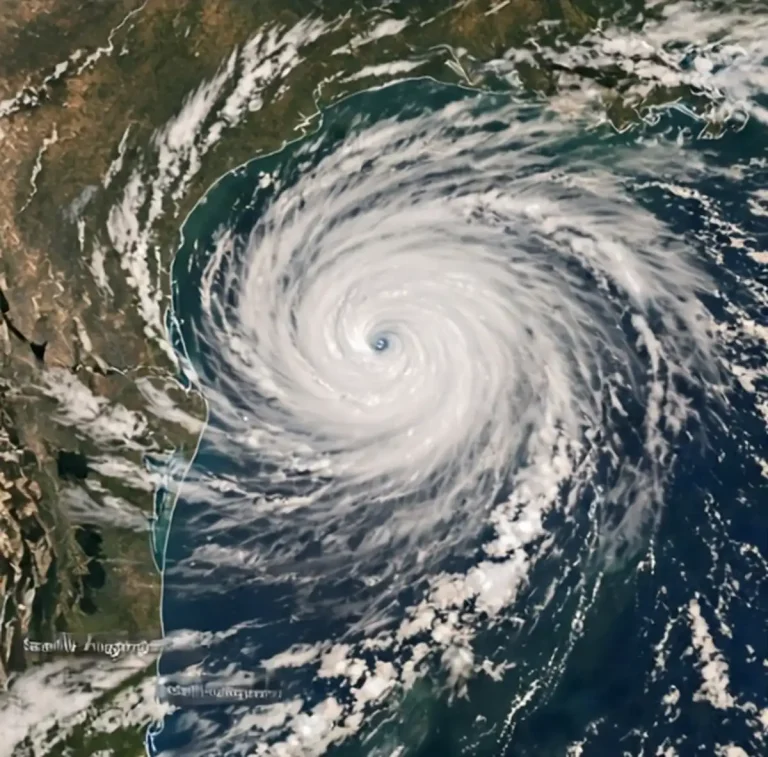
Those numbers told the story of a recovery that moved faster than many residents expected after the damage they woke up to. Zeta came ashore near Cocodrie, Louisiana, on October 28, 2020, as a Category 2 hurricane and cut a path of wind damage across coastal Mississippi and south Alabama, toppling trees and power lines throughout Mobile County. The storm moved fast — a fact that limited the flooding it produced but spread destructive winds well inland from the immediate coastline.
The company said crews were working night and day to replace damaged poles, restring lines and reconnect substations as quickly as safety allowed. In neighborhoods across Mobile, Prichard, Saraland, Satsuma, Creola and the county’s rural stretches, the work was visible at all hours: bucket trucks clustered around broken poles, crews hauling new conductor through right-of-ways, and line workers in the dark rerouting power around damage that could not be fixed immediately.
What Zeta did to the grid
Hurricane damage to an electrical system is rarely one problem. A storm like Zeta leaves behind a full inventory of trouble: poles snapped by falling trees, lines down across roads and yards, transformers blown by surge or debris, and substations knocked offline when the feeder lines that supply them fail. Because the damage is scattered across thousands of individual points rather than concentrated in one place, restoration is a matter of working through the list piece by piece, neighborhood by neighborhood.
Zeta’s track magnified that challenge. After making landfall in Louisiana, the storm tracked across the New Orleans metro area and the Mississippi Gulf Coast and into Alabama with its structure still largely intact, delivering hurricane-force wind gusts to Mobile County hours after landfall. Trees that had stood through earlier storms came down on power lines in every part of the county, and utility crews spent the first days after the storm simply assessing how large the repair list really was.
The outages hit in the days before a presidential election, in the middle of a pandemic that had already made public spaces complicated, leaving thousands of households in the dark for nearly a week. Residents who had ridden out hurricanes for decades described Zeta as the storm they had underestimated — modest on paper as a Category 2, but destructive enough to keep a third of Alabama Power’s storm-out customers waiting into the following week.
How restoration actually works
Utility officials typically restore large feeder lines serving hospitals, water systems and other critical facilities first, before turning to neighborhood-level repairs. That triage system is standard across the industry, and it shapes the order residents see: the hospital lights come on before the subdivision’s do. Repairing the backbone of the system also makes every later repair more effective, because a restored feeder can carry power to hundreds of homes at once once the lines beneath it are fixed.
After the critical facilities come the main distribution lines, then the smaller lines that run through neighborhoods, and finally the individual service drops that connect a single house to the grid. Customers who see a neighbor’s lights come back while their own stay dark are often looking at exactly that layering — the neighbor may be fed by a line that was repaired first, while their own service drop waits for a crew that is still working through the same street.
Alabama Power’s crews were supplemented after major storms by mutual assistance — line workers from other utilities who travel to the damaged area under standing agreements across the industry. The practice turns a single company’s workforce into a regional one for the duration of a restoration, and it is the reason bucket trucks with out-of-state plates become a common sight on Gulf Coast streets after a hurricane.
The Tuesday target
The 95 percent figure the company set as its end-of-day Tuesday target covered the customers knocked offline by the storm. Reaching it would leave a residual group still without service — typically customers whose damage was individual rather than systemic, such as a service mast torn from a house or a line buried under a tree in a hard-to-reach spot. Those repairs are the slowest of the restoration, and many require the customer to complete repairs to their own equipment before the utility can safely reconnect them.
Customers still without service after the Tuesday target were encouraged to report their outage through the company’s outage channels so crews could confirm no isolated damage was missed. That last step matters more than it might seem: in a restoration of this size, a single unreported outage on a quiet street can escape notice while crews believe the area has been completed. Reporting puts the address back on the work list and keeps it from falling through the cracks.
The company also uses outage reporting to sharpen its damage maps. When customers report, the utility can see exactly which transformer and which circuit they sit on, and patterns in the reports reveal damage that aerial surveys and patrol crews missed — particularly in heavily wooded neighborhoods where a single downed span can be invisible from the road.
Reading the numbers
The progression from storm night to the Tuesday target tracked the shape of the repair work. The first days brought the biggest leaps in restored customers, as transmission lines and substations came back and the main feeders were re-energized; each day afterward, the gains came more slowly, as crews moved from fixing systems that served thousands to fixing lines that served hundreds, then dozens.
By Saturday, with roughly 140,000 restored and about 33,000 remaining, the arithmetic of the remaining work was clear — and the company’s public commitment to the 95 percent mark by Tuesday evening gave customers in still-dark neighborhoods a concrete expectation for when the trucks would reach their street.
A season without rest
Zeta’s arrival capped a historically punishing year for Gulf Coast utilities. The 2020 season produced a record number of named storms, and Alabama Power’s system had already absorbed Hurricane Sally’s punishing slow-motion flooding in September, which knocked out power across the same coastal footprint weeks earlier. Crews who worked Sally’s restoration in September found themselves doing it again in October, with barely enough time in between to return the system to its pre-storm condition.
That rhythm is the hard arithmetic of utility storm response on the Gulf Coast. Restoration is measured not just in customers restored but in crews restored — line workers coming off sixteen-hour shifts need rest before they can safely climb another pole, and a season with back-to-back storms strains the roster and the mutual assistance network at the same time.
What customers can do during an outage
The company’s guidance to customers still without power followed the standard storm playbook. Report the outage through official channels rather than assuming a neighbor’s report covers the street. Stay away from downed lines, which should be treated as energized regardless of how long they have been on the ground. And keep generators outdoors, well away from windows and doors, since the carbon monoxide they produce in enclosed or attached spaces has caused deaths after nearly every major Gulf Coast outage.
Customers with damage to the equipment on their own homes — the meter base, the weatherhead, the service mast — also need an electrician to make those repairs before the utility can reconnect service, because the company cannot attach its lines to a damaged structure. That requirement is a common source of delay in the final phase of any restoration and explains a portion of the outages that linger after the neighborhood around them has gone dark.
The road to normal
For the roughly 33,000 customers still waiting as of Saturday’s update, the promise of 95 percent by Tuesday evening was the most concrete information the company had offered since the storm. Restoration updates from Alabama Power during major outages typically include county-level counts, and customers in Mobile County tracked those numbers daily as the crew counts swelled and the map of outages shrank from whole quadrants of the city to scattered pockets.
Zeta will be remembered along the Gulf Coast as the storm that proved wind matters more than category. It made landfall as a Category 2, weaker on the scales than several storms the coast had ridden out before, and still managed to put 140,000 Alabama customers in the dark and keep tens of thousands there for days. By Tuesday night, if the company’s target held, nearly all of them would have their lights back — and the crews who worked around the clock to make it happen would move on to the last few thousand, one pole at a time.